The Ship of Theseus
The Ship of Theseus (also known as Theseus's Paradox) is a foundational thought experiment in Western metaphysics, ontology, and the philosophy of identity, examined closely within both classical thought and modern Analytic Philosophy.[1] It interrogates the nature of diachronic identity—what makes an object or entity remain the "same" thing across the passage of time despite undergoing complete material transformation.[2]
If an object composed of multiple parts has every single one of its original components replaced over time, does it remain the exact same object, or has it become an entirely new entity? Furthermore, if the discarded original parts are reassembled into a second structure, which of the two is the true original?
Historical Origins
Plutarch's Formulation
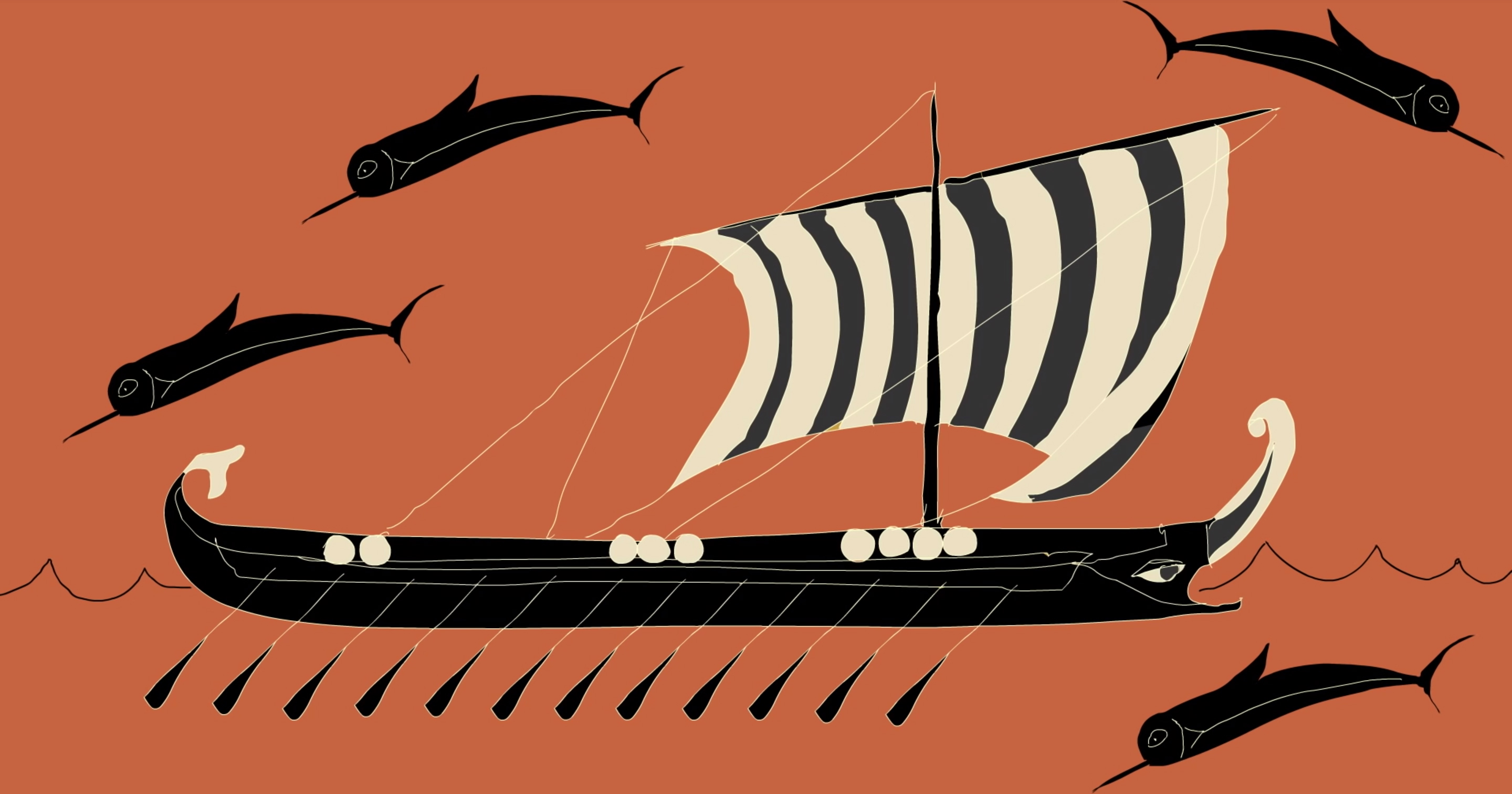
The earliest surviving written account of the paradox appears in the late first century CE, recorded by the Greek historian and Platonist philosopher Plutarch in his biography Life of Theseus.[3] According to Athenian legend, the mythical founder-king Theseus sailed back to Athens from Crete after slaying the Minotaur. To commemorate his victory, the Athenians preserved his thirty-oared galley in the harbor and sailed it annually on a sacred embassy to Delos until the time of Demetrius of Phalerum (c. 350–280 BCE).[3:1]
"The vessel in which Theseus sailed with the youths and returned safely—the thirty-oared galley—was preserved by the Athenians down to the time of Demetrius Phalereus. They took away the old timbers from time to time, and put new and sound ones in their places, so that the vessel became a standing illustration for the philosophers in the disputed question of growth, some declaring that it remained the same, others that it was not the same vessel."[3:2]
Heraclitus and Classical Antecedents
Long before Plutarch recorded the maritime example, pre-Socratic and classical Greek thinkers (explored in From Mythos to Ataraxia - A Survey of Ancient Greek Philosophy) debated the problem of persistence through change:
-
Heraclitus of Ephesus (c. 535–475 BCE): Argued that reality is defined by constant flux (panta rhei), famously stating that one cannot step into the same river twice because new waters are ever flowing in upon you.[4]
-
Plato (c. 428–348 BCE): In the Symposium, Plato notes that although a person is called the same individual from childhood to old age, they never possess the same constituent properties; hair, flesh, bones, blood, and even thoughts and desires are perpetually decaying and being renewed.[1:1]
-
Chrysippus (c. 279–206 BCE): Stoic philosophers explored the "Growing Argument" (Auxanomenos Logos), which asserts that any addition or subtraction of matter immediately destroys the original substrate and brings a new material body into existence.[5]
Thomas Hobbes's Extension
In 1655, the English philosopher Thomas Hobbes intensified the paradox in his treatise De Corpore (On the Body).[2:1] Hobbes asked what would happen if a custodian secretly followed the shipwrights, gathered every rotting plank discarded from the Ship of Theseus, stored them in a warehouse, and eventually reassembled them into a vessel identical in configuration to the original.[2:2]
At the conclusion of Hobbes's thought experiment, two ships exist simultaneously:
-
The Continually Repaired Ship (Ship B): Possesses an unbroken history of spatial, temporal, and functional continuity, yet contains zero original timber.
-
The Reassembled Ship (Ship C): Possesses 100% of the original material components in their initial structural arrangement, yet experienced a total rupture in functional and historical continuity.
Metaphysical Frameworks and Solutions
Philosophers have developed several distinct ontological frameworks to resolve the conflict between material constitution and spatiotemporal continuity.
Much of the modern debate centers on Gottfried Wilhelm Leibniz's principle of the Indiscernibility of Identicals, which states that if object
1. Aristotelian Hylomorphism
Drawing from Aristotle's doctrine of the Four Causes in Physics and Metaphysics, hylomorphism analyzes objects as a compound of two distinct principles: matter (hyle) and form (morphe).[6]
-
Material Cause: The physical wooden planks.
-
Formal Cause: The blueprint, design, and structural arrangement of the planks (resonating with the configurational unity explored in Gestalt Psychology-The Mechanics of the Whole).
-
Final Cause: The teleological purpose of the vessel (sailing and commemorating Theseus).
-
Resolution: According to Aristotle, the identity of an artifact or organism resides primarily in its form and teleology rather than its underlying matter. Because the formal design and functional purpose remain uninterrupted during gradual repair, the repaired vessel (Ship B) remains the true Ship of Theseus.[6:1]
2. Endurantism (Three-Dimensionalism)
Endurantism is the common-sense view that material objects are strictly three-dimensional entities that are wholly present at every moment of their existence.[7]
-
Mechanism: When an object changes over time, the exact same numerical entity persists while gaining or losing time-indexed properties (e.g., the ship has the property of "having Plank A at
" and "having Plank B at ").[7:1] -
Vulnerability to Hobbes's Paradox: Endurantism struggles with the transitivity of identity. If the original ship (A) is numerically identical to the repaired ship (B), and also numerically identical to the reassembled ship (C), then by the transitivity of identity (
and ), Ship B and Ship C must be the exact same ship. However, two distinct ships sitting side-by-side in a harbor cannot be numerically identical.[2:3] -
Closest Continuer Theory: Formulated by Robert Nozick in Philosophical Explanations (1981), this variation argues that an object at
is identical to an object at if and only if it is the "closest continuer" of that object and no other competing candidate is equally close.[8] If both spatiotemporal continuity and material reconstitution have equal weight, the tie destroys the original identity, meaning neither B nor C is the original ship.
3. Perdurantism (Four-Dimensionalism / "Space-Time Worms")
Championed by philosophers such as W.V.O. Quine, David Lewis, and Ted Sider, perdurantism rejects the idea that an object is wholly present at any single moment, interfacing directly with modern conceptions of Time as Change.[7:2]
-
Mechanism: Objects are four-dimensional entities extended across both space and time—often referred to as space-time worms.[7:3] Just as a ship has spatial parts (bow, stern, mast), it also has temporal parts (the ship-on-Monday, the ship-on-Tuesday, the ship-in-300-BCE).
-
Resolution: At no single instant do you see the entire Ship of Theseus; you only observe a three-dimensional temporal slice of a four-dimensional whole. In Hobbes's scenario, two distinct four-dimensional space-time worms (Worm B and Worm C) simply overlap and share an initial temporal segment (Segment A) before branching apart, much like a Y-shaped road shares a single trunk before splitting into two highways.[7:4] This view aligns with Henri Bergson's critique of spatialized duration and the phenomenology articulated in Husserl's Internal Time-Consciousness.
4. Mereological Essentialism and Nihilism
Mereology is the formal study of part-whole relationships.
-
Mereological Essentialism: Advanced by Roderick Chisholm, this theory holds that every part of an object is essential to its identity.[9] If a single splinter of wood is removed from the Ship of Theseus, the original ship ceases to exist, and a new object takes its place. What humans call "the Ship of Theseus" is merely a loose linguistic convention (ens successivum) tracking a succession of thousands of distinct physical objects.[9:1]
-
Mereological Nihilism (Eliminativism): Philosophers like Peter van Inwagen and Trenton Merricks argue that composite inanimate objects (ships, tables, chairs) do not actually exist at all.[2:4] Only fundamental physical simples (such as subatomic particles) exist; a "ship" is simply fundamental particles "arranged ship-wise." This macroscopic illusion parallels the thermodynamic perspective in Boltzmannian Coarse-Graining and Nagarjunian Emptiness and Entropy: because there is no composite entity called a "ship" in fundamental ontology, the paradox of its identity dissolves as a purely linguistic projection.
| Philosophical Position | Key Proponents | Primary Criterion of Identity | Verdict on Hobbes's Two Ships |
|---|---|---|---|
| Hylomorphism | Aristotle, Thomas Aquinas | Continuity of Form and Function (Telos) | The Repaired Ship (B) is the true original. |
| Material Constitution | John Locke (for masses of matter) | Persistence of exact constituent matter | The Reassembled Ship (C) is the true original mass. |
| Perdurantism (4D) | David Lewis, W.V.O. Quine, Ted Sider | Shared temporal slices of a 4D continuum | Both B and C are distinct 4D worms that shared an early temporal stage. |
| Mereological Essentialism | Roderick Chisholm | Exact preservation of all parts | Neither is the original; the ship changes identity with every plank replaced. |
| Cognitive / Eliminativism | Thomas Hobbes, Derek Parfit, Noam Chomsky | Psychological / pragmatic convention | Identity is not an objective metaphysical fact; the question is empty. |
Applications Beyond Artifacts
Personal Identity and Consciousness
The Ship of Theseus directly parallels the problem of personal identity over a human lifespan, deconstructing the assumption of a static, unitary self (analyzed in Constructs of the Mind-Unmasking Consciousness in East and West and Dividual):
-
Cellular Turnover: Biologically, the human body replaces the vast majority of its cells over time; red blood cells last roughly 120 days, skin epidermis renews every few weeks, and the skeletal system remodels itself approximately every decade.[10]
-
Lockean Psychological Continuity: In An Essay Concerning Human Understanding (1689), John Locke distinguished between the identity of a mass of matter (which changes if a single atom is removed), the identity of a living organism (which persists through a continuous vital organization of fleeting particles, akin to The Organic Analogy), and the identity of a Person (which persists through continuity of consciousness and autobiographical memory).[10:1] Treating the person as a separate substantive entity over and above its functioning processes constitutes what Gilbert Ryle famously critiqued as a category mistake in Gilbert Ryle's-The Concept of Mind and the myth of the Ghost in the Machine.
-
The Teletransportation Paradox: Modern philosopher Derek Parfit adapted Hobbes's ship into science fiction in Reasons and Persons (1984).[11] If a teletransporter scans your brain and body, vaporizes your original atoms on Earth, and reconstructs an atom-for-atom replica on Mars with all your memories, is the Martian replica you (Ship B), or did you die? Furthermore, if the scanner malfunctions, leaves your Earth body intact, and still creates the replica on Mars, you face the exact branching dilemma of Hobbes's two ships.[11:1]
Derek Parfit argued that asking whether the replica is "really you" is an empty question—all the physical and psychological facts are already known, and there is no deep metaphysical "further fact" (like a Cartesian soul) left to discover.[11:2] What matters in survival is not strict one-to-one numerical identity, but Relation R: psychological connectedness and continuity, which can hold to degrees and even branch into multiple individuals.
Cross-Cultural Parallels
While Western philosophy treats the Ship of Theseus as an analytical puzzle requiring a strict logical resolution, Eastern traditions have historically embraced the underlying fluidity of identity through spiritual and architectural practices.
-
The Grand Shrine of Ise (Ise Jingū), Japan: Considered the holiest Shinto site in Japan, the Naikū and Gekū shrines have been completely dismantled and rebuilt on an adjacent plot of land using fresh hinoki cypress timber every 20 years in a ritual known as Shikinen Sengū—a practice maintained for over 1,300 years.[12] In Shinto aesthetics and cosmology, permanence (tokowaka, "eternal youth") is achieved specifically through cyclical material renewal rather than static material preservation.[12:1]
-
Buddhist Doctrine of Anattā (Non-Self): Early Buddhist texts, particularly the Milinda Pañha (Questions of King Milinda, c. 100 BCE), explicitly employ the Ship of Theseus logic via the Simile of the Chariot (examined in detail in The Ship of Theseus and the Chariot of King Milinda).[13] The sage Nāgasena asks the Indo-Greek King Menander I whether a chariot is its wheels, its axle, its frame, or its reins. Concluding that the chariot is none of its parts individually nor something separate from them, Nāgasena demonstrates that "chariot" (and by extension, the "Self") is merely a convenient conceptual designation applied to an ever-changing aggregation of interdependent processes (skandhas). This insight forms the foundation of Nāgārjuna's philosophy of emptiness (śūnyatā) and the Yogācāra doctrine of consciousness-continuity in Vasubandhu's-Triṃśikā-vijñaptimātratā.
Resonant Notes
The following notes in the vault share direct metaphysical, philosophical, and conceptual connections with the Ship of Theseus:
🔴 Diachronic Identity, Time & Process Ontology
- The Ship of Theseus and the Chariot of King Milinda — A direct comparative analysis demonstrating how the Ship of Theseus tests persistence across time (diachronic identity), whereas King Milinda's chariot tests structural identity at a single instant (synchronic identity).
- Time as Change — Explores the metaphysical reality of duration, change, and becoming, reinforcing the Heraclitean and perdurantist insight that entities are dynamic causal processes rather than immutable, static substances.
- Henri Bergson — Bergson's formulation of durée (lived duration) and creative evolution critiques spatialized, static models of time, arguing that true continuity is an unbroken qualitative flow rather than a succession of discrete, replaceable parts.
- Husserl's Internal Time-Consciousness & Internal Time-Consciousness and Buddhist Psychology — Examines how the synthesis of retention, primal impression, and protention creates the cognitive illusion of an enduring, unified object persisting through changing temporal moments.
- Boltzmannian Coarse-Graining and Nagarjunian Emptiness & Entropy — Illustrates how macroscopic artifacts (like a ship) emerge from coarse-grained observational perspectives; under thermodynamic and mereological scrutiny, microscopic states continuously disperse without an enduring substrate.
🟡 Consciousness, Mind & The Deconstructed Self
- Milinda Pañha — Contains Nāgasena’s celebrated dialogue with King Menander I, resolving identity dilemmas through the metaphors of the burning lamp (na ca so, na ca añño — "neither the same, nor another") and the transformation of milk into ghee.
- Nāgārjuna — Nāgārjuna’s Madhyamaka dialectic proves that artifacts, composite bodies, and the self lack intrinsic nature (svabhāva); identity is dependently co-arisen (pratītyasamutpāda) and established merely through linguistic convention.
- Vasubandhu's-Triṃśikā-vijñaptimātratā & The Dividual and the Triṃśikā — Analyzes Yogācāra consciousness-only theory, showing that both external objects and the subjective ego are continuous transformations of consciousness (vijñāna-pariṇāma) rather than permanent material entities.
- Gilbert Ryle's-The Concept of Mind & Ghost in the Machine — Ryle's diagnosis of the category mistake—treating an abstract organizational pattern or functional disposition as if it were an independent ghost entity—mirrors the error of seeking a metaphysical "ship-essence" apart from its functional timbers.
- Constructs of the Mind-Unmasking Consciousness in East and West — Synthesizes Western philosophies of mind with Eastern contemplative models to demonstrate how human cognition projects substantial identities onto fleeting physical and mental components.
- Dividual — Deconstructs the indivisible, autonomous individual into divisible, fluid assemblages of relations, paralleling mereological critiques of object identity.
🟢 Metaphysics, Logic & Systemic Frameworks
- Gottfried Wilhelm Leibniz and Perennial Philosophy — Explores Leibnizian metaphysics, including the Principle of the Indiscernibility of Identicals and the Identity of Indiscernibles, which provide foundational logical criteria in formal debates over numerical versus qualitative identity.
- Analytic Philosophy — Examines the linguistic turn, conceptual analysis, and formal logic used by modern analytic metaphysicians (Quine, Lewis, Chisholm) to dissolve mereological paradoxes and debate four-dimensionalism versus three-dimensionalism.
- From Mythos to Ataraxia - A Survey of Ancient Greek Philosophy — Contextualizes pre-Socratic flux (Heraclitus), Platonic forms, and Aristotelian hylomorphism (matter and form) within the broad trajectory of classical Greek inquiry into being and becoming.
- Gestalt Psychology-The Mechanics of the Whole — Investigates how perceptual systems construct holistic configurations (Gestalten) that cannot be reduced to the sum of their individual sensory parts, mirroring the Aristotelian formal cause and the emergent identity of artifacts.
- The Organic Analogy & The Social Construction of Reality - A Treatise in the Sociology of Knowledge — Traces how institutions, biological organisms, and social structures maintain institutional continuity and functional identity despite complete member turnover over generations.
- Defining a Simulacrum — Examines Baudrillard's analysis of copies without originals, paralleling Hobbes's thought experiment regarding whether the reassembled warehouse vessel or the repaired vessel constitutes the authentic original.
Backlinks
- The Ship of Theseus and the Chariot of King Milinda — Investigates the diachronic dimension of identity represented by Theseus's ship against the synchronic dissection of identity in Nāgasena's chariot.
- Milinda Pañha — References the Buddhist foundational text that applies the flame and milk analogies to solve the problem of causal continuity without substantial identity.
- Analytic Philosophy — Grounds the modern logical, mereological, and four-dimensionalist frameworks that formalize the problem of persistence through time.
- Gottfried Wilhelm Leibniz and Perennial Philosophy — Provides the philosophical basis for Leibniz's Law of Indiscernibility applied to spatial and temporal identity.
- From Mythos to Ataraxia - A Survey of Ancient Greek Philosophy — Traces the historical origins of Greek substance and flux debates from Heraclitus to Aristotle.
- Time as Change — Explores how temporal passage necessitates continuous state changes, challenging static notions of object identity.
References
Stanford Encyclopedia of Philosophy / Identity Over Time / plato.stanford.edu ↩︎ ↩︎ ↩︎
Stanford Encyclopedia of Philosophy / Material Constitution / plato.stanford.edu ↩︎ ↩︎ ↩︎ ↩︎ ↩︎
Plutarch / Parallel Lives: Life of Theseus / uchicago.edu ↩︎ ↩︎ ↩︎
Stanford Encyclopedia of Philosophy / Heraclitus / plato.stanford.edu ↩︎
Stanford Encyclopedia of Philosophy / Stoicism / plato.stanford.edu ↩︎
Stanford Encyclopedia of Philosophy / Form vs. Matter / plato.stanford.edu ↩︎ ↩︎
Stanford Encyclopedia of Philosophy / Temporal Parts / plato.stanford.edu ↩︎ ↩︎ ↩︎ ↩︎ ↩︎
Internet Encyclopedia of Philosophy / Personal Identity / iep.utm.edu ↩︎
Stanford Encyclopedia of Philosophy / Mereology / plato.stanford.edu ↩︎ ↩︎
Stanford Encyclopedia of Philosophy / Locke on Personal Identity / plato.stanford.edu ↩︎ ↩︎
Jingū Administration Office / Shikinen Sengū: The 20-Year Renewal of Ise Jingū / isejingu.or.jp ↩︎ ↩︎
Access to Insight / Milindapañha: The Questions of King Milinda (The Simile of the Chariot) / accesstoinsight.org ↩︎