IBM - International Marketing
🗂️ Interactive Notebook: Open Study Companion (Video Summary, Flashcards, Mind Map) ↗
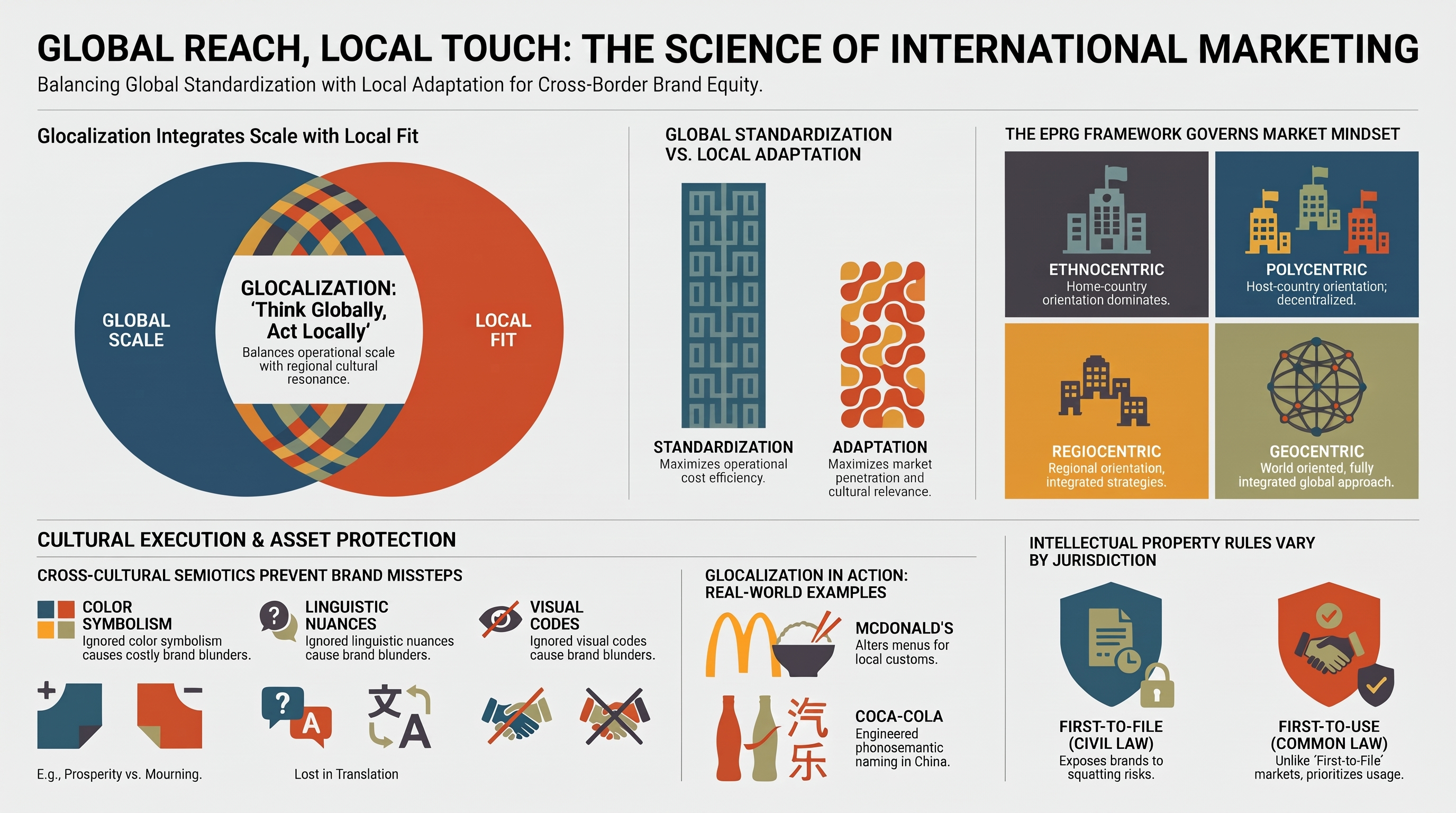
International Marketing is the strategic process of identifying, anticipating, and satisfying customer demands across geopolitical and cultural borders. It requires multinational enterprises to navigate the fundamental tension between global standardization (achieving global scale and cohesive brand identity) and local adaptation (tailoring offerings to diverse cultural, regulatory, and economic realities). Managing this tension demands sophisticated brand architecture, rigorous cross-cultural semiotic and linguistic screening, cross-border intellectual property protection, and an adaptable international marketing mix.
1. The Global Marketing Paradigm: Standardization vs. Adaptation
Unlike domestic marketing, which operates within relatively homogeneous legal, cultural, and distribution frameworks, international marketing demands continuous reconciliation of global scale with local market responsiveness. This dynamic forms the theoretical core of IBM - International Business Strategy.
The Core Dilemma: Economies of Scale vs. Cultural Fit
Multinational enterprises (MNEs) face two competing imperatives when expanding globally:
- Global Standardization: Marketing identical products using uniform brand positioning, messaging, packaging, and distribution across all target territories. The primary drivers are substantial production and operational economies of scale, lower creative and administrative costs, and the cultivation of a globally recognized brand asset.
- Local Adaptation (Localization): Modifying products, packaging, promotional strategies, and distribution channels to align with local consumer tastes, religious mandates, linguistic nuances, and regulatory standards. The primary driver is maximizing market penetration and consumer resonance by eliminating cultural and institutional friction.
- The Synthesis: Glocalization: Operating under the axiom "think globally, act locally." A glocalized strategy maintains a unified corporate positioning and standardized quality architecture while adapting product formulations, menus, and tactical execution to local contexts.
The EPRG Strategic Orientation Framework
A firm's approach to global marketing is typically shaped by its strategic orientation along the EPRG Framework (developed by Howard Perlmutter):
- Ethnocentric Orientation (Home-Country Focus): The domestic market is assumed to be superior. Products developed for the home market are exported with little or no adaptation. Foreign operations are viewed as secondary outlets for surplus domestic capacity.
- Polycentric Orientation (Host-Country Focus): Each foreign market is treated as unique. Subsidiaries operate autonomously, developing customized marketing mixes tailored to specific national habits. While this maximizes local customer resonance, it sacrifices global scale and dilutes unified brand identity.
- Regiocentric Orientation (Regional Focus): Markets are grouped into broader geographic regions (e.g., North America, EMEA, Latin America, Southeast Asia). Marketing strategies are harmonized across countries with shared socioeconomic or cultural characteristics within the region.
- Geocentric Orientation (Global Focus): The world is viewed as a single, interdependent marketplace. The firm pursues a unified global marketing strategy while selectively adapting execution where local differences are strategically non-negotiable.
Standardization vs. Adaptation Strategic Matrix
| Strategic Dimension | Global Standardization | Local Adaptation (Localization) | Glocalized Compromise |
|---|---|---|---|
| Primary Driver | Cost leadership, operational scale, and global brand cohesion | Cultural alignment, regulatory compliance, and market fit | Balance of global scale with local cultural resonance |
| Cost Structure | Low unit manufacturing and promotional development costs | High re-engineering, testing, packaging, and local advertising costs | Moderate baseline costs with targeted incremental adaptation |
| Customer Perception | Viewed as an aspirational, cosmopolitan, or iconic global brand | Viewed as an authentic, domestic-friendly, or native solution | Perceived as a trusted global brand that respects local identity |
| Primary Risk | Cultural tone-deafness, consumer rejection, and regulatory friction | Loss of scale economies, operational fragmentation, and brand dilution | Complex organizational governance and dual reporting overhead |
| Typical Product Sectors | Consumer electronics, industrial machinery, luxury fashion | Food and beverages, personal care, pharmaceuticals, publishing | Fast food, automotive, mass-market retail, hospitality |
2. Cultural Semiotics and Cross-Cultural Consumer Behavior
Culture provides the interpretive grid through which Consumers decode marketing stimuli, reflecting both macro-sociological conformity pressures (examined in William H. Whyte's The Organization Man) and deep-seated cultural symbolism. Failure to account for cultural context leads to costly public missteps and brand alienation.
Semiotic Deconstruction: Signs, Codes, and Symbolism
In cross-cultural marketing, products and promotions communicate on two distinct levels:
- Denotative Meaning: The literal, explicit definition of an image, word, or design.
- Connotative Meaning: The subjective, culturally conditioned emotional and symbolic association evoked by that stimulus.
When entering foreign territories, marketers must evaluate:
- Color Symbolism (Chromatics): Colors convey diametrically opposed meanings across societies. In Western commercial contexts, white signifies purity and bridal celebration; in several East Asian cultures, white is the traditional color of death and mourning. Red denotes celebration, prosperity, and good fortune in China, but signals danger, financial loss, or political conflict in other regions. Green represents nature and fertility in many secular markets, yet carries sacred religious significance across Islamic jurisdictions that precludes commercial trivialization.
- Visual and Non-Verbal Semiotics: Packaging iconography that is intuitive in one society can produce catastrophic misunderstandings in another. Imagery depicting human gestures, animals, religious artifacts, or family hierarchies must be vetted against regional cultural sensitivities.
- Phonosemantics and Linguistic Transference: Direct phonetic transliteration of a brand name into a target language can inadvertently create vulgar, comical, or unappealing verbal associations.
Cultural Context: High-Context vs. Low-Context Communication
Following the anthropological framework of Edward T. Hall, national business communication styles dictate how promotional messaging must be crafted:
| Dimension | High-Context Cultures (e.g., Japan, China, Arab Nations) | Low-Context Cultures (e.g., Germany, USA, Canada, Scandinavia) |
|---|---|---|
| Communication Focus | Implicit messaging, non-verbal cues, shared history, and interpersonal trust | Explicit, direct, verbal clarity, and precise factual documentation |
| Advertising Appeal | Emotional resonance, harmony, atmosphere, mood, and subtle symbolism | Hard-sell benefits, functional performance, comparative data, and logic |
| Brand Building Pace | Long-term relationship nurturing; indirect persuasive signaling | Transaction-oriented persuasion; immediate calls-to-action (CTAs) |
| Comparative Claims | Strongly avoided; viewed as abrasive, disrespectful, and unrefined | Widely utilized; direct competitive performance benchmarking |
3. Global Brand Architecture and Equity Management
A strong brand is an intangible corporate asset that lowers customer acquisition costs and commands pricing power, an essential component of Difference Between Product vs Brand. Managing brand equity across multiple international territories requires structured architectural planning.
Classifications of Brand Ownership
Enterprises categorize their branded offerings across two foundational operational archetypes:
- Manufacturer / National Brands: Brands owned, controlled, and financed directly by the producer (e.g., Sony, Apple, Nike, Nestlé). The manufacturer shoulders the capital burden of research, product development, quality control, and international mass-media marketing. These brands enjoy broad geographical distribution, strong consumer brand equity, and premium shelf positioning.
- Private Label / Store Brands: Brands developed, owned, and marketed exclusively by retailers or wholesalers (e.g., Kirkland Signature by Costco, 365 by Whole Foods). Retailers contract third-party manufacturers to produce goods to their specifications, bypassing manufacturer marketing overhead and capturing higher gross margins while offering cost advantages to consumers.
Tiered Private Label Architecture (The Loblaws Case Study)
Retailers increasingly move beyond generic, low-price store offerings by instituting multi-tiered brand portfolios designed to target distinct demographic segments:
- Generic / Value Tier (No Name): Unadorned yellow packaging with black lower-case typography; focused exclusively on price minimization for cost-sensitive consumers.
- Flagship Mass-Market Tier (President's Choice): Matches or exceeds national manufacturer brand quality across staple consumer packaged goods, building customer store loyalty.
- Wellness / Functional Tier (PC Blue Menu): Focuses on health-conscious consumers through reduced sodium, lower fat content, or enhanced nutritional profiles.
- Gourmet / Premium Tier (PC Black Label): Artisan-grade specialty imports and gourmet ingredients targeting culinary enthusiasts, competing directly with high-end specialty imports.
Brand Structural Strategies in International Markets
When expanding cross-border, MNEs organize their assets across three core structural models:
- Umbrella / Family Branding: Marketing an entire portfolio of diverse products under a single overarching corporate master brand (e.g., Nestlé, Samsung, Virgin). This leverages accumulated parent brand equity, drastically lowers new product launch expenses, and creates immediate recognition. However, a product defect or public relations crisis in one category threatens the equity of the entire global portfolio.
- Individual / House of Brands: Marketing each product or line under an independent, dedicated brand name (e.g., Procter & Gamble operating Tide, Pampers, and Gillette; Unilever operating Dove, Axe, and Ben & Jerry's). This insulates the parent enterprise from localized reputational fallout and allows precise segmentation of divergent consumer demographics, but multiplies international marketing overhead.
- Flanker / Fighting Brands: Introducing a secondary brand within an established product category to protect the market share of a flagship brand against lower-priced challengers, without eroding the flagship's premium pricing or prestige (e.g., Tier-1 Canadian telecommunications carriers deploying flanker sub-brands like Fido, Virgin Mobile, and Koodo to capture price-sensitive subscribers).
Global Brand Architecture Models Matrix
| Architecture Model | Structural Concept | Primary Commercial Advantage | Strategic Trade-off / Disadvantage | Prime Multinational Examples |
|---|---|---|---|---|
| Umbrella / Family Brand | Single master brand applied across all product lines | Maximum equity leverage; low per-unit promotional expenditure | High contagion risk; brand reputation vulnerable across all categories | Nestlé, General Electric, Yamaha, Virgin Group |
| Individual / Standalone Brand | Independent, distinct brand identities per product | Targeted positioning; isolates operational crises and failures | High promotional costs; zero cross-product equity leverage | Procter & Gamble (Pampers, Tide), Unilever (Dove, Knorr) |
| Flanker / Fighting Brand | Secondary brand created to counter budget competition | Shields flagship margins and prestige; captures discount segments | Risk of internal product cannibalization; operating overhead | Telecom sub-brands (Fido, Koodo, Mint Mobile), Seiko (Lorus) |
| Endorsed Brand | Product-specific brand endorsed by a master brand | Combines standalone product personality with parent credibility | Requires balancing parent visibility against sub-brand identity | Courtyard by Marriott, PlayStation by Sony, KitKat by Nestlé |
4. Adapting the Marketing Mix (4 Ps) for International Markets
Executing an international marketing strategy requires systematically adjusting The Marketing Mix (4 Ps) to host-country conditions, aligning with IBM - Global Market Entry frameworks.
Product: Standardization vs. Adaptation
Enterprises distinguish between mandatory adaptation (driven by statutory laws and physical infrastructure) and discretionary adaptation (driven by cultural preferences and economic conditions):
- Mandatory Product Adaptation: Legally or physically enforced alterations, including voltage specifications (110V vs. 220V), left-hand vs. right-hand drive vehicle configurations, metric vs. imperial measurement labeling, and statutory compliance with food and drug safety codes (e.g., Halal certification in Malaysia or Kosher standards in Israel).
- Discretionary Product Adaptation: Voluntary adjustments made to cater to local taste preferences, packaging size limitations (e.g., single-use shampoo sachets in developing markets under Bottom of the Pyramid models popularized by C.K. Prahalad), or aesthetic norms.
Price: International Pricing Pressures and Escalation
Setting prices across borders involves complex variables beyond domestic cost-plus calculations, heavily influenced by principles in Pricing Strategy and IBM - International Financial Management:
- Price Escalation: The compounding effect of export costs—including ocean freight, insurance, import tariffs, customs broker fees, and multi-layered distributor margins—that dramatically inflates the final retail price of imported merchandise above domestic levels.
- Currency Fluctuation and Hedging: Exchange rate volatility can suddenly render a competitively priced export unviable or erode repatriated operational profit margins.
- Dumping: The practice of exporting goods at prices below domestic production cost or below home-market prices, frequently triggering protective countervailing tariffs from host governments under IBM - International Business Law.
- Gray Market Goods (Parallel Importing): The unauthorized cross-border sale of authentic branded goods by third parties exploiting geographic price differentials. When an MNE prices a product significantly lower in Market A than in Market B, independent arbitragers purchase inventory in Market A and export it to Market B, undermining authorized distribution networks and confusing brand positioning.
- Transfer Pricing: The internal accounting prices charged between affiliated business units of an MNE across national borders, subjected to strict regulatory scrutiny by international tax authorities to prevent base erosion and profit shifting.
Place (Distribution): Channel Length and Infrastructure Friction
Distributing goods in foreign markets requires navigating localized retail infrastructure and channel intermediaries:
- Channel Length: Advanced economies often feature consolidated, short distribution channels (e.g., large big-box retailers sourcing directly from manufacturers). In contrast, emerging markets often rely on highly fragmented, multi-tiered wholesale networks consisting of small family-owned kiosks and open-air markets.
- Logistical Adaptations: Physical urban design dictates fulfillment models. In dense, congested East and Southeast Asian metropolitan centers where drive-through accessibility is impractical, global fast-food chains replace automobile drive-throughs with large fleets of two-wheeled electric delivery scooters.
Promotion: Cross-Cultural Communication and Regulatory Constraints
Promotional campaigns must adapt to local media consumption habits, cultural norms, and statutory restrictions:
- Regulatory Bans: Many jurisdictions enforce strict statutory prohibitions against comparative advertising (e.g., directly naming competitors), pharmaceutical advertising, or marketing junk food to children.
- Media Infrastructure: In markets with limited digital connectivity, firms prioritize radio, outdoor transit murals, and experiential roadshows over sophisticated digital marketing and programmatic display advertising (covered in DM - The Fundamentals).
The International Marketing Mix Adaptation Matrix
| 4 Ps Element | Operational Focus | Standardization Pressure | Adaptation Imperative | International Commercial Metric |
|---|---|---|---|---|
| Product | Core attributes, design, packaging, and warranties | Uniform manufacturing scale and global brand recognition | Mandatory technical standards, climate, dietary laws, and tastes | SKU rationalization; warranty claim rates |
| Price | Base price, credit terms, discounts, and currency | Global price parity; avoiding brand equity degradation | Local purchasing power parity (PPP), tariffs, and gray market arbitrage | Landed gross margin; distributor markup ratios |
| Place | Logistics, channel length, warehousing, and retail formats | Centralized supply chain planning and direct-to-retail models | Dense urban logistics, fragmented rural retail, and port congestion | Channel inventory turns; delivery lead times |
| Promotion | Advertising, public relations, digital media, and sales promos | Unified global message and centralized creative production | Language localization, semiotic vetting, and advertising regulations | Return on ad spend (ROAS); localized brand sentiment |
5. Intellectual Property, Legal Protection, and Asset Defense
International marketing depends upon the defensibility of intangible assets. A global brand name, proprietary packaging format, or slogan possesses value only if it is legally insulated against domestic misappropriation under IBM - International Business Law.
Trademarks: First-to-File vs. First-to-Use
- First-to-Use Systems (Common Law Jurisdictions): Legal ownership of a commercial trademark is granted to the entity that first demonstrates genuine commercial use of the mark in commerce, even in the absence of formal registration (e.g., the United States, Canada, the United Kingdom). Unregistered trademarks exist under common law protection, though formal registration confers broader legal presumptions.
- First-to-File Systems (Civil Law Jurisdictions): Legal ownership of a trademark belongs strictly to the first party that successfully files and registers the trademark application with the national intellectual property office, regardless of whether they have ever used the mark commercially (e.g., China, member states of the European Union, Japan). This creates significant vulnerabilities for expanding MNEs, exposing them to "trademark squatters" who preemptively register famous Western corporate names and demand exorbitant extortionate settlements when the foreign firm enters the territory.
- The Madrid System (Madrid Protocol): A centralized international filing treaty administered by the World Intellectual Property Organization (WIPO). It allows a business to file a single international trademark application and pay one set of fees to secure registration across more than 130 member nations, streamlining global portfolio management.
Trade Dress, Copyright, and Asset Protection
- Trade Dress: Legal protection granted to the visual, sensory, and packaging characteristics of a product that signal source identity to consumers (e.g., the distinctive contour shape of the glass Coca-Cola bottle, the signature blue box of Tiffany & Co., or the unique architectural layout of an Apple Store). Trade dress protection protects against imitation packaging designed to confuse consumers.
- Copyright Protection: Governed internationally by the Berne Convention, granting automated cross-border copyright protection for original artistic, literary, musical, and software creations without requiring mandatory national registration filings.
Global Intellectual Property & Brand Asset Protection Matrix
| IP Category | Legal Domain | Global Protection Mechanism | Commercial Vulnerability | Strategic Corporate Defense |
|---|---|---|---|---|
| Registered Trademark | Brand names, logos, slogans, and wordmarks | Madrid Protocol (WIPO); national intellectual property filings | Trademark squatting in first-to-file civil law jurisdictions | Preemptive defensive trademark filings prior to physical market entry |
| Trade Dress | Packaging geometry, color palettes, and store aesthetics | Lanham Act provisions; national unfair competition statutes | Confusingly similar copycat packaging by domestic store brands | Documented evidence of acquired distinctiveness and consumer recognition |
| Copyright | Advertising copy, commercial video assets, and software code | Berne Convention for the Protection of Literary and Artistic Works | Digital piracy, unauthorized reproduction, and asset theft | Centralized digital rights management; swift DMCA / international takedowns |
| Patents | Proprietary formulations, mechanics, and design innovations | Patent Cooperation Treaty (PCT); regional patent offices | Reverse-engineering by local competitors with short lead times | Aggressive provisional patent filing; robust trade secret compartmentalization |
6. Case Studies: Cross-Cultural Blunders, Triumphs, and Naming Pivots
Real-world corporate expansions illustrate the critical intersection of linguistics, semiotics, and operational adaptation in international marketing.
McDonald's: The Quintessential Glocalization Playbook
McDonald's maintains an instantly recognizable brand identity and rigorous operational assembly-line discipline, while radically tailoring its culinary portfolio to respect local cultural taboos, religious rituals, and regional palates:
- India (Religious Dietary Observance): In a market where cows are sacred in Hinduism and pork is forbidden in Islam, McDonald's eliminated all beef and pork products. The brand engineered the Chicken Maharaja Mac and expanded vegetarian selections (e.g., the McAloo Tikki burger), segmenting kitchen production lines into separate vegetarian and non-vegetarian prep zones to respect religious requirements.
- France (Gastronomic Prestige): Rather than imposing American diner aesthetics, McDonald's introduced the McBaguette, partnered with French mustard producers, and upgraded restaurant interiors with contemporary cafe seating to align with French leisurely dining rituals.
- The Philippines (Sweet Palate): To compete with dominant domestic fast-food rival Jollibee, McDonald's integrated sweet-style spaghetti with sliced hot dogs into its standard Philippine menu.
- Urban Logistics Adaptation: In dense, traffic-choked Asian and Latin American metropolitan centers where suburban drive-through formats are physically unviable, McDonald's deployed dedicated fleets of motorcycle delivery couriers, creating a high-volume delivery revenue stream.
Coca-Cola & KFC: Linguistic Adaptation in China
Entering the Chinese consumer market requires navigating a logographic language where characters communicate phonetic sound and conceptual meaning simultaneously:
- Coca-Cola's Phonosemantic Triumph: Initial informal Chinese shopkeeper transliterations approximated the sounds "Ke-ke-ken-la," producing nonsensical or grotesque meanings such as "bite the wax tadpole" or "female horse stuffed with wax." Coca-Cola invested in comprehensive linguistic research to engineer the trademark Kekou Kele (可口可乐). The name phonetically mirrors the global brand while delivering an auspicious semantic meaning: "delicious happiness" or "to permit the mouth to rejoice."
- KFC's Cultural Refinement: Early translations of KFC's global slogan "Finger Lickin' Good" inadvertently translated into Mandarin as "Eat Your Fingers Off," prompting consumer bewilderment. KFC rebranded under the auspicious Chinese trademark Kendeji (肯德基) and radically adapted its menu to incorporate local breakfast staples, including savory rice congee, egg tarts, and tree fungus salads, becoming China's leading international restaurant franchise.
The Automotive Sector: Naming Disasters
Automakers have repeatedly demonstrated the dangers of failing to run international brand names through cross-cultural linguistic screening:
- Mitsubishi Pajero: Named after the Pampas cat (Leopardus pajeros), the vehicle encountered severe consumer backlash in Spanish-speaking markets, where "pajero" is an offensive vulgar insult. Mitsubishi was forced to rebrand the SUV as the Montero ("mountain warrior") across Spain and Latin America, and as the Shogun in the United Kingdom.
- Chevrolet Nova Myth vs. Reality: Business folklore often claims the Chevrolet Nova failed in Latin America because "no va" translates to "it doesn't go." In reality, the vehicle performed respectably, as native speakers clearly distinguished between the compound noun Nova and the verb phrase no va. However, the case remains an instructive cautionary tale regarding the reputational hazards of unintended double entendres in cross-border commerce.
Visual Semiotics & Packaging Disasters
- Gerber in Sub-Saharan Africa: When Gerber launched its packaged baby food products in select African retail markets, it utilized its traditional domestic packaging featuring a photograph of a smiling Caucasian infant. In regions with lower adult literacy rates, packaging conventions dictated that jars depict an illustration of the actual physical contents inside the container (e.g., fish, carrots, or fruit). The presence of an infant portrait on the label led horrified consumers to misinterpret the jar as containing processed infant meat, severely crippling the brand's initial market debut.
- Red Bull's Logo Alterations: In specific international markets where traditional depictions of fighting bulls carried connotations of raw agricultural beast-of-burden labor or uncontained demonic aggression, Red Bull carefully recalibrated its visual marketing imagery to emphasize athletic endurance, mental acuity, and high-performance lifestyle design rather than livestock aggression.
Cross-Cultural Branding Pitfalls & Strategic Resolutions Matrix
| Brand | Target Market | Strategic / Linguistic Challenge | Nature of Error | Corrective Action & Final Outcome |
|---|---|---|---|---|
| McDonald's | India | Prohibition of beef (Hinduism) and pork (Islam) | Cultural / religious incompatibility of core domestic product | Re-engineered menu using chicken and vegetarian offerings (Maharaja Mac); segregated kitchens |
| Coca-Cola | China | Inadvertent translation of sounds to "bite the wax tadpole" | Phonetic transliteration without semantic screening | Engineered phonosemantic trademark Kekou Kele ("delicious happiness"); historic market success |
| KFC | China | Slogan translation: "Eat your fingers off" | Literal translation of figurative domestic idiom | Pivoted to localized menu (congee, egg tarts) and auspicious brand naming (Kendeji) |
| Mitsubishi | Latin America & Spain | Name "Pajero" represents a vulgar Spanish insult | Linguistic ignorance of regional slang | Rebranded product line to Montero and Shogun, saving regional brand equity |
| Gerber | Sub-Saharan Africa | Infant portrait misinterpreted as jar contents | Misalignment with local visual literacy packaging conventions | Adapted label design to feature ingredients clearly; rebuilt community consumer trust |
🎴 Interactive Web Practice (Comprehension Check)
Question 1 (Standardization vs. Adaptation in Global Marketing): Why is pure global standardization rarely viable across diverse international consumer markets, and how does the concept of glocalization reconcile economies of scale with local cultural requirements?
Answer: Pure global standardization—marketing an identical product with uniform packaging, messaging, and positioning worldwide—assumes consumer preferences, regulatory frameworks, and cultural values are homogeneous across nations. In practice, this assumption breaks down due to mandatory institutional constraints (such as legal packaging mandates, electrical voltages, and religious dietary laws) and discretionary cultural differences (such as taste profiles, linguistic idioms, and non-verbal semiotics). Forcing an unadapted domestic offering into an unreceptive market often results in regulatory penalties, public relations blunders, or outright consumer rejection.
Glocalization ("think global, act local") resolves this tension by disaggregating the value chain: the multinational enterprise standardizes its overarching brand architecture, quality control benchmarks, supply chain efficiencies, and core technologies to capture economies of scale, while intentionally decentralizing and adapting product formulations, menus, and marketing communications to match host-country consumer expectations. McDonald's exemplifies this approach by maintaining standardized kitchen technology, brand marks, and operational discipline globally while engineering culturally tailored menus like the Chicken Maharaja Mac in India and the McBaguette in France.
Question 2 (Brand Architecture and Tiered Private Label Strategy): How does a tiered private-label portfolio allow a supermarket enterprise to compete effectively against national manufacturer brands while serving diverse customer segments?
Answer: A tiered private-label brand architecture allows a retailer to transcend the historical perception of store brands as cheap, inferior alternatives by structuring distinct brands across specific price and value dimensions:
- Value / Generic Tier (e.g., Loblaws' No Name): Features utilitarian packaging and stripped-down presentation, designed to capture price-sensitive consumers and defend against hard-discount competitors without sacrificing retailer margin.
- Core Flagship Tier (e.g., Loblaws' President's Choice): Offers quality equivalent or superior to leading national manufacturer brands at a competitive price point, driving customer store loyalty and capturing higher gross margins by eliminating manufacturer advertising surcharges.
- Specialized / Functional Tier (e.g., PC Blue Menu): Targets wellness-oriented consumers with dietary modifications (low sodium, reduced fat, nutrient-dense ingredients).
- Premium / Gourmet Tier (e.g., PC Black Label): Features high-end, artisan, and specialty imported ingredients designed to compete directly with luxury specialty imports, elevating the overall brand image of the retailer.
Question 3 (Linguistic Semiotics and Intellectual Property Protection Across Borders): What legal and linguistic risks do multinational corporations face when launching brand names and slogans in foreign markets, and how does the Madrid System assist in brand asset protection?
Answer: When expanding internationally, corporations face two interconnected risks:
- Linguistic and Semiotic Pitfalls: Direct translation of domestic slogans often fails because idioms rarely carry identical figurative meanings across cultures (e.g., KFC's "finger lickin' good" translating as "eat your fingers off"). Furthermore, purely phonetic transliteration into logographic languages like Mandarin can assign bizarre or unflattering meanings to brand names (such as Coca-Cola's early translation to "bite the wax tadpole"). To succeed, firms must conduct phonosemantic research, selecting target-language words that harmonize phonetic pronunciation with culturally appealing meanings (e.g., Coca-Cola's Kekou Kele / "delicious happiness").
- Institutional IP Vulnerabilities (First-to-File Jurisdictions): In civil-law nations operating on a first-to-file basis, legal trademark ownership belongs to whichever party files first, regardless of actual commercial use. Expanding firms that delay registration risk having their brand names hijacked by predatory trademark squatters.
Resonant Notes
The following notes in the vault share direct thematic, marketing, and strategic connections with IBM - International Marketing:
🔴 International Business Strategy & Institutional Architectures
- IBM - Global Market Entry — Analyzes the strategic modes of cross-border expansion (exporting, licensing, joint ventures, FDI) that determine a firm's international marketing scope and distribution channel control.
- IBM - International Business Strategy — Explores global integration versus local responsiveness frameworks (such as Bartlett and Ghoshal's MNE typology) underpinning global standardization and localization strategies.
- IBM - International Business Law — Details the cross-border legal treaties, intellectual property conventions (WIPO, Berne, Madrid Protocol), and international dispute settlement mechanisms essential for protecting brand equity.
- IBM - Global Market Dynamics — Examines macroeconomic market structures, trade barriers, tariffs, and sovereign regulatory environments that create price escalation and distribution friction.
- IBM - International Financial Management — Investigates foreign exchange volatility, purchasing power parity, currency hedging, and cross-border transfer pricing mechanisms that dictate international product pricing.
- IBM - The Corporate Ecosystem — Maps the complex web of global stakeholders, supply networks, and host-country institutional partners that multinational enterprises must align when marketing abroad.
🟡 Cross-Cultural Adaptation, Consumers & Market Expansion
- Glocalization — Deconstructs the core strategic balance between preserving centralized global brand equity and adapting product offerings to regional cultural and institutional conditions.
- Consumers — Examines psychological, sociological, and cultural factors driving consumer decision-making, brand affinity, and purchasing habits across diverse demographic groups.
- William H. Whyte's The Organization Man — Landmark sociological study of mid-century suburbanization and corporate conformity (notably in Park Forest, Illinois), illuminating how group belonging and the "Social Ethic" drive consumer bandwagon effects and standardized purchasing patterns.
- The Provenance Paradox — Investigates how country-of-origin stereotypes affect consumer perception and brand equity, exploring why developing-market goods struggle to compete in premium tiers.
- Bottom of the Pyramid — Analyzes how multinational enterprises serve low-income emerging market segments through innovative, high-volume, low-margin product packaging and pricing strategies.
- C.K. Prahalad — Outlines core competency theory and business models addressing underserved global socioeconomic populations through market-based product innovation.
- Reverse Innovation — Traces how products developed for resource-constrained emerging markets can be redeployed into developed markets to create unexpected competitive advantages.
🟢 Brand Strategy, Digital Marketing & Positioning
- The Marketing Mix (4 Ps) — Outlines the traditional product, price, place, and promotion framework, providing the foundational architecture that international marketers must adapt across foreign markets.
- Difference Between Product vs Brand — Clarifies the vital distinction between physical merchandise functionality and the intangible emotional, cognitive, and symbolic equity represented by a brand.
- DM - Brand Storytelling — Explores narrative construction, brand archetypes, and emotional priming required to build brand resonance across modern cross-border media platforms.
- Pricing Strategy — Analyzes cost-plus, value-based, dynamic, and penetration pricing models, highlighting how pricing power interacts with consumer perception and competitive dynamics.
- Product-Market Fit — Demonstrates how companies validate and refine their value propositions when entering unfamiliar international target markets.
- The AIDA Model — Deconstructs the consumer journey through Attention, Interest, Desire, and Action, illustrating how cross-cultural marketing campaigns must guide foreign audiences through persuasive funnels.
- Analyzing the Lululemon Brand Controversy — Evaluates how corporate brand missteps, leadership messaging, and cultural tone-deafness can damage consumer brand equity and corporate reputation.
- Competitive Strategy — Analyzes Michael Porter's generic strategies (Cost Leadership vs. Differentiation), demonstrating how global brands position themselves against domestic incumbents.