The Neuroscience of Consciousness
🗂️ Interactive Notebook: Open Study Companion (Video Summary, Flashcards, Mind Map) ↗
The neuroscience of consciousness seeks to bridge the explanatory gap between objective biological mechanisms and subjective inner life. While standard empirical methods can map how the brain processes sensory data and directs behavior, explaining why those physical operations feel like anything at all remains science's greatest frontier.
The Explanatory Gap: "Easy" vs. "Hard" Problems
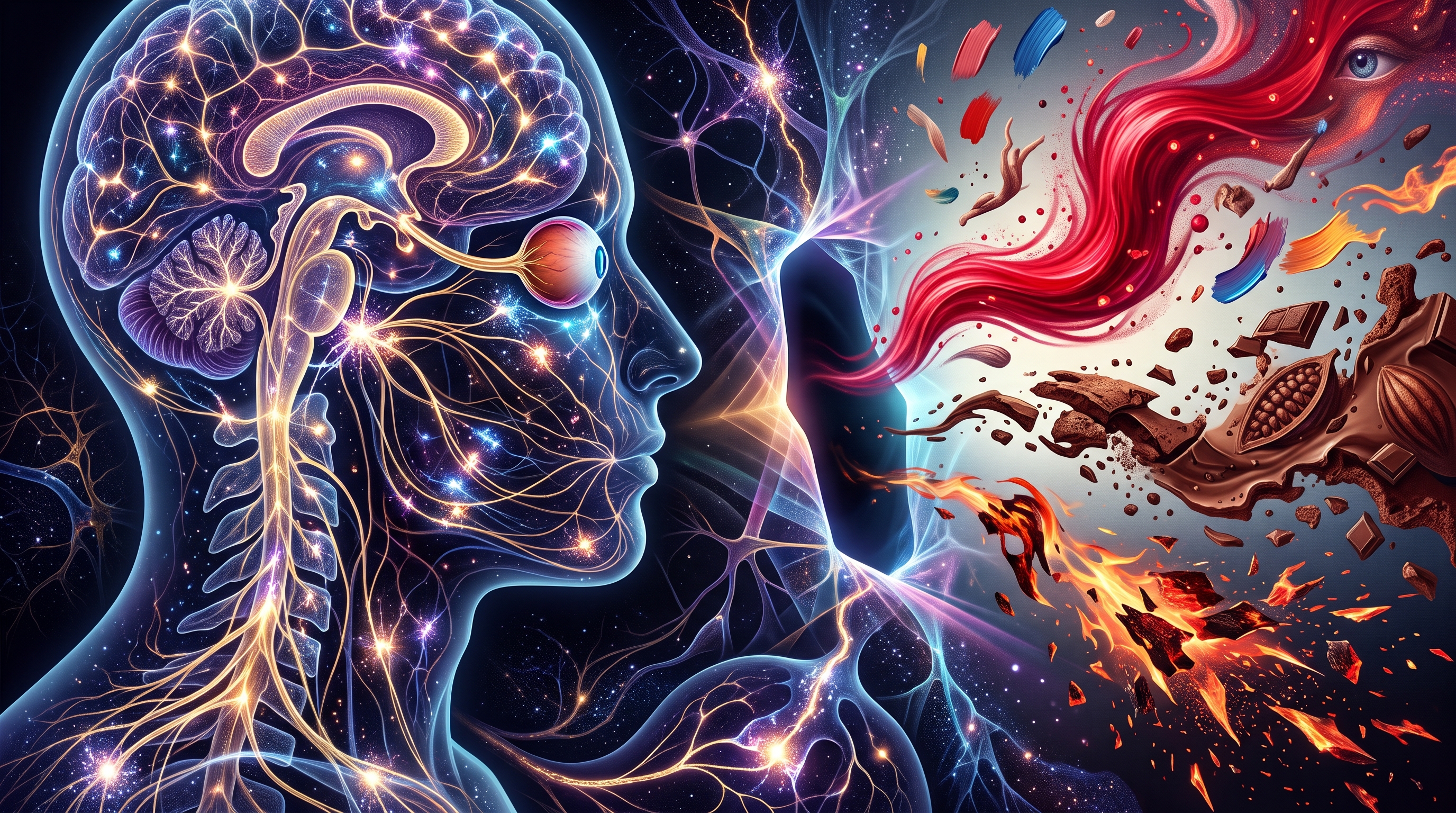
When light strikes the retina, it triggers a cascade of electrochemical signals that travel along the optic nerve to the visual cortex. Similarly, touching a hot surface sends rapid electrical impulses up the spinal cord via peripheral pathways. Neuroscientists can map these physical pathways in extraordinary detail, yet an epistemic chasm remains: how does wet, biological machinery transform electrical oscillations into the vivid sensation of seeing the color red, tasting dark chocolate, or feeling the sting of a burn? This epistemic divide forms the core of The Mind-Body Dichotomy in classical and contemporary Philosophy of Mind.
In 1995, philosopher David Chalmers divided this puzzle into two distinct conceptual categories that continue to guide modern consciousness research.[1]
The "Easy" Problems (Functional Mechanisms)
In cognitive neuroscience, "easy" does not mean trivial—it means the problem is solvable using standard scientific methods, computational architectures, and mechanistic modeling.[1:1] Think of this like reverse-engineering a smartphone: if you study the hardware and software long enough, you can explain how the camera sensor captures photons, how the processor routes data packets, and how the display refreshes pixels.
In the human brain, the "easy" problems involve mapping functional tasks:
- How the brain discriminates, categorizes, and reacts to environmental stimuli.
- How distinct sensory inputs are integrated into perceptual representations to guide motor behavior.
- How selective attention is focused and how the brain alternates between sleep, coma, and wakefulness.
The "Hard" Problem (Subjective Experience)
Even if neuroscientists succeed in mapping every single synaptic transmission and explaining every behavioral function, a foundational question remains: why doesn't all this information processing just happen "in the dark"?[1:2]
Imagine an autonomous AI agent or an automaton navigating an obstacle course. Both can detect barriers, calculate vector trajectories, and execute avoidance maneuvers without possessing an inner life or feeling anything at all. Why aren't biological organisms simply sophisticated automata? Why is physical computation accompanied by an inner qualitative "movie"? Philosophers and cognitive scientists call these private, felt qualities of subjective experience qualia—the intrinsic redness of a rose, the bitterness of espresso, or the acute ache of physical injury (a boundary explored in depth in Sentience vs. Consciousness).[2] Positing an internal spectator to watch this inner movie commits the homunculus fallacy dismantled by Gilbert Ryle (cf. Ghost in the Machine and Gilbert Ryle's-The Concept of Mind).
| Dimension | The "Easy" Problems (Cognitive Functions) | The "Hard" Problem (Phenomenal Qualia) |
|---|---|---|
| Core Question | How does the brain process information, discriminate stimuli, and guide adaptive behavior? | Why is any of this physical information processing accompanied by an inner felt experience? |
| Epistemic Approach | Mechanistic decomposition, computational modeling, and empirical neurobiology | Conceptual analysis, phenomenological mapping, and metaphysical inquiry |
| Subject Matter | Sensory integration, motor control, attentional selection, working memory storage | Raw subjective experience (qualia)—the redness of red, the felt ache of pain, sensory presence |
| Philosophical Foil | Functional system or automated agent (e.g., algorithmic computer, cybernetic robot) | Philosophical Zombie (p-zombie)—a functional physical replica entirely devoid of subjective awareness |
| Scientific Tractability | High; resolvable using standard empirical neuroscience and cognitive science tools | Contentious; resists purely functional reduction without a unifying explanatory bridge |
"Even when we have explained the performance of all the cognitive and behavioral functions in the vicinity of experience—perceptual discrimination, categorization, internal access, verbal report—there may still remain a further unanswered question: Why is the performance of these functions accompanied by experience?" — David Chalmers[1:3]
How Neuroscientists Practicalize the Question
Because empirical science relies on third-person objective measurement, it struggles to observe private, first-person subjective sensations directly. To bring consciousness into the laboratory, researchers reframe the philosophical "Hard Problem" into testable, empirical parameters.
1. The Neural Correlates of Consciousness (NCC)
Pioneered by biophysicist Francis Crick and neuroscientist Christof Koch in the 1990s, the search for the Neural Correlates of Consciousness (NCC) sets aside the metaphysical question of why consciousness exists to investigate where and how it arises in the nervous system.[3] Specifically, researchers look for the minimal set of neuronal events and mechanisms jointly sufficient to produce a specific conscious percept.[4]
A classic neuroanatomical puzzle in NCC research is the sharp contrast between the cerebellum and the thalamocortical system:
| Neuroanatomical System | Functional Role | Neuron Population | Role in Conscious Awareness | Architectural Dynamic |
|---|---|---|---|---|
| The Cerebellum ("The Autopilot") | Sensorimotor coordination, fine motor tuning, procedural automation | > 50% of all brain neurons (~69 billion) | Negligible / Unconscious: Complete cerebellar agenesis or resection disrupts motor fluidity but leaves subjective awareness fully intact.[4:1] | Feed-forward, modular, parallel processing streams with minimal lateral integration |
| The Thalamocortical System ("The Main Stage") | Multimodal sensory integration, global cognitive broadcast, flexible planning | ~16 billion cortical neurons | Indispensable: Small focal lesions can abolish specific phenomenal contents (e.g., color vision, face recognition) or induce coma.[4:2] | Dense recurrent feedback loops, bidirectional reentrant signaling, wide-scale synchrony |
Analogy: The Factory vs. The Showroom
Think of the cerebellum as a massive, automated fulfillment center operating in the dark. Billions of packages (signals) are sorted along rigid, parallel tracks that never intersect. Because the workstations operate independently, no single hub possesses an integrated overview of the operation. The cerebral cortex, however, operates like an interconnected newsroom where every desk is networked to every other desk—allowing fragmented data to coalesce into a single, unified story.
2. The Binding Problem
When observing a dog bark, the brain does not process the animal in a single, localized compartment. One region of the visual cortex (V4) computes color, another (MT/V5) tracks movement, a third analyzes geometric contour, and the auditory cortex processes the acoustic frequencies of the bark—each at different processing latencies.[5]
The Binding Problem asks how the nervous system binds these fragmented, spatially distributed signals into a single, coherent conscious experience without a miniature "viewer" (a homunculus) sitting in a Cartesian control room.[5:1] This inquiry mirrors the top-down principles of perceptual organization detailed in Gestalt Psychology-The Mechanics of the Whole and the distinction between passive sensory reception and active cognitive synthesis explored in Perception vs. Apperception. Many cognitive neuroscientists propose that synchronized gamma-band electrical oscillations (~40 Hz) act as a temporal glue, dynamically binding disparate cortical assemblies into a unified representational field.
3. The "Seat" of Awareness: Front vs. Back of the Brain
One of the most fiercely debated questions in empirical neuroscience pits the anterior prefrontal networks against posterior sensory regions. This debate was recently subjected to formal "adversarial collaborations" funded by the Templeton World Charity Foundation.[6]
| Cortical Sector | Key Anatomical Regions | Theoretical Alignment | Primary Empirical Hypothesis | Role in Subjective Experience |
|---|---|---|---|---|
| The Front (Anterior System) | Prefrontal Cortex (dlPFC), Anterior Cingulate Cortex, Frontoparietal Network | Global Neuronal Workspace Theory (GNWT), Higher-Order Theories (HOT) | Sensory processing remains unconscious until selected by executive attention and globally broadcast. | Essential for executive access, cognitive monitoring, working memory, and verbal reportability |
| The Back (Posterior System) | Posterior Cortical "Hot Zone" (Temporo-parieto-occipital sensory cortices) | Integrated Information Theory (IIT), Recurrent Processing Theory | Dense recurrent grid structures natively generate phenomenal states independent of task performance. | Sufficient for raw phenomenal appearance (seeing, hearing, feeling) prior to verbalization or behavioral report |
The Leading Competing Theories
To explain how biological tissue gives rise to subjective awareness, neuroscientists have formulated four major theoretical frameworks:
| Theory | Core Analogy | Key Brain Regions | What Makes Something Conscious? | Core Empirical Mechanism | Stance on Machine / Synthetic Consciousness |
|---|---|---|---|---|---|
| Global Neuronal Workspace (GNW) | The Theater Spotlight | Prefrontal and parietal cortices | Information enters a central workspace and is broadcast globally across the brain.[7] | Non-linear threshold "ignition" across long-range excitatory axons | Substrate-Neutral: Any computational architecture executing global broadcast dynamics can achieve consciousness. |
| Integrated Information Theory (IIT) | The Woven Tapestry | Posterior cortical "hot zone" | Dense, irreducible cause-effect power where the whole exceeds the sum of its parts.[8] | High intrinsic integrated information ( | Substrate-Dependent: Conventional feed-forward silicon processors have near-zero |
| Predictive Processing (PP) | The "Controlled Hallucination" | Hierarchical cortical feedback loops | The brain's top-down generative simulation, updated continuously by sensory error signals.[9] | Minimization of prediction error via hierarchical Bayesian active inference | Embodied / Homeostatic: Grounded in allostatic self-regulation and metabolic vulnerability; resists purely disembodied AI. |
| Higher-Order Theories (HOT) | The Security Monitor | Dorsolateral prefrontal cortex (dlPFC) | A higher-order representation meta-indexes or monitors what a lower-order sensory region is computing.[10] | Metacognitive re-representation distinguishing mere sensory reception from conscious awareness | Cognitivist: Synthetic systems with dedicated higher-order meta-representational indexing modules could instantiate consciousness. |
1. Global Neuronal Workspace (GNW): The Theater Spotlight
Developed by psychologist Bernard Baars and translated into neurobiology by Stanislas Dehaene and Jean-Pierre Changeux, Global Neuronal Workspace theory models the brain as an ensemble of specialized, unconscious processors.[7:1]
- Unconscious Substrates: At any millisecond, dozens of modular systems run in parallel—regulating cardiovascular tone, parsing background noise, or calibrating postural equilibrium. These operations remain entirely outside conscious awareness.
- Ignition and Global Broadcast: Information becomes conscious only when it enters the focus of attention and crosses an activation threshold, triggering a non-linear "ignition" across long-range axons in the prefrontal and parietal cortices.[7:2] Once ignited, this information is broadcast back down to specialized modules across the entire brain, making it simultaneously available for working memory, motor execution, and verbal report (a distributed dynamic that deconstructs the illusion of an executive commander, as examined in Deconstruction of the Central Controller).
2. Integrated Information Theory (IIT): The Woven Tapestry
Formulated by neuroscientist Giulio Tononi, Integrated Information Theory takes a radically phenomenological approach: instead of asking how biological matter creates functions, IIT begins with the essential axioms of experience itself (intrinsic existence, composition, information, integration, and exclusion) and deduces the physical causal properties a substrate must possess to instantiate them.[8:1]
- The Measure of Phi (
): IIT quantifies consciousness mathematically as (Phi), which measures the degree of irreducible cause-effect power an integrated system exerts upon itself above and beyond its isolated subcomponents.[8:2] - The Posterior Tapestry: While a digital camera sensor contains millions of independent light-sensitive pixels, it possesses zero conscious experience because cutting the sensor in half yields two functional halves with no integrated loss. The human posterior cortical hot zone, by contrast, operates like an intricately woven tapestry: every neuronal group affects and is affected by thousands of reciprocal feedback loops. IIT argues that consciousness is an intrinsic physical property of systems whose causal architecture yields high
.
3. Predictive Processing: The "Controlled Hallucination"
Championed by cognitive scientists and neuroscientists such as Andy Clark, Anil Seth, and Karl Friston, the predictive processing framework reconceptualizes the perceptual apparatus (detailed extensively in the Bayesian Brain Hypothesis and Glitches in The Bayesian Brain):[9:1]
- The Inverse Problem: Sealed within the soundproof, lightless enclosure of the skull, the brain has no direct access to external reality; it receives only noisy, ambiguous electrical signals along peripheral nerves.[9:2]
- Generative Top-Down Simulation: Rather than passively receiving sensory data bottom-up, the brain operates as a prediction machine. It continuously projects a top-down probabilistic simulation of the world downward through hierarchical cortical networks. Incoming sensory signals serve merely as "prediction errors"—correction signals that refine and tether the brain's internal hypothesis to external constraints.[9:3]
- Perception as Controlled Hallucination: What an organism consciously perceives is not raw external reality, but its brain's internally generated best guess—a species-specific model that aligns with Donald Hoffman's findings in The Interface Theory of Perception (ITP) and the evolutionary filter proposed in Bergson’s Eliminative Model of Perception and Memory. As Anil Seth notes, normal perception is a "controlled hallucination," whereas clinical hallucination represents uncontrolled perception.[9:4]
4. Higher-Order Theories (HOT): The Inner Narrator
Pioneered by philosopher David Rosenthal and neuroscientist Joseph LeDoux, Higher-Order Theories maintain that first-order sensory activity—regardless of how synchronized or integrated—is insufficient to produce phenomenal awareness on its own.[10:1]
- First-Order vs. Higher-Order Representations: Primary sensory cortices in the occipital or temporal lobes generate first-order representations of environmental stimuli (e.g., detecting edge orientation or frequency spectra). According to HOT, these representations remain unconscious until a higher-order system—typically anchored in the dorsolateral prefrontal cortex—constructs a meta-representation targeting that lower-order state.[10:2]
- The Introspective Gap: Consciousness consists precisely in the higher-order awareness that one is in a particular sensory state. This dynamic mirrors the transition from baseline sensation to reflective apperception (see Perception vs. Apperception), explaining phenomena such as absent-minded driving, where first-order sensory processing navigates vehicle trajectory while phenomenal awareness of the roadway is absent.[10:3]
Where the Field Stands Today: Adversarial Collaborations
Recent large-scale adversarial experiments testing these models head-to-head (notably the 2023 COGITATE consortium comparing GNW and IIT) revealed that neither paradigm emerged fully vindicated.[6:1] While the posterior hot zone sustained persistent representation of visual stimuli (supporting IIT's anatomical claims), the anterior prefrontal cortex exhibited critical bursts of synchronization during perceptual onset (partially supporting GNW). The science of consciousness is moving toward an integrative synthesis of these frameworks rather than an absolute binary resolution.
Resonant Notes
The following notes in the vault share direct thematic, cognitive, and philosophical connections with the neuroscience of consciousness:
🔴 Philosophy of Mind, Qualia & The Explanatory Gap
- Sentience vs. Consciousness — Details the taxonomic boundary separating minimal affective sentience (valenced feelings of pain/pleasure) from higher-order metacognitive awareness and sapience.
- Philosophy of Mind — Deconstructs the Cartesian Theater and the internal spectator, examining how modular neurobiology challenges traditional metaphysical models of mind.
- The Mind-Body Dichotomy — Traces the historical evolution of substance dualism, property dualism, and physicalism, contextualizing Chalmers's Hard Problem within Western intellectual history.
- Ghost in the Machine & Gilbert Ryle's-The Concept of Mind — Exposes the category mistake of treating consciousness as an occult internal entity residing within an organic mechanical chassis.
- David Hume's Bundle Theory (1739) — Parallels modern neurobiological findings by demonstrating that introspective inquiry uncovers only a fleeting bundle of perceptions rather than an immutable, indivisible ego.
- Derek Parfit's Reductionism (1984) — Demonstrates that personal identity is not an indivisible metaphysical entity, but a continuum of psychological connections that decentralize the unitary conscious subject.
🟡 Cognitive Architectures, Predictive Processing & Neuroanatomy
- Bayesian Brain Hypothesis & Glitches in The Bayesian Brain — Explores the computational architecture of predictive coding, Active Inference, and precision weighting that underpins the "controlled hallucination" model of conscious awareness.
- Default Mode Network (DMN) — Examines the neuroanatomical hub responsible for self-referential cognition, autobiographical narrative, and internal mental simulation.
- Deconstruction of the Central Controller — Synthesizes split-brain findings, readiness potentials, and modular neurobiology to dismantle the illusion of a centralized executive driver in the human brain.
- The Interface Theory of Perception (ITP) — Presents Donald Hoffman’s mathematical proof that evolutionary fitness drives perceptual systems to hide objective reality behind an adaptive user interface rather than depict veridical truth.
- Perception vs. Apperception — Maps the critical cognitive boundary separating baseline, pre-reflective sensory reception from higher-order, reflective mental synthesis.
- Bergson’s Eliminative Model of Perception and Memory — Formulates the brain as an action-oriented eliminative filter designed to restrict sensory input to what is practically relevant for survival.
- Gestalt Psychology-The Mechanics of the Whole — Investigates how perceptual systems impose emergent structural organization onto fragmented sensory data, illustrating the visual dynamics of the Binding Problem.
🟢 Phenomenology, Perception & Social Cognition
- Theory of Mind - The Cognitive Architecture of Social Intelligence — Analyzes the cognitive evolutionary mechanisms required to attribute subjective mental states, beliefs, and conscious desires to other agents.
- Aldous Huxley's The Doors of Perception (1954) — Formulates the concept of the brain as a biological "reducing valve," examining how altered neurochemical states temporarily suspend predictive constraints to flood phenomenal awareness.
- Constructs of the Mind-Unmasking Consciousness in East and West & Vasubandhu's-Triṃśikā-vijñaptimātratā — Integrates Western cognitive science with Buddhist Yogācāra analyses of representation-only (vijñaptimātratā), demonstrating that perceived reality is an internally assembled mental fabrication.
- Defining a Simulacrum — Explores Jean Baudrillard’s theory of simulation and hyperreality, providing a cultural and philosophical counterpart to the brain's internal predictive models.
- William James — Highlights James's pioneering analysis of selective attention, habit formation, and the continuous stream of thought that laid the foundation for modern consciousness studies.
- Louis Sass - Phenomenological Psychopathology and the Self — Investigates how disruptions in pre-reflective self-awareness, hyperreflexivity, and aberrant predictive salience distort phenomenal experience in schizophrenia.
- Iain McGilchrist — Explores the hemispheric lateralization of attention, contrasting the left hemisphere's narrow, manipulative focus with the right hemisphere's open, holistic awareness of living context.
Backlinks
- Sentience vs. Consciousness — Serves as the primary taxonomic companion note delineating minimal valenced experience from reflective conscious access.
- Philosophy of Mind — Synthesizes the neuroscientific challenges to the Cartesian spectator with broader cognitive and metaphysical frameworks.
- Bayesian Brain Hypothesis — Supplies the formal computational engine explaining how top-down predictive priors interact with bottom-up sensory prediction errors to assemble conscious perception.
- Deconstruction of the Central Controller — Provides empirical neurosurgical and behavioral case studies demonstrating the absence of a localized central executive in consciousness.
- The Mind-Body Dichotomy — Establishes the historical and metaphysical foundation of the explanatory gap that contemporary neuroscience seeks to resolve.
References
David J. Chalmers / Facing Up to the Problem of Consciousness / Journal of Consciousness Studies ↩︎ ↩︎ ↩︎ ↩︎
Stanford Encyclopedia of Philosophy / Qualia / plato.stanford.edu ↩︎
Francis Crick & Christof Koch / Towards a Neurobiological Theory of Consciousness / Seminars in the Neurosciences ↩︎
Christof Koch, Marcello Massimini, Melanie Boly & Giulio Tononi / Neural Correlates of Consciousness: Progress and Problems / Nature Reviews Neuroscience ↩︎ ↩︎ ↩︎
Anne Treisman / The Binding Problem / Current Opinion in Neurobiology ↩︎ ↩︎
Cogitate Consortium et al. / An Adversarial Collaboration to Critically Evaluate Theories of Consciousness / bioRxiv ↩︎ ↩︎
Stanislas Dehaene & Jean-Pierre Changeux / Experimental and Theoretical Approaches to Conscious Processing / Neuron ↩︎ ↩︎ ↩︎
Giulio Tononi, Melanie Boly, Marcello Massimini & Christof Koch / Integrated Information Theory: From Consciousness to Its Physical Substrate / Nature Reviews Neuroscience ↩︎ ↩︎ ↩︎
Anil K. Seth / Being You: A New Science of Consciousness / Penguin Random House ↩︎ ↩︎ ↩︎ ↩︎ ↩︎
Richard Brown, Hakwan Lau & Joseph E. LeDoux / Understanding the Higher-Order Approach to Consciousness / Trends in Cognitive Sciences ↩︎ ↩︎ ↩︎ ↩︎