Frank Gehry's Master-Builder Model - De-Risking Megaprojects Through Simulation and Execution
🗂️ Interactive Notebook: Open Aesthetics in Religion Study Companion (Video Summary, Flashcards, Mind Map) ↗
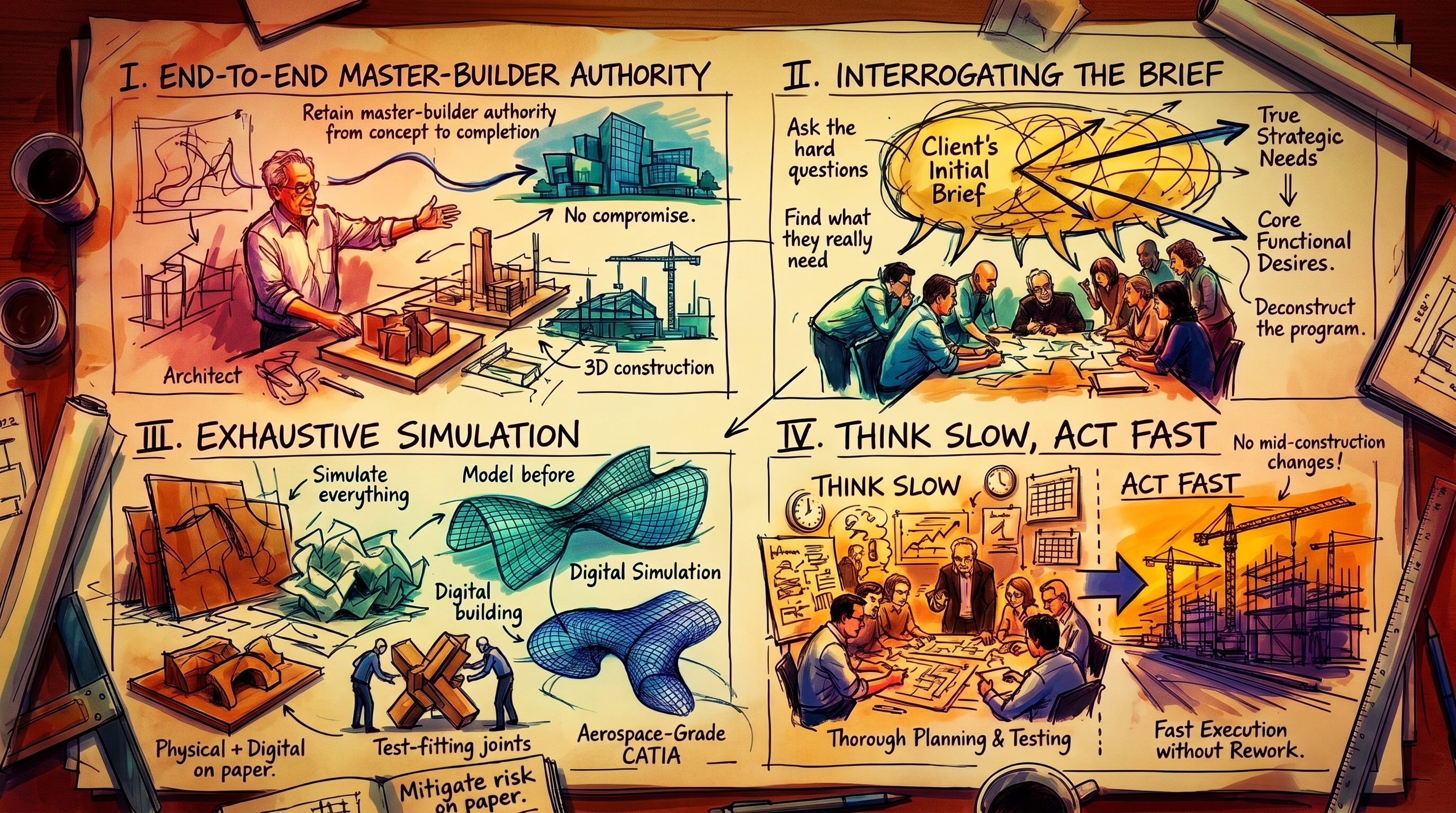
While Frank Gehry’s architectural designs appear as spontaneous bursts of artistic chaos, his project management methodology—famously analyzed by Bent Flyvbjerg in How Big Things Get Done—was disciplined, risk-averse, and structured around four core principles: retaining end-to-end master-builder authority, interrogating the client's brief to uncover true strategic needs, exhaustively simulating designs via physical and aerospace-grade digital models, and practicing "think slow, act fast" to eliminate mid-construction rework.[1]
1. Aligning Authority with Responsibility
A primary failure mode in modern megaproject delivery is assigning responsibility without commensurate authority. Gehry rejected the fragmented modern division between design architects and executive delivery managers, insisting on operating as a modern "master builder" with end-to-end control over both design and construction oversight.[1:1]
Separating design intent from construction execution introduces bureaucratic friction, diluted accountability, and costly translation errors between 2D blueprints and physical fabrication.
The Walt Disney Concert Hall Crisis
During the early 1990s phase of the Walt Disney Concert Hall in Los Angeles, the project's oversight committee stripped Gehry’s firm of control over the working blueprints, handing production of the construction documents to an external executive architecture firm.[2] Because the external firm lacked the methodologies to translate Gehry’s complex curved geometries into buildable specifications, the project collapsed into severe delays, unbuildable blueprints, and cost overruns exceeding $100 million.[1:2][2:1]
When philanthropic billionaire Eli Broad subsequently attempted to sideline Gehry further to expedite construction via third-party contractors, Gehry threatened to resign and remove his name from the building.[2:2] Backed by primary benefactor Diane Disney Miller, who insisted that Gehry’s authority be restored, Gehry reclaimed full control over the engineering and construction pipeline, ultimately delivering a landmark acoustic and architectural achievement.[1:3][2:3]
The Guggenheim Bilbao Triumph
Conversely, when Solomon R. Guggenheim Foundation director Thomas Krens commissioned Gehry for the Guggenheim Museum Bilbao, Krens granted Gehry total authority to manage the entire design-to-construction pipeline, paired with a strict, immovable budget ceiling.[1:4] Empowered to negotiate directly with steel fabricators, contractors, and local engineers without bureaucratic intermediaries diluting his decisions, Gehry delivered the museum in October 1997 strictly on schedule and roughly $3 million under its $100 million construction budget.[1:5][3]
2. Uncovering True Project Needs ("Asking Why")
Before committing to initial sketches, Gehry systematically interrogated the client’s brief by repeatedly asking why the building was wanted and what it truly needed to accomplish—a core discipline of project initiation and stakeholder alignment.[1:6] This diagnostic phase frequently revealed that a client's stated spatial requirements masked a deeper strategic or emotional objective.
Moving Beyond the Checklist
Clients routinely approach architects with a prescriptive checklist of square-footage allocations for galleries, offices, and lobbies. Rather than treating the brief as a fixed specification, Gehry used iterative questioning to uncover the underlying mission of the project and prevent downstream scope creep.[1:7]
Strategic and Democratic Purpose in Practice
- Economic Regeneration in Bilbao: Probing the underlying goals of the Basque regional government revealed that they did not merely need wall space to hang contemporary art; they required a transformative global catalyst capable of pulling a decaying, post-industrial port city out of severe economic depression.[1:8][3:1] This realization justified the bold, titanium-clad sculptural form that sparked the "Bilbao Effect."[3:2]
- Democratic Intimacy at Disney Hall: Questioning the core purpose of the Walt Disney Concert Hall led Gehry and acoustician Yasuhisa Toyota to reject the traditional, aristocratic European "shoebox" opera house—characterized by segregated box seats and social hierarchy.[2:4][4] Instead, they designed an intimate, vineyard-style hall where terraced seating surrounds the orchestra, fulfilling Lillian Disney's foundational wish for an egalitarian civic gift to the people of Los Angeles—exemplifying how comprehensive stakeholder analysis uncovers emotional and civic mandates.[2:5][4:1]
3. Exhaustive Physical and Digital Simulation
Gehry never treated the active construction site as an arena for experimentation. All trial, error, and geometric problem-solving occurred inside the studio before excavation began, driven by a continuous loop of physical prototyping and aerospace-grade digital simulation.[1:9][5]
By combining tactile physical models with parametric aerospace software, Gehry's studio bridged the gap between sculptural intuition and rigid industrial manufacturing tolerances.
Tactile Physical Prototyping
For any single commission, Gehry and his team constructed dozens to hundreds of physical scale models across varied scales using wood, cardboard, metal foil, and crumpled paper.[5:1] These models allowed rapid iteration of spatial flow, structural massing, and natural light behavior.
For the Walt Disney Concert Hall's acoustics, Gehry and Yasuhisa Toyota constructed a meticulous 1:10 scale physical model of the auditorium.[4:2] Technicians pumped the model full of nitrogen—removing oxygen and moisture to simulate the acoustic absorption density of full-scale air—and fired high-frequency sound impulses through the miniature space to empirically test and refine acoustic reflections for every seat.[1:10][4:3]
Digital Aerospace Simulation (CATIA)
Once a physical model achieved the desired architectural and functional performance, Gehry’s studio—spearheaded by partner Jim Glymph—digitized the physical coordinates using a 3D medical optical digitizer and imported the data into CATIA (Computer-Aided Three-Dimensional Interactive Application), a parametric 3D modeling platform originally developed by Dassault Systèmes to design Mirage fighter jets.[1:11][5:2]
- Structural and Clash Detection: Inside this virtual "digital twin", engineers simulated structural stresses, mechanical routing, and geometric intersections across the entire building, pre-emptively resolving clashes that typically derail complex project execution.[5:3]
- Cost-Control via Curvature Analysis: The software monitored material tolerances in real time. If a proposed titanium or limestone panel curved too sharply—risking structural buckling or requiring expensive custom fabrication—CATIA flagged the surface in red.[1:12][5:4] This feedback loop allowed Gehry to adjust the surface geometry digitally and re-test until every component was proven buildable within budget constraints.[1:13]
4. "Think Slow, Act Fast" in Execution
Conventional megaproject managers frequently rush into early site mobilization and concrete pouring to demonstrate visible "progress" to stakeholders, only to spend years trapped in expensive mid-construction change orders, schedule delays, and litigation.[1:14] Gehry inverted this paradigm entirely, embodying the operational principle that Flyvbjerg defines as "Think slow, act fast."[1:15]
"Planning is relatively cheap and safe; delivery is expensive and dangerous. Therefore, you want to do your iteration and experimentation in the planning phase, not the delivery phase." — Bent Flyvbjerg, How Big Things Get Done[1:16]
Deliberate, Unhurried Planning
Gehry dedicated years to the planning and modeling phase—questioning baseline assumptions, discarding entire design iterations, and resolving engineering conflicts inside the 3D digital master model.[1:17] He refused to authorize full-scale construction mobilization until the virtual building was 100% resolved down to individual structural nodes and fastener tolerances, operationalizing the rigor of a detailed Work Breakdown Structure (WBS).[1:18][5:5]
Rapid, Frictionless Fabrication and Assembly
Because geometric and engineering conflicts were discovered and resolved during the planning phase, physical construction proceeded with exceptional speed and precision:
- Direct-to-Factory CNC Manufacturing: Rather than forcing field contractors to interpret complex 2D paper blueprints on-site, Gehry's studio transmitted 3D CATIA files directly to the Computer Numerical Control (CNC) machinery of steel and stone fabricators.[5:6]
- Barcoded Precision Assembly: At the Guggenheim Bilbao, every structural steel beam was pre-cut to exact three-dimensional specifications and barcoded at the factory.[1:19][3:3] When the components arrived on-site, construction crews assembled the complex non-linear skeleton like a precision manufacturing kit, achieving zero structural rework and eliminating contractor contingency padding—a masterclass in effectiveness driving downstream efficiency.[1:20][5:7]
🎴 Interactive Web Practice (Comprehension Check)
Question 1 (Governance & Master-Builder Alignment): Why does Bent Flyvbjerg identify the separation of design authority from delivery responsibility as a fatal flaw in megaproject governance, and how did Frank Gehry's experiences at Disney Hall versus Guggenheim Bilbao demonstrate this dynamic?
Answer: Separating design authority from executive delivery splits accountability, creates bureaucratic friction, and introduces severe translation errors between conceptual designs and physical construction. When the Disney Hall oversight committee sidelined Gehry and transferred blueprint execution to an outside executive architecture firm, that external firm could not translate Gehry's complex curved geometries into buildable specifications, triggering unbuildable documents, severe delays, and over $100 million in cost overruns. Only when Gehry's full authority over the engineering and construction pipeline was restored could the project be rescued. In contrast, at the Guggenheim Bilbao, Thomas Krens granted Gehry end-to-end master-builder authority paired with an unyielding budget ceiling. Because Gehry could negotiate directly with fabricators and contractors without bureaucratic distortion, the museum was delivered strictly on time and roughly $3 million under its $100 million budget.
Question 2 (Front-Loaded Simulation & De-Risking): How does exhaustive studio simulation (nitrogen acoustic modeling and CATIA digital twins) operationalize Flyvbjerg's principle that "planning is cheap and delivery is dangerous"?
Answer: Conventional project management often rushes into physical excavation and concrete pouring to project visible momentum, leaving structural clashes, material tolerances, and acoustic flaws to be discovered in the field where change orders, rework, and delays are exponentially expensive. Gehry treats the studio, rather than the construction site, as the sole testing laboratory. By testing a 1:10 scale auditorium filled with nitrogen to simulate full-scale atmospheric acoustic absorption, acoustic issues were resolved empirically before pouring concrete. Furthermore, by importing digitized physical models into CATIA (aerospace software), engineers performed automated clash detection and curvature tolerance analysis: surfaces curving too sharply were flagged in red, enabling Gehry to re-engineer geometries virtually until every single panel and beam was proven buildable within budget, ensuring zero trial-and-error on the job site.
Question 3 (Execution Dynamics & Upstream Discipline): How does Gehry's "think slow, act fast" philosophy bridge the gap between upstream deliberate planning and downstream lean, frictionless manufacturing?
Answer: "Thinking slow" entails dedicating years to diagnostic inquiry ("asking why" to uncover true strategic and civic purposes) and exhaustive virtual prototyping, deliberately refusing to authorize physical mobilization until the digital model is 100% resolved down to the millimeter. This slow, disciplined investment enables "acting fast" during delivery: because the virtual model is clash-free, 3D design files are piped directly to factory Computer Numerical Control (CNC) machinery. Structural steel and stone components are fabricated with aerospace precision and barcoded at the plant. When shipped to the site, workers assemble the building like a pre-engineered kit with zero field modification, no contractor padding, and zero structural rework. Upstream deliberation thus eliminates the friction, delays, and cost cascades that plague conventional megaprojects.
Resonant Notes
The following notes in the vault share direct thematic, structural, and operational connections with Frank Gehry's Master-Builder Methodology:
🔴 Core Project Management, Governance & Lifecycles
- PM - Assessing Risk — Deconstructs proactive threat identification and qualitative/quantitative risk modeling, principles Gehry operationalizes by treating design-stage simulation as an exhaustive risk-mitigation firewall.
- Project Management Lifecycles and Gate Deliverables — Examines phase-gate governance and exit criteria; Gehry enforces an uncompromising quality gate by freezing physical site mobilization until virtual 3D models achieve 100% clash-free resolution.
- PM - Initiation — Details stakeholder mandate definition and project charter development, mirroring Gehry's diagnostic "asking why" phase to uncover core civic, emotional, and economic missions.
- PM - Work Breakdown Structure — Analyzes the decomposition of complex deliverables into manageable work packages, paralleling Gehry's conversion of sculptural geometries into discrete, barcoded CNC structural components.
- PM - Budgeting — Explores parametric and bottom-up cost estimation alongside contingency management, illustrating how Gehry achieved Bilbao's $3M budget surplus through real-time CATIA curvature cost-tracking.
- PM - Monitoring and Controlling — Details variance tracking, change control, and delivery oversight, contrasting conventional reactive change orders with Gehry's pre-emptive master-builder governance.
🟡 Operational Resilience, Simulation & Trade-Offs
- Difference Between Efficiency and Effectiveness — Explores the tension between short-term execution speed and long-term strategic value; Gehry demonstrates that investing heavily in front-end planning effectiveness unlocks unprecedented downstream construction efficiency.
- Difference Between Just-in-Time (JIT) and Just-in-Case (JIC) — Contrasts lean pull-based assembly with buffer reserves; Gehry's direct-to-factory CNC fabrication operates as high-precision JIT assembly, underpinned by exhaustive JIC virtual risk mitigation.
- Stakeholder Mapping and Analysis — Examines power-interest dynamics and executive sponsorship, reflected in Diane Disney Miller's intervention to restore Gehry's master-builder authority and Thomas Krens's unbureaucratic governance at Bilbao.
- Every Business Is a Software Business - Core Frameworks and Enterprise Transformation — Details the strategic role of digital twins, parametric data workflows, and automated manufacturing pipelines, pioneered architecturally by Gehry Technologies and Dassault CATIA.
- Te Āpiti Wind Farm - A Case Study in Risk Management and Infrastructure Resilience — Real-world infrastructure case study demonstrating relational contracting, geotechnical de-risking, and active stakeholder alignment under volatile field conditions.
🟢 Post-Mortems, Cognitive Biases & System Complexity
- The Anatomy of a Project Disaster - RMS Titanic Case Study — Examines the catastrophic antithesis of Gehry's methodology, where unchecked schedule pressure, compromised structural baselines, and suppressed engineering warnings led to total disaster.
- Unsinkable Assumptions - A Project Management Post-Mortem of the RMS Titanic — Deconstructs optimistic executive biases and unvalidated design assumptions, highlighting why Gehry's empirical stress-testing (nitrogen models, CATIA clash detection) is vital for megaproject survival.
- Execution - The Discipline of Getting Things Done — Connects organizational culture and operational realism, emphasizing Gehry's insistence that visionary leadership cannot be detached from granular manufacturing and construction oversight.
- The McNamara Fallacy — Warns against managing purely by superficial quantitative checklists while ignoring qualitative purpose, a pitfall Gehry actively circumvented by interrogating client briefs beyond square-footage quotas.
- Entropy — Explores how complex systems degrade toward disorder without continuous energy input, disciplined change control, and single-point structural accountability.
References
Bent Flyvbjerg & Dan Gardner / How Big Things Get Done: The Surprising Factors Behind Every Successful Project, from Home Renovations to Space Exploration / penguinrandomhouse.com ↩︎ ↩︎ ↩︎ ↩︎ ↩︎ ↩︎ ↩︎ ↩︎ ↩︎ ↩︎ ↩︎ ↩︎ ↩︎ ↩︎ ↩︎ ↩︎ ↩︎ ↩︎ ↩︎ ↩︎ ↩︎
Los Angeles Philharmonic Association / The History of Walt Disney Concert Hall / laphil.com ↩︎ ↩︎ ↩︎ ↩︎ ↩︎ ↩︎
Guggenheim Museum Bilbao / The Building and Construction History / guggenheim-bilbao.eus ↩︎ ↩︎ ↩︎ ↩︎
Nagata Acoustics / Acoustic Design of Walt Disney Concert Hall / nagata.co.jp ↩︎ ↩︎ ↩︎ ↩︎
Bruce Lindsey / Digital Gehry: Material Resistance, Digital Construction / degruyter.com ↩︎ ↩︎ ↩︎ ↩︎ ↩︎ ↩︎ ↩︎ ↩︎