Georg Lukács's formulation of reification (Verdinglichung) in History and Class Consciousness (1923)
🗂️ Interactive Notebook: Open Study Companion (Video Summary, Flashcards, Mind Map) ↗
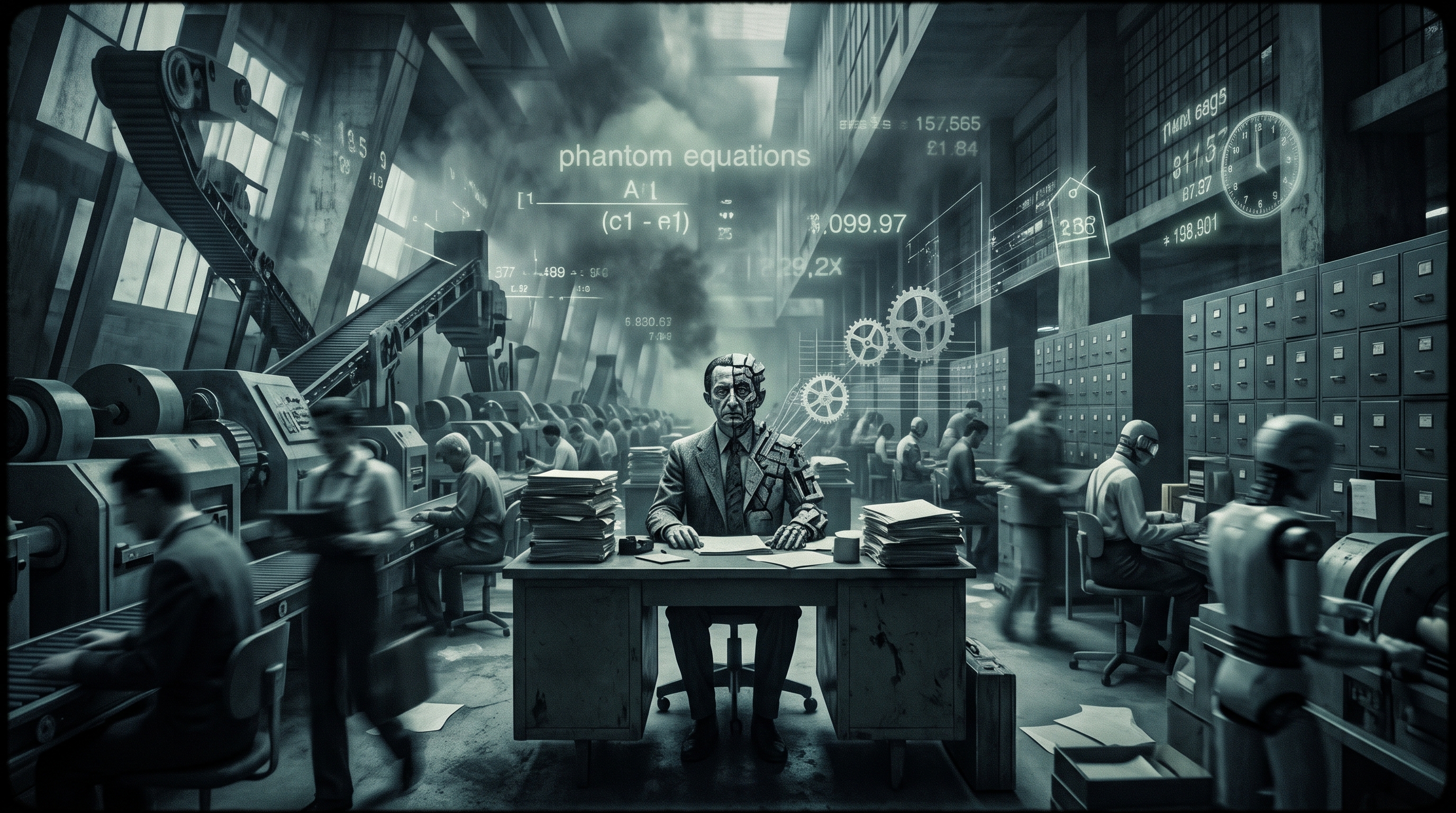
Georg Lukács’s History and Class Consciousness: Studies in Marxist Dialectics (Geschichte und Klassenbewußtsein, 1923)—specifically its centerpiece essay, "Reification and the Consciousness of the Proletariat" (Die Verdinglichung und das Bewußtsein des Proletariats)—constitutes the foundational text of Western Marxism and twentieth-century Critical Theory. By synthesizing Karl Marx’s critique of commodity fetishism, Max Weber’s theory of formal rationalization and bureaucratic calculability, and Georg Simmel’s tragedy of culture, Lukács formulates reification (Verdinglichung, literally "thingification" or "making into a thing") as the defining structural pathology of modern capitalist civilization. Under the universal dominance of the commodity form, dynamic qualitative social relations between human beings are systematically inverted into a rigid, autonomous "phantom objectivity" (gespenstige Gegenständlichkeit) that confronts human subjects as an immutable, natural law. Reification ceases to be merely an economic mechanism: it colonizes subjective consciousness, installs a passive "contemplative stance" (kontemplative Haltung), fragments the organic sensorium through hyper-specialization, and mirrors itself in the unresolved antinomies of bourgeois philosophy. When juxtaposed with Mahāyāna Buddhist epistemology—specifically the deconstruction of intrinsic nature (svabhāva) through emptiness (śūnyatā) and the critique of conceptual proliferation (prapañca)—Lukács’s formulation reveals a profound structural homology, exposing human alienation as a catastrophic cognitive and systemic habit of freezing living relational flux into autonomous, petrified substances.
1. Intellectual Architecture: The Triadic Synthesis
Lukács’s breakthrough in History and Class Consciousness was not an exegesis of orthodox Marxist dogma, but a revolutionary philosophical synthesis. Confronting the historical failure of the Central European socialist revolutions (1918–1919) and the deterministic rigidity of Second International Marxism (represented by Karl Kautsky), Lukács asked why the working class remained immobilized and compliant within the capitalist order.[1]
To answer this question, he fused Karl Marx’s political economy with the most sophisticated sociological and philosophical currents of Wilhelmine and Weimar Germany:[2]
| Theoretical Pillar | Core Source & Concept | Conceptual Contribution to Reification (Verdinglichung) |
|---|---|---|
| Karl Marx (1818–1883) | Capital, Vol. 1 (1867): Commodity Fetishism (Der Fetischcharakter der Ware) | Uncovers how social relations of labor assume the illusory, fantastic form of a relation between things; value appears as an intrinsic physical property of commodities rather than human labor time. |
| Max Weber (1864–1920) | Economy and Society (1922): Formal Rationalization (Zweckrationalität) | Details the historical rise of systematic calculability, bureaucratic administration, and functional quantification that encases modern life in an "iron cage" (stahlhartes Gehäuse). |
| Georg Simmel (1858–1918) | The Philosophy of Money (1900): The Tragedy of Culture (Die Tragödie der Kultur) | Analyzes how externalized cultural artifacts, financial systems, and objective institutions detach from subjective cultivation (Bildung) to develop an autonomous momentum that dominates the human mind. |
| Georg Lukács (1885–1971) | History and Class Consciousness (1923): Reification (Verdinglichung) | Synthesizes all three: the commodity form becomes the universal structural archetype of modern society, colonizing economics, state bureaucracy, jurisprudence, journalism, science, and the human sensorium. |
Karl Marx: Commodity Fetishism and the Inversion of Relations
In Chapter 1, Section 4 of Capital (Vol. 1), Marx unveiled the "fetish character" of the commodity. In a market economy, the private labor of independent producers is mediated exclusively through commodity exchange. Consequently, human beings do not experience their social interdependence directly; instead, their social connection is established post-facto through the market value of their products.[3]
Social relations between living human beings are thereby obscured, appearing as material relations between things, while physical commodities take on quasi-human, autonomous social powers. Lukács realized that Marx had discovered something far larger than an economic illusion: he had isolated the central organizing principle of modern social reality.[1:1] The reality that value and social order are forged through dynamic human labor is not buried beneath metaphysical mysteries, but operates in-plain-sight; however, under the reified gaze of market society, this living relational truth remains invisible.
Max Weber: Formal Rationality and Calculability
Lukács was an active participant in Max Weber’s Heidelberg intellectual circle from 1912 to 1915. From Weber, Lukács adopted the diagnostic concepts of formal rationalization (Zweckrationalität), bureaucratic functionalization, and the relentless drive for mathematical calculability (Rechenhaftigkeit). Weber demonstrated that modern capitalism demands predictable, standardized operations stripped of human emotional variance, ethical idiosyncrasy, and qualitative unpredictability.[4]
Lukács recognized that Weber's "iron cage" was the precise organizational mechanism through which the commodity form disciplined human labor and institutional administration into quantified subroutines.
Georg Simmel: Monetary Abstraction and the Tragedy of Culture
Prior to his conversion to Marxism, Lukács was Georg Simmel’s student in Berlin. In The Philosophy of Money (Philosophie des Geldes) and "On the Concept and the Tragedy of Culture" (1911), Simmel diagnosed the modern crisis wherein objective cultural artifacts accumulate exponentially and develop an autonomous evolutionary logic (Eigengesetzlichkeit), leaving subjective human cultivation (Subjektive Kultur) dwarfed, alienated, and fragmented.[5]
Lukács stripped Simmel’s tragedy of its tragic fatalism, historicizing it: what Simmel treated as an insurmountable existential condition of human culture in general, Lukács identified as the historically specific consequence of the universalized commodity form under industrial capitalism.[1:2]
2. The Anatomy of Reification (Verdinglichung)
Lukács begins his core essay by establishing that reification can only emerge when the commodity ceases to be an isolated or marginal phenomenon (as in pre-capitalist trade) and becomes the universal organizing principle of society.[1:3]
"The essence of commodity-structure has often been pointed out. Its basis is that a relation between people takes on the character of a thing and thus acquires a 'phantom objectivity', an autonomy that seems so strictly rational and all-embracing as to conceal every trace of its fundamental nature: the relation between people."[1:4]
Reification functions along two inseparable, dialectical dimensions: the objective structural realm and the subjective realm of human consciousness.[6]
| Dimension of Reification | Structural Arena | Operational Mechanism | Manifest Phenomenon |
|---|---|---|---|
| Objective Reification | Economic markets, legal codes, state apparatus, corporate hierarchies. | Commodification and legalistic formalism; relations between producers are mediated by prices and statutes. | Phantom Objectivity (Gespenstige Gegenständlichkeit): Society appears governed by inexorable, immutable natural laws that operate independently of human volition. |
| Subjective Reification | Epistemology, psychology, emotional life, somatic bodily disposition. | Rationalization, quantification of time, and cognitive fragmentation. | The Contemplative Stance (Kontemplative Haltung): The subject becomes a detached, passive spectator watching their own alienated labor and faculties function as commodified objects. |
Phantom Objectivity (Gespenstige Gegenständlichkeit) and "Second Nature"
Under advanced capitalism, social institutions are experienced as an alien, hostile, and unalterable environment. Lukács calls this externalized institutional reality second nature (zweite Natur). Just as pre-modern humans confronted raw physical nature—storms, droughts, predators—with fatalistic awe, the modern citizen confronts the capitalist market, inflationary waves, technical automation, and bureaucratic decrees as if they were unbending physical laws of nature.[1:5]
The social reality created entirely by human collective labor is perceived as an autonomous object that operates like-clockwork, concealing its human, historical, and contingent origins behind a-facade of seamless technical rationality.
The Contemplative Stance (Die kontemplative Haltung)
Because the objective apparatus functions autonomously according to calculable mathematical laws, the individual worker is stripped of subjective agency. The laborer does not direct the production process; rather, the mechanized assembly line disciplines and coordinates the laborer.[6:1]
- The human worker is reduced to an interchangeable cog-in-the-machine, assigned a specialized, repetitive micro-task.
- Time is transformed from an organic, lived duration into a spatialized, quantifiable continuum of discrete units (clock-time).
- The worker’s own physical stamina, intellectual problem-solving, and emotional expressions are separated from their living personality and treated as external instruments—commodities sold on the labor market.[1:6]
- The worker adopts a contemplative stance: a psychological disposition of passive observation, navigating the workplace on-autopilot while watching the automated machinery execute its prescribed choreography.
The Universal Colonization of Modern Life
Crucially, Lukács insists that reification is not confined to manual factory workers. The division of labor, formal rationalization, and the contemplative stance permeate every social stratum and profession. The factory assembly line, the modern civil courthouse, the state bureaucracy, and commercial mass journalism are all cut-from-the-same-cloth: each operates through abstract calculability, mathematical standardization, and the subordination of qualitative human ethics to functional efficiency:[1:7]
- The Jurist and Bureaucrat: The modern legal system functions as a formal, closed axiomatic machine where human disputes are translated into abstract legal categories, indifferent to concrete justice or ethical suffering.
- The Modern Journalist and Academic: Intellectuals and writers commodify their critical faculties, transforming knowledge and opinions into marketable cultural goods packaged for mass consumption.
- The Bourgeoisie: The capitalist executive is equally trapped within the contemplative stance, passively tracking market movements, quarterly returns, and algorithmic dashboards as if reading atmospheric barometers, powerless to guide the macroeconomic system as a whole.
3. The Antinomies of Bourgeois Thought
The second major section of Lukács’s treatise undertakes a comprehensive historical critique of modern Western philosophy, focusing on classical German idealism from Immanuel Kant through Johann Gottlieb Fichte to Georg Wilhelm Friedrich Hegel.[7] Lukács demonstrates that the unresolved philosophical impasses—the antinomies of bourgeois thought—are not abstract academic blunders, but the exact conceptual reflections of reified social reality.[1:8]
| Philosophical Antinomy | Classical Epistemological Manifestation | Underlying Socio-Economic Root (Reification) |
|---|---|---|
| Subject vs. Object | The knowing mind (res cogitans) stands radically opposed to an inert, external world of things (res extensa). | The alienated worker and consumer confront social relations as cold, immovable commodities. |
| Form vs. Content | Universal, abstract formal laws (e.g., Kantian categories, formal logic) cannot grasp concrete, empirical matter. | Formal rationalization (mathematical calculation, corporate metrics) ignores qualitative human needs and lived life. |
| Freedom vs. Necessity | The moral subject possesses transcendental inner freedom (Kantian ethics), but is completely bound by deterministic physical laws in the phenomenal world. | The bourgeois subject possesses formal legal freedom in liberal ideology, but is subordinated to economic determinism in practice. |
| Rationality vs. Irrationality | Micro-systems achieve hyper-rational optimization (accounting, logistics), while the global macro-system careens into periodic crises. | Specialized capitalist enterprises operate with mathematical efficiency, but the market totality is anarchic and irrational. |
| The "Thing-in-Itself" (Ding an sich) | Kant's assertion that human reason can only know phenomenal appearances, while the ultimate essence of reality remains forever unknowable. | Bourgeois thought cannot comprehend the historical totality of its own society, hitting an epistemic barrier at the commodity form. |
The Kantian Barrier and the Ding an sich
In Kantian critical philosophy, the human understanding (Verstand) imposes universal, formal mathematical categories onto the manifold of sensible intuition. However, Kant conceded that reason can never know the ultimate substrate of reality—the thing-in-itself (Ding an sich).[8]
Lukács unmasks Kant’s Ding an sich as the quintessential philosophical expression of reification:[1:9]
- Bourgeois philosophy and specialized social sciences harbor an incurable epistemological blind-spot: by treating isolated empirical facts and the commodity form as eternal natural constants, they remain completely incapable of perceiving the historical totality and the dialectical mediations that produce them.
- The bourgeois philosopher experiences the social world as a collection of isolated, quantified, and rationalized formal laws.
- Because bourgeois thought accepts the capitalist market and the commodity form as eternal natural facts, it cannot comprehend the living, historical process that generated them.
- Whenever bourgeois theory tries to grasp the totality of the social organism, it hits an insurmountable wall: the concrete, qualitative content of life eludes its formal equations.
- That unassimilable content is projected outward as the mysterious, unknowable "thing-in-itself."
Hegel's Breakthrough and Its Idealist Limit
Hegel made the historic breakthrough of overcoming Kant's static dualisms by introducing dialectics and history. For Hegel, reality is not a static collection of things, but an unfolding historical process where contradictions drive consciousness to higher stages of synthesis.[9]
However, Lukács argues that Hegel ultimately retreated from material reality into speculative mysticism:[1:10]
- Hegel recognized that subject and object must be unified in an identical subject-object (identisches Subjekt-Objekt).
- But because Hegel remained trapped within the bourgeois horizon, he could not identify the real, material agent capable of embodying this unity.
- Instead, Hegel invented a metaphysical myth: the abstract World Spirit (Weltgeist), which realizes itself through history and contemplates itself in philosophical thought.
- Hegel’s philosophy ended in a contemplative idealist cul-de-sac, where the philosopher merely reflects upon history after the fact (the Owl of Minerva taking flight at dusk).
4. The Category of Totality (Totalität) as Revolutionary Method
In the opening essay of History and Class Consciousness ("What is Orthodox Marxism?"), Lukács makes his famous and controversial methodological declaration:[1:11]
"Orthodox Marxism, therefore, does not imply the uncritical acceptance of the results of Marx's investigations. It is not the 'belief' in this or that thesis, nor the exegesis of a 'sacred' book. On the contrary, orthodoxy refers exclusively to method. It is the scientific conviction that dialectical Marxism is the road to truth and that its methods can be developed, expanded and deepened only along the lines laid down by its founders."[1:12]
The absolute core of this Marxist dialectical method is the category of totality (die Kategorie der Totalität).[6:2]
| Analytical Level | Core Focus & Epistemological Manifestation | Methodological Characteristics | Dialectical Status & Function |
|---|---|---|---|
| Reified Bourgeois Science | Isolated empirical facts, discrete variables, and static metrics. | Compartmentalized disciplinary silos; uncritical naturalization of immediate surface appearances. | Epistemic Barrier: Trapped within phantom objectivity (gespenstige Gegenständlichkeit). |
| Dialectical Mediations (Vermittlungen) | Relational dynamics, living social labor, and historical origins. | Intermediary analytical bridges that connect isolated commodities and institutions to human collective activity. | Methodological Solvent: Dissolves the static autonomy of reified objects. |
| The Category of Totality (Totalität) | Dynamic social whole, historical process, and subject-object unity. | Grasps society as an evolving, interconnected organism; grounds revolutionary consciousness. | Dialectical Truth: Reclaims collective human agency through conscious historical praxis. |
The Critique of Bourgeois Positivism and "Facts"
Bourgeois social science, economics, and sociology model themselves on the natural sciences, proudly claiming to study "pure, objective facts." Lukács exposes this empiricism as a profound epistemological delusion:[1:13]
- The so-called "facts" worshipped by bourgeois social science—prices, unemployment statistics, interest rates, voter percentages—are already pre-formed products of reification.[6:3]
- By isolating an empirical fact from the socio-historical totality that produced it, bourgeois science uncritically legitimizes the status quo, treating temporary capitalist phenomena as eternal constants.
- Specialization in social science creates isolated silos (economics, political science, psychology, sociology) that investigate their own technical corners with meticulous precision, while remaining blind to the contradictory historical trajectory of the whole society.
- As specialized administrative and academic disciplines proliferate, the accumulated body of reified data threatens to collapse-under-its-own-weight, generating mountains of empirical literature that obscure rather than illuminate the underlying mechanisms of exploitation.
Dialectical Mediations (Vermittlungen)
The category of totality does not mean an encyclopedic accumulation of all empirical details. Rather, it means uncovering the dialectical mediations (Vermittlungen) that link every isolated commodity, legal dispute, or technological device to the dynamic historical process of human labor.[1:14]
To view society through totality is to dissolve the "phantom objectivity" of things, exposing commodities not as fixed objects, but as frozen moments of living social interaction that can be unmade, transformed, and liberated through conscious historical praxis.[2:1]
5. The Proletariat as the Identical Subject-Object of History
How can human consciousness break through the suffocating web of reification if reification colonizes the minds of workers and bourgeoisie alike? Lukács answers that liberation cannot come from an external intellectual elite or contemplative moral preaching. It can only arise from a class whose structural position within capitalism compels it to de-reify reality from within: the proletariat (das Proletariat).[1:15]
| Analytical Dimension | The Bourgeoisie | The Proletariat |
|---|---|---|
| Structural Position | Beneficiary and manager of the commodity apparatus. | Direct material object and commodity within the apparatus. |
| Experiential Reality | Experiences reification as an affirmation of its own social power, security, and class supremacy. | Experiences reification as absolute degradation, physical mutilation, and the reduction of its life to an exchange-value. |
| Epistemic Horizon | Trapped in Contemplation: Cannot pierce the commodity form without contemplating its own class abolition. | Driven to Action: Must pierce the commodity form to survive and achieve human recognition. |
| Dialectical Identity | Fragmented subject confronting an alien objective world. | Identical Subject-Object of History: The producer of the social world who becomes conscious of itself as the producer. |
The Standpoint of the Proletariat (Standpunkt des Proletariats)
The bourgeoisie is condemned to false consciousness because its class interests depend on maintaining the illusion that capitalist property relations are natural and permanent. Any attempt by the capitalist to understand the social totality would reveal the historically transient nature of capitalism, signaling their own eventual demise.[1:16]
The proletariat, by contrast, occupies a unique epistemic vantage point:
- The Human Commodity: The worker enters the factory not as an autonomous subject, but as the living embodiment of a commodity—labor-power (Arbeitskraft).
- The Awakening of Self-Consciousness: When the worker contemplates their own position, they do not discover an external object; they discover that their own life, somatic vitality, and creative time have been stolen and commodified.[1:17]
- The Shattering of the Commodity Form: In this flash of recognition, the commodity becomes conscious of itself. The barrier between "subject" (the conscious observer) and "object" (the traded commodity) violently collapses. The worker realizes: "I am not a thing; I am the living labor that created this entire social apparatus."
| Dialectical Stage | Structural Condition | Consciousness & Psychological Stance | Revolutionary Movement & Praxis |
|---|---|---|---|
| 1. Capitalist Production Process | Formal rationalization, assembly-line mechanization, and market abstraction. | Living human labor is degraded into an interchangeable thing; worker internalizes the passive contemplative stance. | Imposition of Reification: Subordinates living human vitality to the autonomous logic of capital. |
| 2. Worker as Commodity-Object (Labor-Power) | The laborer is positioned directly as a commodity traded on the market. | Self-contemplation reveals that one's own bodily vitality, time, and creative capacity are alienated exchange-values. | Awakening of Dialectical Consciousness: The commodity becomes self-conscious; subject and object collide within the worker. |
| 3. The Identical Subject-Object | Recognition of human labor as the sole creator of the entire social and institutional apparatus. | Overcoming of contemplative detachment; realization that objective "second nature" is alienated collective activity. | Revolutionary Praxis: Reclaiming historical agency, shattering phantom objectivity, and transforming the social totality. |
From Contemplation to Praxis (Praxis)
This self-knowledge is not passive theoretical contemplation; it is fundamentally practical (Praxis). The moment the proletariat perceives that the market's "iron laws" and the state's "phantom objectivity" are merely the alienated products of its own daily activity, the psychological hold of reification dissolves.[6:4]
The moment the proletariat awakens to self-consciousness as the living commodity, the suffocating spell of phantom objectivity begins to unravel: the worker recognizes that the capitalist "second nature" is not an unalterable cosmic law, but an alienated collective creation that can be unmade through conscious historical praxis. The proletariat recognizes itself as the identical subject-object of history—the creator of the social universe that has now awakened to its own world-transforming historical mission.[1:18]
6. Cross-Tradition Structural Homology: Western Critical Theory and Buddhist Epistemology
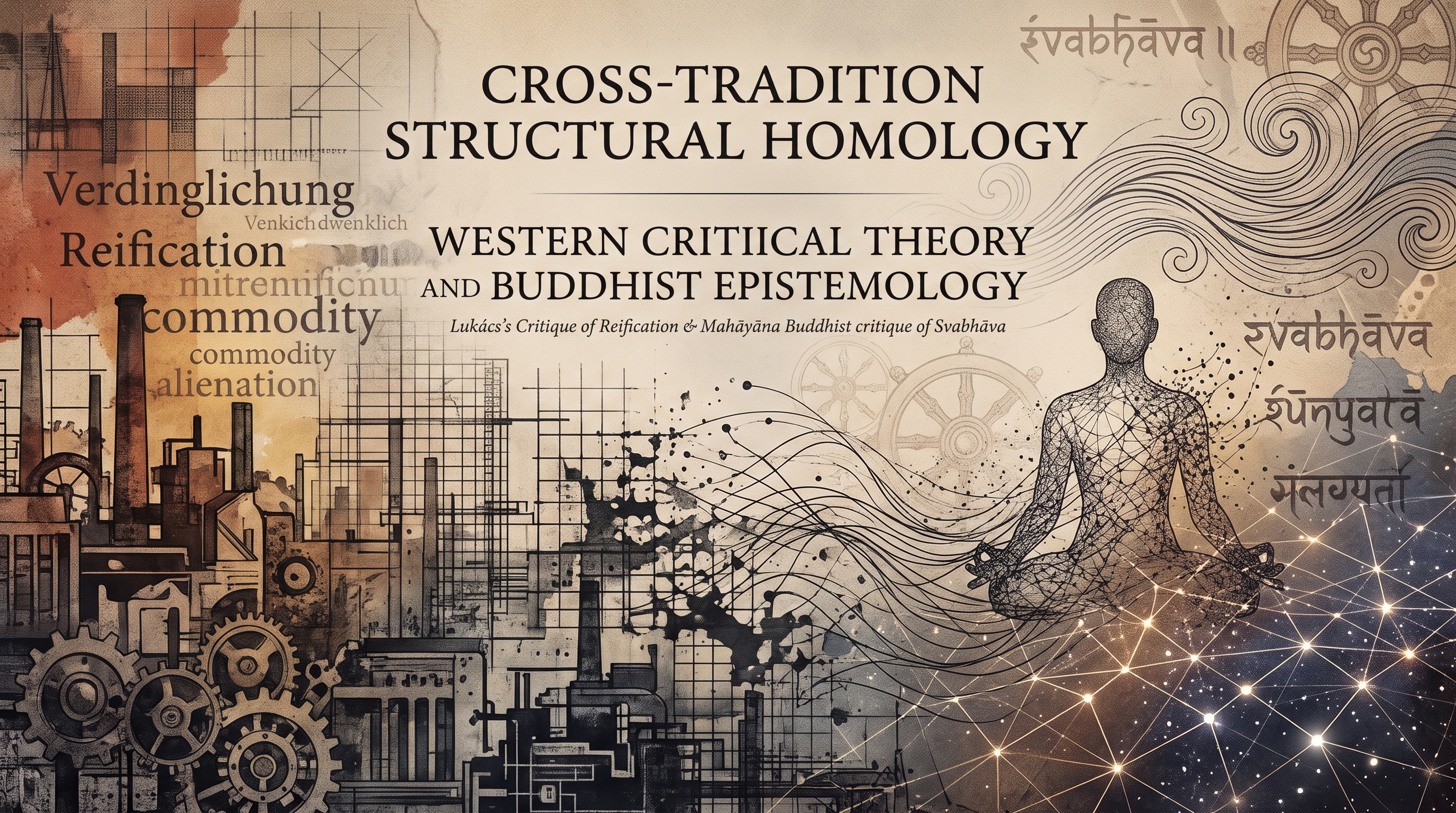
Although operating from vastly divergent historical, sociological, and metaphysical frameworks—twentieth-century historical materialism versus ancient Indian soteriology—Lukács’s critique of reification (Verdinglichung) and the Mahāyāna Buddhist critique of intrinsic existence (svabhāva) share a stunning structural homology.[10] Both traditions diagnose human suffering and alienation as a catastrophic cognitive failure: the hypostatization of dynamic, fluid, and interdependent processes into rigid, autonomous, and static things.[11]
| Analytical Dimension | Lukácsian Marxism (History and Class Consciousness) | Mahāyāna Buddhist Epistemology (Mādhyamika & Yogācāra) |
|---|---|---|
| Primary Term for Reification | Verdinglichung (thingification) & Entfremdung (alienation). | Prapañca (conceptual proliferation) & Svabhāva-grāha (grasping at intrinsic existence). |
| Surface Illusion | Phantom Objectivity (Gespenstige Gegenständlichkeit): Social relations appear as immutable natural things. | Conventional Illusion (Saṃvṛti / Parikalpita): Interdependent events appear as independent, self-existent entities. |
| Underlying Reality | Dialectical Totality: Dynamic human social labor and historical relationships in constant flux. | Dependent Origination (Pratītyasamutpāda): Radical, empty relational flux without permanent substance (Śūnyatā). |
| Subjective Distortion | The Contemplative Stance: Fragmented subject passively observing a mechanized system. | Ego-Grasping (Ātma-grāha): Consciousness reifying psychophysical skandhas into a solid, enduring "I". |
| Mechanism of Error | The Commodity Form: Quantitative exchange-value obliterates qualitative, concrete labor. | Linguistic Proliferation (Prapañca): Dualistic concepts overlay raw sensory flux with fixed labels. |
| Vehicle of Liberation | Proletarian Class Consciousness & Praxis: The commodity awakens to transform the historical totality. | Insight (Vipassanā) & Non-Dual Wisdom (Prajñā): Deconstructive analysis dissolving conceptual fabrications. |
Svabhāva and Phantom Objectivity
In the Mūlamadhyamakakārikā, Nāgārjuna establishes that unenlightened consciousness is afflicted by the instinct to project intrinsic existence (svabhāva—own-being or self-substance) onto the phenomenal world.[12] Ordinary beings perceive objects (tables, trees, human identities) as possessing solid, self-contained, and permanent cores.
Nāgārjuna demonstrates that this is an ontological delusion: all phenomena are fundamentally empty (śūnya) of intrinsic existence because they arise strictly through dependent origination (pratītyasamutpāda).[12:1]
- Lukács’s "phantom objectivity" operates as the socio-economic equivalent of svabhāva.
- Under capitalism, the commodity is treated as if value were its intrinsic, natural essence (svabhāva), concealing the reality that value is purely a relational, contingent product of human social labor.
- Nāgārjuna’s method of deconstructive dialectics serves the precise epistemological function of Lukácsian historical materialism: exposing petrified, "objective" things as fluid networks of relational interaction.[10:1]
Prapañca and Formal Rationalization
In early Buddhist psychology (such as the Madhupiṇḍika Sutta) and Yogācāra epistemology, the cognitive mechanism that drives reification is conceptual proliferation (pāli: papañca; sanskrit: prapañca).[13]
- Raw sensory experience is subjected to perceptual identification (saññā).
- The mind reflexively overlays this sensory contact with conceptual categories, dualistic boundaries (subject vs. object, mine vs. yours), and verbal projections.
- In the Yogācāra doctrine of the "Three Natures" (trisvabhāva), the parikalpita-svabhāva (the imaginary nature) describes how consciousness mistakes its own linguistic fabrications for real, external things-in-the-mselves.[14]
- This directly mirrors Max Weber’s formal rationalization and Lukács’s analysis of modern quantification: living, qualitative human experience is chopped into abstract mathematical metrics, trapping the mind within its own conceptual constructs.
Anātman and the Commodification of the Ego
For Buddhism, the foundational reification is the invention of a permanent, enduring self (ātman). Driven by existential anxiety, consciousness aggregates the five impermanent psychophysical bundles (skandhas—form, sensation, perception, volition, consciousness) and falsely unifies them into an independent "I".[13:1]
Contemporary Buddhist theorists, notably David Loy in The Great Awakening: A Buddhist Social Theory, demonstrate how late capitalism weaponizes this existential lack:[11:1]
- Because the reified ego is inherently fictitious and groundless, the alienated subject experiences a chronic, agonizing sense of existential insecurity (dukkha).
- Commodity fetishism steps in to offer a false remedy: the subject attempts to solidify its empty ego by accumulating status-symbol commodities and corporate titles.
- The consumer trades their living creative vitality to purchase material possessions, hoping to convert the phantom self into an enduring, solid monument.
The Irreducible Divergence: Historical Praxis vs. Ontological Insight
Despite their profound structural parallels, an essential philosophical divide separates Lukács from Buddhist thought:[10:2]
- Historical Specificity vs. Universal Condition: For Lukács, reification is an acute, historically contingent disease of the capitalist mode of production, destined to be resolved through political revolution and the establishment of socialism.[1:19] For Buddhism, reification (avidyā / prapañca) is a primordial, trans-historical cognitive flaw hardwired into the architecture of unenlightened consciousness, persisting across all economic epochs and social systems.[11:2]
- Objectification vs. Alienation: In his critical 1967 Preface to History and Class Consciousness, Lukács recognized that his 1923 work had mistakenly equated objectification (Vergegenständlichung—the necessary material externalization of human creativity into tools and language) with alienation/reification (Entfremdung / Verdinglichung).[1:20] Buddhism navigates this distinction through the Two Truths Doctrine (satyadvaya): conventional designations (saṃvṛti-satya) are functional and necessary tools for navigating everyday life, provided one does not mistake them for ultimate reality (paramārtha-satya).[12:2]
7. Critical Legacy, Self-Critique, and Reification 2.0
Lukács’s History and Class Consciousness sparked immediate controversy upon publication. Condemned by the Soviet Comintern under Grigory Zinoviev for "deviationism" and Western-Hegelian subjectivism, Lukács was compelled to engage in tactical political self-criticism.[15] Yet the underground influence of his reification treatise was immense, birthing the entire tradition of Western Marxism and shaping generations of social philosophers.[2:2]
| Critical Trajectory | Primary Thinkers & Texts | Evolution of Lukács's Reification Thesis |
|---|---|---|
| The Early Frankfurt School | Max Horkheimer & Theodor W. Adorno / Dialectic of Enlightenment (1944) | Extends reification into the Culture Industry (Kulturindustrie); instrumental reason dominates nature and turns back to dominate human interiority, stripping the proletariat of revolutionary consciousness. |
| Negative Dialectics | Theodor W. Adorno / Negative Dialectics (1966) | Radicalizes reification as identity thinking (Identitätsdenken): the violent conceptual reduction of the qualitative, heterogeneous object to the abstract equivalence of the concept. |
| One-Dimensional Society | Herbert Marcuse / One-Dimensional Man (1964) | Analyzes how advanced technological industrialism integrates the working class through consumer affluence and false needs, making reification total and non-repressive. |
| Communicative Rationality | Jürgen Habermas / The Theory of Communicative Action (1981) | Reformulates reification as the colonization of the lifeworld (Kolonisierung der Lebenswelt): autonomous economic and bureaucratic systems encroach upon communicatively structured social spheres. |
| Recognition & Affect | Axel Honneth / Reification: A Recognition-Theoretical View (2005) | Redefines reification not as an epistemological error, but as an affective "forgetfulness of recognition" (Anerkennungsvergessenheit): treating other persons as things by losing sight of our primary emotional empathy. |
Lukács's 1967 Self-Critique
In the famous 1967 Preface to the new edition of History and Class Consciousness, an older Lukács evaluated his youthfully brilliant work with rigorous self-criticism:[1:21]
- The Idealist Illusion of the Proletariat: Lukács admitted that his portrayal of the proletariat as the "identical subject-object of history" was an idealist, quasi-religious messianism borrowed directly from Hegel’s World Spirit. The proletariat does not automatically transcend reification through spontaneous dialectical epiphany; capitalist ideology exercises an enduring structural grip over working-class consciousness.
- The Conflation of Objectification and Alienation: He acknowledged that by failing to distinguish between material externalization (Vergegenständlichung) and reified alienation (Entfremdung), his 1923 work had painted an overly utopian picture where the overcoming of capitalism seemed to require the impossible abolition of all objective social forms.
Reification 2.0: The Contemporary Attention Economy and Algorithmic Governance
In twenty-first-century late capitalism, Lukács’s concept of reification has found its most chilling realization in digital platform capitalism, generative artificial intelligence, and the global attention economy:[16]
- The Financialization and Quantification of Affect: Social interaction, interpersonal intimacy, and creative expression are transformed into quantified behavioral data (likes, impressions, follower counts, engagement metrics). The living human soul is explicitly packaged into financial assets.
- Algorithmic Phantom Objectivity: Planetary algorithmic recommendation feeds, high-frequency financial trading algorithms, and automated credit-scoring architectures confront citizens as a hyper-modern "second nature." Even senior software engineers cannot trace or explain why deep neural networks output specific determinations. The artificial system operates with an autonomous momentum that dwarfs mortal human oversight.
- The Radicalized Contemplative Stance: Armed with smartphones, contemporary knowledge workers and consumers maintain a permanent, hyper-stimulated contemplative stance. Glued to infinite scrolls, users passively absorb an unrelenting torrent of automated cultural content, navigating their digital environments on-autopilot while experiencing cognitive exhaustion, depersonalization, and chronic burn-out.
- The Complete Commodification of the Sensorium: The human gaze, attention span, and subconscious neurological responses are bought, sold, and manipulated in real-time ad-bidding auctions. Reification is no longer merely the objective discipline of the factory floor: it is the total internal engineering of human subjectivity itself.
🎴 Interactive Web Practice (Comprehension Check)
Question 1 (The Triadic Foundation & Phantom Objectivity): How does Georg Lukács synthesize the insights of Karl Marx, Max Weber, and Georg Simmel into his concept of reification (Verdinglichung), and what does he mean by "phantom objectivity" (gespenstige Gegenständlichkeit)?
Answer: Georg Lukács constructs his theory of reification by synthesizing three distinct intellectual pillars into a unified critique of modern capitalist society:
- Karl Marx (Commodity Fetishism): From Marx's Capital, Lukács draws the foundational insight that under capitalism, the social relationships between human producers take on the illusory, fantastic appearance of a relationship between physical things (commodities and market prices).
- Max Weber (Formal Rationalization & Calculability): From Weber, Lukács incorporates the concepts of formal rationality (Zweckrationalität), bureaucratic organization, and the relentless mathematical quantification of human activity, which encases society in a functional, rigid "iron cage."
- Georg Simmel (The Tragedy of Culture): From Simmel's The Philosophy of Money, Lukács adopts the insight that externalized objective cultural artifacts and monetary instruments develop an autonomous internal momentum (Eigengesetzlichkeit) that alienates and dominates subjective human cultivation (Bildung). Lukács historicizes Simmel's tragic fatalism, demonstrating that this cultural alienation is the specific historical result of the universalized commodity form.
Question 2 (The Contemplative Stance & Antinomies of Bourgeois Thought): What is the "contemplative stance" (kontemplative Haltung) produced by reification, and how do classical German philosophy's unresolved antinomies (such as Kant's Ding an sich) reflect this socio-economic condition?
Answer:
The Contemplative Stance (Kontemplative Haltung): Because modern industrial production and bureaucratic administration are organized around automated, calculated subroutines, the individual subject is stripped of genuine creative agency. The factory laborer, office clerk, or corporate manager becomes a passive, detached spectator watching an external mechanical process unfold. Time is spatialized into measurable clock-units, while the worker's own physical and intellectual faculties are separated from their personality and sold as quantifiable commodities. Rather than actively shaping history, the reified individual passively observes the self-regulating apparatus, navigating social reality on autopilot.
The Antinomies of Bourgeois Thought: In his critique of classical German philosophy (Kant, Fichte, Hegel), Lukács demonstrates that the chronic philosophical impasses of modern thought directly mirror the reified division of labor in capitalist society:
- The Split between Subject and Object / Form and Content: Reification severs human thought from living material reality. Thinkers like Immanuel Kant develop formal, mathematical systems of understanding that can organize appearances, but remain completely incapable of grasping the concrete, qualitative essence of reality.
- The Unknowable "Thing-in-Itself" (Ding an sich): Kant's doctrine that human reason can only know phenomenal appearances while the true nature of things remains permanently unknowable is the direct philosophical projection of reification. Because bourgeois thought accepts the capitalist market and its reified categories as eternal natural laws, it cannot perceive the underlying historical process of human labor. Whenever bourgeois philosophy attempts to grasp the social totality, it hits an insurmountable barrier: the qualitative historical core eludes its formal categories and is mystified as the unknowable Ding an sich.
Question 3 (The Identical Subject-Object vs. Buddhist Epistemology): Why does Lukács designate the proletariat as the "identical subject-object of history," and how does his critique of reification structurally compare to the Mahāyāna Buddhist deconstruction of intrinsic nature (svabhāva)?
Answer:
The Proletariat as the Identical Subject-Object: Unlike the bourgeoisie—whose class privileges depend upon maintaining the reified illusion that capitalist relations are eternal—the proletariat occupies a unique structural position:
- The worker enters capitalism directly as an objectified commodity (labor-power).
- When the worker achieves class consciousness, they do not discover an external theoretical concept; they realize that their own physical vitality, time, and life-energy have been commodified.
- In this moment, the commodity becomes conscious of itself. The subject who knows and the object that is known become identical. The worker recognizes that the entire objective apparatus of capitalism is nothing other than their own alienated, collective labor. This self-recognition is not passive contemplation, but revolutionary praxis that ruptures the illusion of phantom objectivity.
Structural Comparison to Mahāyāna Buddhism:
- Svabhāva vs. Phantom Objectivity: In Nāgārjuna's Mādhyamika philosophy, the core cognitive error of unenlightened beings is projecting intrinsic, independent existence (svabhāva) onto phenomena. Nāgārjuna shows that all things are "empty" (śūnya) because they arise strictly through dependent origination (pratītyasamutpāda). Similarly, Lukács demonstrates that commodities do not possess intrinsic value; value is a reified illusion masking the dynamic, relational process of human labor.
- Prapañca vs. Formal Rationalization: In Buddhist psychology, conceptual proliferation (prapañca) freezes the fluid flux of sensory reality into rigid, dualistic labels (self vs. other, subject vs. object). This directly parallels how capitalist rationalization chops organic human life into abstract, calculable units.
- Key Divergence: Lukács views reification as a historically specific pathology of capitalism that must be overcome through historical revolution and political praxis. Buddhism views reification as a universal cognitive delusion inherent in unenlightened consciousness, requiring internal meditative insight (vipassanā) and non-dual wisdom (prajñā) to dissolve the illusion of an enduring ego (anātman).
Resonant Notes
The following notes in the vault share direct thematic, sociological, and philosophical connections with Georg Lukács's formulation of reification:
🟣 Core Lexical Syllabus & Applied Metaphoric Expressions
- a-facade (Buildings & Structures) — Illustrates how the "phantom objectivity" (gespenstige Gegenständlichkeit) of capitalist social relations erects an outward display of immutable, natural necessity, constructing a deceptive facade of technical rationality that conceals dynamic human labor and historical contingency.
- in-plain-sight (Light & Vision) — Captures Marx and Lukács's critique of commodity fetishism, demonstrating how the foundational reality of capitalist value—crystallized human social labor—operates in plain sight across every market transaction, yet remains systematically invisible to habituated, reified consciousness.
- like-clockwork (Time & Measurement) — Articulates the formal rationalization (Zweckrationalität) and mechanical calculability of the modern factory and bureaucracy, operating like clockwork with relentless precision while spatializing qualitative human duration into measurable, interchangeable clock-time.
- cog-in-the-machine (Machines & Mechanics) — Conceptualizes the mutilating division of labor (Arbeitsteilung), wherein the living worker is fractured into an interchangeable, subordinate cog in the machine, executing specialized, repetitive subroutines stripped of creative autonomy or holistic purpose.
- on-autopilot (Machines & Mechanics) — Frames the dissociative psychological defense of the "contemplative stance" (kontemplative Haltung), where the alienated worker and modern consumer navigate social reality on autopilot, passively observing automated mechanical and algorithmic workflows without active conscious agency.
- cut-from-the-same-cloth (Weaving, Textiles & The Loom) — Diagnoses the universal colonization of modern institutional life under the commodity form, revealing that mechanized factory labor, legal-rational jurisprudence, state bureaucracy, and commercial journalism are all cut from the same cloth of formal quantification and abstract calculability.
- blind-spot (Light & Vision) — Epitomizes the fatal epistemological limitation of bourgeois philosophy and specialized sciences, which investigate compartmentalized empirical data with rigorous technical precision while harboring an insurmountable blind spot regarding the socio-historical totality.
- collapse-under-its-own-weight (Buildings & Structures) — Diagnoses the structural crisis of hyper-specialized bourgeois empiricism, wherein towering edifices of fragmented data, isolated disciplines, and reified metrics threaten to collapse under their own weight because they lack the unifying, dialectical category of totality.
- unravel (Weaving, Textiles & The Loom) — Symbolizes the revolutionary threshold where the commodity awakens to self-consciousness as the identical subject-object of history, causing the reified illusions of "second nature" and the fatalistic grip of bourgeois hegemony to systematically unravel from within.
- burn-out (Fire & Heat) — Reflects the terminal consequence of twenty-first-century reification (Reification 2.0) across algorithmic platform capitalism and the global attention economy, where total sensorium commodification and continuous partial attention push human neurology to acute burn out.
🔴 Classical Sociology, Critical Theory & Marxist Dialectics
- Karl Marx - Economic and Philosophic Manuscripts of 1844 — Marx's early Paris manuscripts analyzing estranged labor (Entfremdung), species-being (Gattungswesen), and the inversion of subject and object, which Lukács brilliantly anticipated a decade before their historical rediscovery.
- Georg Simmel's Tragedy of Culture — Simmel's foundational diagnosis of the widening chasm between cumulative objective culture (Objektive Kultur) and finite subjective cultivation (Subjektive Kultur), which Lukács historicized as the universalization of the commodity form.
- Georg Simmel (1858-1918) — Intellectual profile of Lukács's early mentor, exploring formal sociology, the geometry of sociation, and the dialectic of life (Leben) and form (Form).
- The Philosophy of Money (Philosophie des Geldes) — Simmel's magnum opus detailing how monetary calculability, quantification, and the inversion of teleological chains convert human qualitative life into cold abstractions.
- Max Weber (1864-1920) — Weber's sociology of formal rationalization (Zweckrationalität), legal-rational bureaucracy, and the "iron cage" (stahlhartes Gehäuse), serving as the structural blueprint for Lukács's critique of capitalist factory organization.
- Durkheimian Sociology and Reified Gestalt — Explores Émile Durkheim's formulation of social facts as things (choses) exerting coercive external force, providing an alternative sociological perspective on institutional reification.
- The Social Construction of Reality - A Treatise in the Sociology of Knowledge — Peter Berger and Thomas Luckmann's phenomenological sociology, tracing how human typifications and institutional habituations undergo historical "reification" into objective realities.
- Jürgen Habermas's The Structural Transformation of the Public Sphere — Habermas's Critical Theory of public communication, later culminating in The Theory of Communicative Action, which reformulates reified alienation as the systemic colonization of the communicative lifeworld.
🟡 Urban Modernity, Formal Rationalization & Systems of Control
- The Metropolis and Mental Life — Simmel's landmark urban treatise examining how the sensory deluge (Steigerung des Nervenlebens) and monetary exchange force the modern metropolitan subject to adopt an unreadable poker-face and the intellectual shield of the blasé attitude (Die Blasiertheit).
- The flâneur — The quintessential modern archetype of urban observation; moves through the metropolitan commodity spectacle oscillating between aesthetic fascination and alienated, contemplative detachment.
- Walter Benjamin’s Theses on the Philosophy of History — Benjamin's radical critique of linear, bourgeois historicism and the myth of automatic progress, synthesizing Lukácsian totality with messianic Jewish theology.
- The Work of Art in the Age of Mechanical Reproduction — Benjamin's exploration of how industrial mass reproduction strips the traditional aesthetic object of its unique "aura" (Aura), mirroring the reifying dissolution of qualitative craftsmanship.
- Postscript on the Societies of Control — Gilles Deleuze's formulation of contemporary algorithmic modulation, where individuals are fragmented into digital data points (Dividual), fulfilling the terminal stage of reified quantification.
- McLuhan's The Medium is the Message — Marshall McLuhan's media ecology, demonstrating how the formal structural properties of technological media reconfigure human cognition beneath the threshold of conscious awareness, acting as a cognitive sleight of hand.
- Innis (1951) - The Bias of Communication — Harold Innis's political economy of communication, analyzing how technological media establish institutional monopolies of knowledge that dominate subjective agency across space and time.
- Don DeLillo Major Themes Analysis — DeLillo's postmodern literature dramatizing the triumph of corporate commodity fetishism, consumer reification, and media white noise over authentic existential subjectivity.
🟢 Cognitive Epistemology, Phenomenology & Buddhist Philosophy
- The Digital Infrastructure of Delusion-A Buddhist Economic and Psychological Analysis of Corporate Culture — Comprehensive synthesis of Buddhist economics, organizational sociology, and institutional delusion, investigating how modern corporations operationalize institutionalized greed, aversion, and reified delusion (moha).
- Vasubandhu's-Triṃśikā-vijñaptimātratā — Classical Yogācāra treatise on the "Thirty Verses on Representation-Only," dissecting the Three Natures (trisvabhāva) and showing how consciousness reifies its own internal projections into external things (parikalpita-svabhāva).
- Three Marks of Existence — Analysis of impermanence (anitya), suffering/unsatisfactoriness (dukkha), and non-self (anātman); exposes the metaphysical impossibility of finding permanent, substantial security in reified commodities.
- The Dhammapada — Core Theravāda scripture articulating the psychological primacy of the mind in constructing reality, warning against the attachments born of conceptual delusion and sensory craving (taṇhā).
- Traditional vs. Secular Buddhist vs. General Spiritual Teachers — Contrastive analysis of modern secular interpretations of Buddhism and their intersection with social critique, existential phenomenology, and consumerist co-optation.
- William James and the Landscape of Eastern Thought — Explores Jamesian radical empiricism, the continuous "stream of consciousness," and the philosophical critique of intellectualist reification, bridging Western pragmatism and Eastern non-dualism.
References
Georg Lukács / History and Class Consciousness: Studies in Marxist Dialectics (Geschichte und Klassenbewußtsein, 1923) / Translated by Rodney Livingstone / MIT Press ↩︎ ↩︎ ↩︎ ↩︎ ↩︎ ↩︎ ↩︎ ↩︎ ↩︎ ↩︎ ↩︎ ↩︎ ↩︎ ↩︎ ↩︎ ↩︎ ↩︎ ↩︎ ↩︎ ↩︎ ↩︎ ↩︎
Andrew Feenberg / The Philosophy of Praxis: Marx, Lukács and the Frankfurt School / Verso Books ↩︎ ↩︎ ↩︎
Karl Marx / Capital: A Critique of Political Economy, Volume I (Chapter 1, Section 4: "The Fetishism of the Commodity and Its Secret") / Marxists Internet Archive ↩︎
Max Weber / Economy and Society: An Outline of Interpretive Sociology / Edited by Guenther Roth and Claus Wittich / University of California Press ↩︎
Georg Simmel / The Philosophy of Money (Philosophie des Geldes, 1900) / Translated by Tom Bottomore and David Frisby / Routledge ↩︎
Lucien Goldmann / Lukács and Heidegger: Towards a New Philosophy / Translated by William Q. Boelhower / Routledge & Kegan Paul ↩︎ ↩︎ ↩︎ ↩︎ ↩︎
Martin Jay / Marxism and Totality: The Adventures of a Concept from Lukács to Habermas / University of California Press ↩︎
Immanuel Kant / Critique of Pure Reason (Kritik der reinen Vernunft, 1781/1787) / Translated by Paul Guyer and Allen W. Wood / Cambridge University Press ↩︎
G. W. F. Hegel / Phenomenology of Spirit (Phänomenologie des Geistes, 1807) / Translated by A. V. Miller / Oxford University Press ↩︎
Ross Abbinnett & Garry Potter / Buddhism and Critical Theory: Parallel Critiques of Reification / PhilPapers ↩︎ ↩︎ ↩︎
David R. Loy / The Great Awakening: A Buddhist Social Theory / Wisdom Publications ↩︎ ↩︎ ↩︎
Jay L. Garfield / The Fundamental Wisdom of the Middle Way: Nāgārjuna's Mūlamadhyamakakārikā / Oxford University Press ↩︎ ↩︎ ↩︎
Bhikkhu Ñāṇananda / Concept and Reality in Early Buddhist Thought: An Essay on Papañca and Papañca-Saññā-Saṅkhā / Buddhist Publication Society ↩︎ ↩︎
Dan Lusthaus / Buddhist Phenomenology: A Philosophical Investigation of Yogācāra Buddhism / Routledge ↩︎
Leszek Kołakowski / Main Currents of Marxism: The Breakdown / Oxford University Press ↩︎
Shoshana Zuboff / The Age of Surveillance Capitalism: The Fight for a Human Future at the New Frontier of Power / PublicAffairs ↩︎