Henri Bergson’s Creative Evolution
🗂️ Interactive Notebook: Open Study Companion (Video Summary, Flashcards, Mind Map) ↗
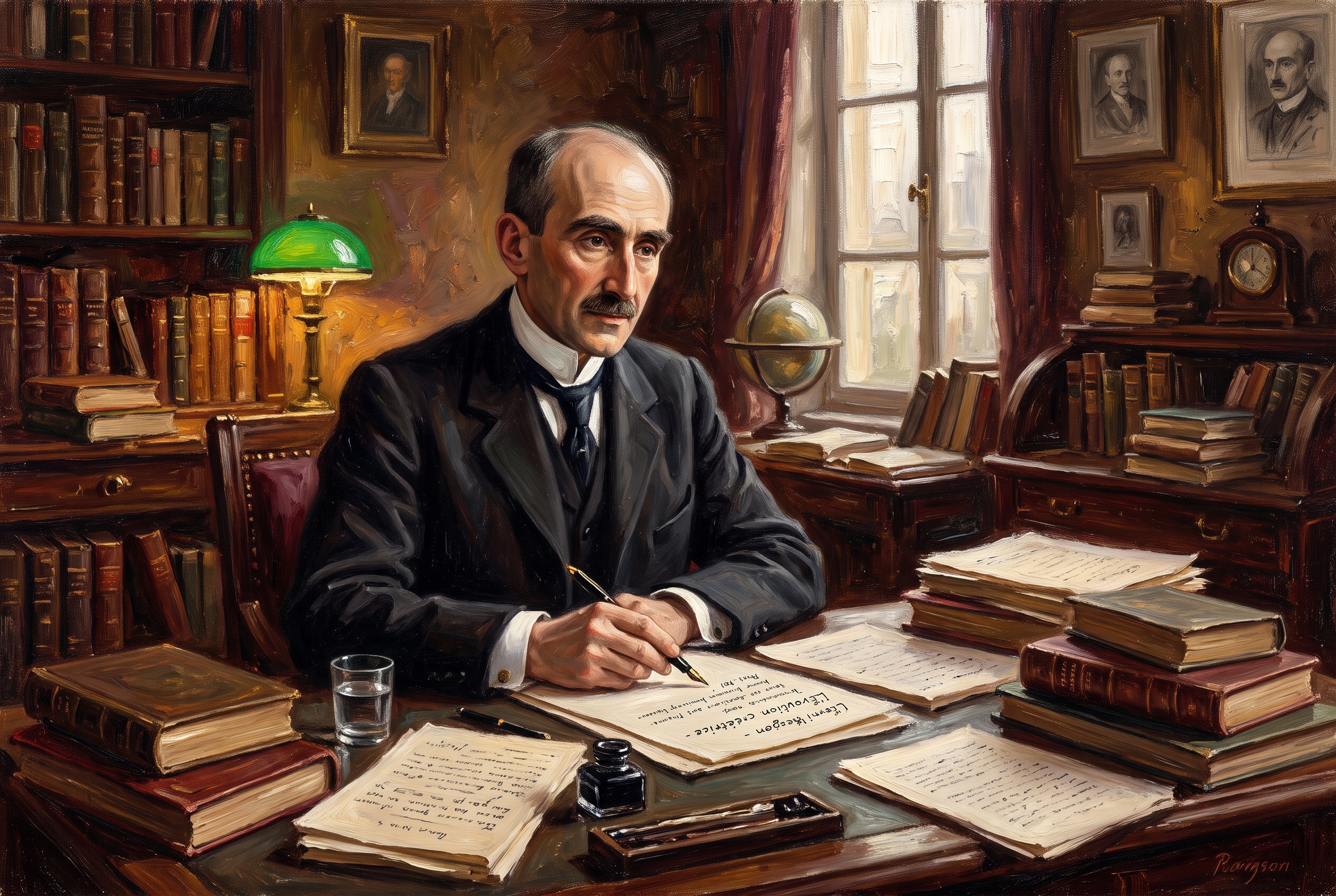
Published in 1907 (L'Évolution créatrice) and translated into English in 1911 by Arthur Mitchell, Henri Bergson's Creative Evolution stands as a monumental masterpiece of early twentieth-century process philosophy, biological metaphysics, and evolutionary epistemology.[1] Extending his psychological concept of lived duration (la durée) into cosmology and evolutionary biology, Bergson challenges the twin dogmas of nineteenth-century thought: radical mechanism (materialist determinism) and radical finalism (teleological design; cf. The Organic Analogy and Ghost in the Machine).[2]
Bergson demonstrates that biological evolution is neither an accidental collision of mechanical parts nor the predetermined execution of a cosmic blueprint. Instead, evolution is propelled by an original, creative surge—the élan vital (vital impetus; explored in Vital Materialism)—which continuously generates radical, unrepeatable novelty as it struggles against and organizes resistant physical matter.[1:1][3] Along divergent evolutionary trajectories, this vital impulse dissociates into vegetative torpor, animal instinct, and human intelligence (Homo faber). To overcome the spatializing, cinematographical limits of the intellect, Bergson advocates for intuition—an intellectual sympathy that allows consciousness to coincide with the living, undivided becoming of reality itself (cf. Husserl's Internal Time-Consciousness and The Interface Theory of Perception (ITP)).[4]
| Analytical Dimension | Radical Mechanism (Scientific Materialism) | Radical Finalism (Teleological Design) | Bergsonian Creative Evolution (Élan Vital) |
|---|---|---|---|
| Primary Driver | Random genetic accident, mechanical sorting, physico-chemical laws. | Pre-existing cosmic plan, divine telos, external blueprint. | Original, creative vital impetus (élan vital) surging through matter. |
| Status of Time | Repetitive: Time is an inert screen; the future is calculable from the present. | Illusory: Time merely unfolds what was already pre-ordained; "all is given." | Creative Duration (La Durée): Irreversible, cumulative, generating radical novelty (cf. Time as Change). |
| Evolutionary Trajectory | Passive adaptation to fixed external environmental niches. | Harmonious convergence toward a pre-determined cosmic goal. | Divergent, open-ended bifurcations into torpor, instinct, and intellect. |
| Conception of Organisms | Complex clockwork machines assembled from discrete physical components (cf. Ghost in the Machine). | Realization of a pre-established archetypal form or divine intention. | Dynamic centers of indeterminacy and action striving for freedom against matter. |
| Core Epistemological Error | Spatializes life into static parts; mistakes retrospective analysis for creation. | Inverts mechanism by placing the machine's blueprint at the finish line. | Recognizes that genuine creation cannot be anticipated by conceptual molds. |
1. Historical Context and Philosophical Ambition
During the late nineteenth and early twentieth centuries, European intellectual life was trapped between a suffocating positivist materialism and neo-Kantian or scholastic idealism.[2:1] The triumphant rise of classical mechanics, thermodynamics (cf. Entropy and Ludwig Boltzmann (1844-1906)), and neo-Darwinian evolutionary theory had fostered a widespread deterministic consensus: the cosmos was conceived as an immense, automatic machine governed by blind physical laws, in which consciousness was reduced to an epiphenomenal byproduct of cerebral mechanics.[2:2]
Having established his international reputation with Time and Free Will (1889)—which introduced lived duration (la durée)—and Matter and Memory (1896)—which formulated the brain as an eliminative filter for action (analyzed in Bergson’s Eliminative Model of Perception and Memory and Henri Bergson)—Bergson spent over a decade conducting rigorous research into biology, embryology, physiology, and paleontology.[2:3] He engaged closely with the evolutionary theories of Charles Darwin (1809–1882), Jean-Baptiste Lamarck, August Weismann, and Hugo de Vries, seeking to bridge empirical biology with speculative metaphysics.[2:4][5]
Published in Paris in 1907, L'Évolution créatrice became an immediate global sensation. It catapulted Bergson into unprecedented international prominence, drawing admirers ranging from William James in America to George Bernard Shaw in England, and directly contributing to his 1927 Nobel Prize in Literature.[1:2][2:5] Bergson's grand ambition was to construct an evolutionary philosophy that redeemed human freedom, temporal duration, and organic creativity from mechanistic reductionism without lapsing into theological dogmatism.[3:1]
Bergson structures his treatise across four rigorously developed chapters, progressing from biological critique to metaphysical ontology and epistemology:[4:1]
- Chapter I: The Evolution of Life — Mechanism and Teleology: Critiques mechanistic materialism and teleological finalism; establishes lived duration (la durée) as a biological reality (cf. Time as Change); introduces the élan vital and the challenge of convergent evolution.[1:3][4:2]
- Chapter II: The Divergent Directions of the Evolution of Life: Rejects linear evolutionary ladders; maps the explosive dissociation of the vital impetus into vegetative torpor, arthropod instinct, and vertebrate intelligence (Homo faber).[4:3][5:1]
- Chapter III: On the Meaning of Life — The Order of Nature and the Form of Intelligence: Investigates the simultaneous co-genesis of the analytical intellect and spatialized matter (cf. The Interface Theory of Perception (ITP)); deconstructs the pseudo-problems of "disorder" and "nothingness" (cf. Two Kinds of Nothingness-Astrophysics and Buddhist Philosophy).[3:2][4:4]
- Chapter IV: The Cinematographical Mechanism of Thought and the Mechanistic Illusion: Critiques the spatializing bias of Western metaphysics from Plato to Kant; unmasks the cinematographical illusion of the intellect (anticipating Marshall McLuhan (1911-1980), McLuhan's The Medium is the Message, and The Work of Art in the Age of Mechanical Reproduction); formulates philosophical intuition as the faculty of metaphysical insight.[4:5][5:2]
2. Duration (La Durée) as Biological Reality
At the foundation of Creative Evolution lies Bergson's essential distinction between spatialized time and lived duration (la durée) (examined further in Time as Change and Husserl's Internal Time-Consciousness).[1:4][6]
| Temporal Conception | Structural Progression | Dynamic Characteristics |
|---|---|---|
| Spatialized Clock Time | Discrete, external points juxtaposed across an inert spatial axis. | |
| Lived Duration (La Durée) | Past | Continuous, cumulative swell preserving the whole past in organic becoming. |
In the inanimate physical world investigated by classical physics, time functions as an abstract, homogeneous, and reversible parameter (
By contrast, an organic living being exists in duration:[5:4]
-
The Snowball of the Past: An organism preserves its entire history within its present state. Just as a snowball rolling down a hillside continuously accumulates snow, an organic form swells with its own elapsed duration. The past gnaws into the future, expanding irreversibly as it advances.[6:2]
-
Irreversibility and Novelty: Because every succeeding moment carries the weight of all prior moments, an organism never passes through the identical state twice—a principle echoing Heraclitus (c. 500 BCE)'s ancient doctrine of unceasing flux (panta rhei). Biological evolution is fundamentally irreversible: no species or complex organ can ever return to a prior historical configuration.[2:6][6:3]
-
The Sugar Lump Metaphor: Bergson demonstrates that duration is an irreducible metaphysical reality through the physical act of dissolving sugar in a glass of water:[6:4]
"If I want to mix a glass of sugar and water, I must, willy-nilly, wait until the sugar melts. This little fact is big with meaning. For here the time I have to wait is not that mathematical time which would apply equally well to the entire history of the material world... It coincides with my impatience, that is to say, with a certain portion of my own duration, which cannot be lengthened or shortened at will." — Henri Bergson, Creative Evolution[6:5]
The melting of sugar is not an abstract mathematical equation; it demands real, qualitative waiting, proving that physical processes unfold within an intrinsic temporal cadence that cannot be arbitrarily compressed.
| Dimension | Spatialized Scientific Time (Le Temps Spatialisé) | Qualitative Lived Duration (La Durée) |
|---|---|---|
| Ontological Domain | Inanimate physical systems, classical mechanics, geometry. | Biological organisms, conscious experience, evolutionary history. |
| Structure of Multiplicity | Quantitative multiplicity: discrete, juxtaposed, countable units. | Qualitative multiplicity: continuous, interpenetrating, indivisible flow. |
| Temporal Dynamic | Succession without interpenetration; static coordinates on a grid. | Interpenetration without spatial succession; continuous preservation of the past. |
| Predictability | Strictly deterministic; calculable in advance by Laplace's demon. | Radically open-ended, spontaneous, generating unforeseen novelty. |
| Epistemological Faculty | Intellect: Analyzes, measures, and freezes motion into static models. | Intuition: Enters sympathetically into the inner temporal surge. |
3. The Critique of Mechanism and Finalism
Bergson argues that whenever human thought attempts to grasp biological evolution, it reflexively falls into one of two explanatory illusions, both of which deny the reality of time:[1:5][3:3]
Radical Mechanism: The Myth of the Assembly Line
Radical mechanism (encompassing Newtonian physics, nineteenth-century physico-chemical reductionism, and strict neo-Darwinian selection) treats living organisms as machines assembled from pre-existing physical parts (anticipating Gilbert Ryle's critique in Gilbert Ryle's-The Concept of Mind and Ghost in the Machine).[2:7] Mechanism asserts that every biological change is caused by antecedent physical forces, so that if a superhuman intellect (Laplace's demon) possessed complete knowledge of every atom's position and velocity, the entire future of the organic world could be calculated with mathematical certainty.[2:8][3:4]
Bergson exposes the core fallacy of mechanism: it treats time as an inert, impotent screen.[3:5] Under mechanism, nothing genuinely new ever emerges; evolution is merely the spatial reshuffling of pre-existing units. Furthermore, mechanism fails to explain convergent evolution:[1:6]
- The complex camera eye of the vertebrate and the complex eye of the common mollusk (Pecten) possess virtually identical anatomical structures (cornea, retina, lens, cellular layers), yet they evolved along completely independent evolutionary lineages separated since the Precambrian era.[1:7][6:6]
- Accidental, random variations accumulating mechanically could never assemble the same intricate, synchronized, multi-tissue organ across divergent phylogenetic branches without collapsing the organism's sight during intermediate stages.[1:8]
Radical Finalism: Inverted Mechanism
To escape mechanism, traditional metaphysics and theology turn to radical finalism (teleology), asserting that evolution unfolds according to a pre-determined cosmic blueprint, divine plan, or ultimate goal (telos; cf. The Organic Analogy in classical sociology).[1:9][3:6]
Bergson demonstrates that finalism is merely mechanism turned on its head:[3:7]
- Instead of being pushed from behind by mechanical causes, living beings are pulled from ahead by a pre-established plan.
- In both systems, "all is given" (tout est donné) in advance.[3:8] In finalism, time is stripped of its creative efficacy; the future contains nothing that was not already pre-figured in the divine mind or cosmic seed. Genuine surprise, evolutionary innovation, and authentic freedom are liquidated.[3:9]
"In vain we force the living into this or that one of our molds. All the molds crack. They are too narrow, above all too rigid, for what we try to put into them." — Henri Bergson, Creative Evolution[6:7]
4. The Élan Vital and the Divergent Lines of Life
To transcend the impasse between mechanism and finalism, Bergson introduces the foundational concept of the élan vital (vital impetus): an original, dynamic surge of life that carries organic evolution forward through geological epochs (a vitalist ontology directly re-evaluated in modern political ecology by Vital Materialism and Animism).[1:10][2:9]
| Evolutionary Branch (Élan Vital) | Representative Realm | Primary Adaptation | Mode of Consciousness & Action |
|---|---|---|---|
| Vegetative Torpor | Flora / Plant kingdom | Direct carbon fixation, immobility, solar energy storage | Dormant consciousness; passive organic synthesis. |
| Instinct | Arthropods / Social insects (Hymenoptera) | Innate, specialized biological organs used as tools | Direct, unreflective sympathetic action with living matter. |
| Intelligence | Vertebrates / Humans (Homo faber) | Fabrication and manipulation of artificial, unorganized tools | Reflective, analytical, spatializing mastery over inert matter. |
The Artillery Shell Metaphor
Unlike a teleological plan that draws diverse lines together toward a single harmonious goal, the élan vital operates by dissociation and divergence.[1:11][6:8] Bergson compares the vital impulse to an artillery shell that bursts into fragments, which are themselves shells that burst into further fragments.[1:12][6:9]
- The original vital impulse contains an unstable multiplicity of virtual tendencies packed together in mutual interpenetration.[2:10]
- Because it cannot sustain all tendencies within a single physical form, the impulse fractures as it advances, distributing different vital functions across distinct phylogenetic lineages.[1:13][6:10]
Matter as Resistance and Inverted Movement
Why does the élan vital fracture? Bergson explains that life does not operate in an abstract void; it encounters inert physical matter:[1:14][2:11]
- Matter as Inverted Vitality: In Chapter III, Bergson reveals that physical matter is not a permanent, self-sufficient substance; it represents the descent, relaxation, or unwinding of the creative surge, akin to steam that condenses into falling water droplets when its upward energy is spent.[3:10][6:11] Matter is necessity, inertia, geometric spatiality, and entropy.
- Life as the Upward Effort: Life is the reverse movement—an uphill climb that strives to inject freedom, indeterminacy, and creative choice into resistant physical necessity (analyzed in Control and Vital Materialism).[2:12] Life captures solar energy from the sun, concentrates it within organic chemical bonds, and releases it in unpredictable, variable motor actions.[2:13][6:12]
5. Torpor, Instinct, and Intelligence (Homo Faber)
In Chapter II, Bergson rejects the Aristotelian and Spencerian doctrine of the scala naturae—the erroneous view that evolution is a single, unilinear ladder ascending from simple microbes to plants, animals, and humans (a conceptual bias critiqued in The Organic Analogy and Philosophy of Mind).[4:6][5:5] Evolution is not a straight staircase, but a branching tree. As the élan vital bifurcates, it develops three primary evolutionary solutions to the challenge of material resistance:[4:7][5:6]
| Dimension of Life | Vegetative Torpor (Plants) | Instinct (Arthropods / Hymenoptera) | Intelligence (Vertebrates / Humans) |
|---|---|---|---|
| Primary Physical Focus | Carbon fixation; direct synthesis of organic food from minerals and sunlight. | Sensory-motor action using innate biological organs as tools. | Manufacturing and manipulating unorganized, artificial tools from inert solids. |
| Organ of Action | None; immobile roots and passive leaves. | Organized, biological tools: stings, mandibles, specialized bodily anatomy. | Unorganized, artificial tools: stone axes, hammers, microchips, machines. |
| Cognitive Faculty | Dormant consciousness; unconscious vegetative torpor. | Instinct: Direct, intuitive, unreflective sympathy with living objects. | Intellect: Analytical, conceptual, spatializing, tool-making (Homo faber). |
| Flexibility vs. Precision | Zero behavioral mobility; fixed to geographical soil. | Infallible precision on specific tasks, but completely rigid and incapable of innovation. | Clumsy and hesitant initially, but infinitely variable, innovative, and self-correcting. |
| Object of Mastery | Solar energy capture and chemical storage. | Vital, living organic processes (e.g., paralyzing prey without killing it). | Inert, solid, unorganized physical matter; spatial geometry and mechanics. |
| Culmination in Nature | Trees, flora, marine algae. | Ants, bees, wasps, social spiders. | Human civilization (Homo faber evolving toward Homo sapiens). |
The Epistemological Paradox of Instinct and Intelligence
Bergson articulates the tragic epistemic divergence separating instinct and intellect in a celebrated maxim:[1:15][6:13]
"There are things that intelligence alone is able to seek, but which, by itself, it will never find. These things instinct alone could find; but it will never seek them." — Henri Bergson, Creative Evolution[6:14]
- Intelligence: Possesses the capacity to inquire, analyze, and build theories, but because it evolved to manipulate dead, inert solids, it treats everything—including living organisms and time itself—as static, spatial, and mechanical (analyzed in The Mind-Body Dichotomy and Perception vs. Apperception). It seeks the secret of life, but its analytical knives dissect life into dead parts.[5:7][6:15]
- Instinct: Operates from within the living flow via direct sympathy with organic reality (such as the solitary wasp Ammophila stinging the exact nerve centers of a caterpillar to paralyze it without killing it, providing fresh food for its larvae). Yet instinct is bound to immediate survival; it cannot reflect upon itself, ask philosophical questions, or enlarge its scope.[5:8][6:16]
6. Intellect, Matter, and the Cinematographical Illusion
In Chapters III and IV, Bergson diagnoses why human philosophy and natural science consistently falsify the nature of reality.[4:8][5:9]
The Co-Genesis of Intellect and Spatialized Matter
Bergson formulates an evolutionary epistemology: the human intellect and spatial matter have co-evolved and mutually adapted to one another.[3:11][4:9]
- The intellect is not a transcendent, disinterested spectator engineered for pure metaphysical contemplation.
- It is the mental equipment of Homo faber (man the tool-maker).[6:17] Its evolutionary purpose is to cut, carve, assemble, and manipulate inert solids for practical physical survival—an evolutionary model directly formalized in contemporary cognitive science by The Interface Theory of Perception (ITP) and the biocognitive gating of the Default Mode Network (DMN).
- Consequently, the intellect is fascinated by stability, solids, repetition, and geometry. When confronted with movement, qualitative change, and life, it instinctively freezes them into discrete spatial coordinates.[5:10][6:18]
Deconstructing Philosophical Pseudo-Problems
Bergson demonstrates that two of the most famous perplexities in Western philosophy—"disorder" and "nothingness"—are cognitive mirages produced by the practical habits of the intellect:[3:12][6:19]
- The Illusion of Disorder: Disorder does not exist in nature. When we encounter what we call "disorder," we are merely experiencing the presence of an unexpected order (e.g., vital, organic, or artistic order) when our analytical intellect was expecting a geometric or automatic order.[3:13][6:20]
- The Illusion of Nothingness (Le Néant): The ancient question—"Why is there something rather than nothing?"—is a pseudo-problem (examined in Two Kinds of Nothingness-Astrophysics and Buddhist Philosophy). The concept of "Nothingness" is not simpler than "Something"; it is cognitively and logically richer. To conceive of nothingness, one must first conceive of "Everything," and then perform an additional, voluntary intellectual act of mental erasure and negation.[3:14][6:21]
The Cinematographical Mechanism of Thought
Bergson's most celebrated epistemological analogy compares the human intellect to a motion-picture projector (cinematograph):[4:10][5:11]
| Perspective / Level | Operational Mode | Temporal Structure | Epistemic Reality |
|---|---|---|---|
| Continuous Reality | Living indivisible flux | Unbroken, qualitative flow through duration | Genuine, undivided becoming. |
| Cinematographical Intellect | Series of static frames ( | Frozen, juxtaposed snapshots strung on a timeline | Simulated motion reconstructing flux from static immobility. |
- The Illusion: A cinema camera recreates movement across a screen by capturing thousands of static, immobile photographic snapshots and running them through a projector. The camera never captures movement itself; it captures motionless frames, relying on the external mechanical apparatus to simulate motion.[5:12][6:22]
- The Epistemic Error: In the identical manner, the human intellect slices the undivided temporal flow of reality into static concepts, words, and spatial points (
). It then attempts to reconstruct living duration by stringing these dead concepts along an abstract, empty timeline. In doing so, the intellect completely misses the qualitative becoming that occurs between the snapshots (a diagnostic framework foundational to Marshall McLuhan (1911-1980), McLuhan's The Medium is the Message, and The Work of Art in the Age of Mechanical Reproduction by Walter Benjamin (1892–1940)).[5:13][6:23] - Zeno's Paradoxes: This cinematographical habit generated Zeno's ancient paradoxes (Achilles and the tortoise, the flying arrow; connected to the puzzle of persistence in The Ship of Theseus and The Ship of Theseus and the Chariot of King Milinda). Zeno assumed that the flight of an arrow is composed of a series of points where the arrow is at rest. Bergson shows that the movement of the arrow is an indivisible, qualitative act; space can be divided indefinitely, but the act of motion through duration cannot be divided into motionless rests (cf. Time as Change).[5:14][6:24]
7. Philosophical Intuition: Grasping the Flow from Within
To overcome the inherent limitations of the cinematographical intellect, philosophy must cultivate intuition (l'intuition).[1:16][3:15]
Defining Intuition
Bergson insists that intuition is neither irrational mysticism nor vague emotionalism. He defines intuition as instinct that has become disinterested, self-conscious, capable of reflecting upon its object, and enlarged indefinitely:[5:15][6:25]
- Sympathetic Coincidence: While the analytical intellect circles an object from the outside—using abstract symbols, spatial measurements, and linguistic definitions—intuition places itself inside the object to coincide with what is unique and ineffable within it.[3:16][6:26]
- The Musical Melody Analogy: When we listen to a symphony, the analytical intellect can transcribe the notes onto a score or measure the acoustic sound waves. However, the qualitative aesthetic reality of the melody exists only when consciousness enters sympathetically into the continuous, indivisible melodic flow (directly paralleled in Husserl's Internal Time-Consciousness and Internal Time-Consciousness and Buddhist Psychology).[6:27]
- Complementarity: Bergson does not reject science or the intellect; the intellect remains indispensable for manipulating matter, engineering technology, and surviving in physical space. However, when the intellect claims to explain life, time, and metaphysics, it generates paralysis. Science must be completed by metaphysics through intuition (explored in Philosophy of Mind and Aesthetics).[2:14][5:16]
| Dimension | The Analytical Intellect (L'Intelligence) | Philosophical Intuition (L'Intuition) |
|---|---|---|
| Evolutionary Root | Pragmatic survival; manipulating inert solids (Homo faber). | Instinct rendered disinterested, reflective, and conscious. |
| Cognitive Stance | Operates from the outside; translates reality into symbols and concepts. | Enters into the object from within; coincides with its unique essence. |
| Methodology | Analysis: Decomposes wholes into static, juxtaposed parts. | Sympathy: Inhabits the seamless qualitative continuity of duration. |
| Cognitive Analogy | The Cinematograph: Simulates motion via frozen snapshots. | Melodic Immersion: Direct experiential resonance with living flow. |
| Appropriate Domain | Mathematics, classical physics, engineering, everyday survival. | Metaphysics, aesthetics, psychology, evolutionary biology, ethics. |
8. Reception, Scientific Controversies, and Philosophical Legacy
The publication of Creative Evolution reshaped European thought, provoking intense debates across biology, process metaphysics, aesthetics, and cultural theory.[2:15][7]
Scientific and Analytic Critiques
- The Analytic Assault: Early analytic philosophers, particularly Bertrand Russell and George Santayana, launched polemical attacks against Bergson's method. Russell accused Bergson of anti-intellectualism, arguing that the élan vital was a poetic metaphor that explained biological development no better than explaining the operation of a train by positing an "élan locomotif" (defining the early schism between Continental Philosophy and Analytic Philosophy).[1:17][2:16]
- The Modern Evolutionary Synthesis: With the integration of Mendelian genetics, population biology, and natural selection in the 1930s and 1940s, mainstream biology rejected vitalistic explanations. However, historians of science note that major twentieth-century biologists—such as C.H. Waddington, Julian Huxley, and Theodosius Dobzhansky—drew inspiration from Bergson's organicist critiques of naive reductionism and his insistence on emergent novelty.[2:17]
Process Philosophy and Post-Structuralist Revitalization
- Process Metaphysics: William James praised Creative Evolution as a liberation from the intellectualist prison (see William James and the Landscape of Eastern Thought), while Alfred North Whitehead drew heavily upon Bergsonian duration to formulate the organic process metaphysics of Process and Reality (1929).[1:18][7:1]
- Gilles Deleuze and the Virtual: In Bergsonism (1966), French philosopher Gilles Deleuze rescued Creative Evolution from mid-century neglect. Deleuze demonstrated that the élan vital is not an occult vitalistic fluid, but the continuous actualization of the virtual—a process of open-ended differentiation (différenciation) that provides the metaphysical foundation for contemporary theories of complexity, morphogenetic systems, and new materialism (further developed in Postscript on the Societies of Control, Capitalism and Schizophrenia, and Vital Materialism).[7:2]
🎴 Interactive Web Practice (Comprehension Check)
Question 1 (Mechanism, Finalism & Creative Duration): Why does Henri Bergson argue that both mechanistic materialism and teleological finalism commit the identical error regarding time, and how does the concept of duration (la durée) resolve this dilemma?
Answer: Henri Bergson demonstrates that radical mechanism and radical finalism are mirror images of each other, united by the fatal philosophical premise that "all is given" (tout est donné) in advance. Under mechanism, the universe is conceived as a giant clockwork machine where physical causes push organisms from behind; if one possessed complete knowledge of all particles, the entire future could be calculated with mathematical certainty. Under finalism (teleology), evolution is conceived as the execution of a pre-established plan or divine blueprint pulling organisms from ahead. In both models, time is stripped of its creative efficacy and reduced to an impotent screen that merely reveals pre-existing configurations. Real temporal creation is rendered impossible.
Bergson resolves this impasse through lived duration (la durée; cf. Time as Change): real time is not an abstract spatial coordinate ($t$), but an indivisible, qualitative, and cumulative reality where the past continuously gnaws into the future. Because an organic being preserves its entire elapsed history within its present state (like a rolling snowball), every biological moment is radically unique, irreversible, and unpredictable. The vital impetus (élan vital) generates genuine novelty that cannot be pre-calculated by mechanical equations or pre-ordained by static blueprints.
Question 2 (The Divergence of Life: Instinct vs. Intellect): How does Bergson's rejection of the unilinear evolutionary ladder explain the distinct evolutionary functions of animal instinct and human intelligence (*Homo faber*), and what is their fundamental epistemological paradox?
Answer: Rejecting the Aristotelian and Spencerian notion of a unilinear ladder of nature, Bergson shows that the original vital impetus (élan vital) fractures as it encounters resistant matter, developing divergent, complementary solutions along branching evolutionary pathways. Along the arthropod lineage (culminating in insects like bees and wasps), evolution perfected instinct: the faculty of utilizing innate, organized biological tools (bodily organs) with infallible, unconscious precision through direct sympathetic contact with living matter. Along the vertebrate lineage (culminating in humans), evolution perfected intelligence: the faculty of manufacturing and manipulating unorganized, artificial tools out of inert matter (*Homo faber*; analyzed through evolutionary biology in The Interface Theory of Perception (ITP)). While artificial tools open an infinite field of flexible, innovative action, the intellect is intrinsically adapted to dead solids and geometric spatialization.
This divergence yields Bergson's famous epistemological paradox: "There are things that intelligence alone is able to seek, but which, by itself, it will never find. These things instinct alone could find; but it will never seek them." Intelligence alone possesses the reflective curiosity to ask metaphysical questions about the nature of life, yet its analytical tools dissect living flow into dead, static parts. Instinct possesses direct sympathetic contact with the living, yet lacks the reflective capacity to generalize or construct philosophy.
Question 3 (The Cinematographical Mechanism of Thought & Intuition): What is the cinematographical illusion of the intellect, why does it generate philosophical pseudo-problems like "nothingness," and how does intuition overcome these limits?
Answer: The cinematographical mechanism of thought describes the analytical intellect's habit of operating like a movie projector. A cinematograph recreates movement by taking thousands of static, immobile photographic snapshots and running them across a projector; it never captures the movement itself, only frozen frames. Similarly, the human intellect slices the continuous qualitative flow of duration into static concepts, words, and spatial coordinates, attempting to reconstruct movement by stringing these frozen snapshots along an abstract timeline. In doing so, it misses the living transition that occurs between the snapshots, generating ancient paradoxes such as Zeno's flying arrow.
This cinematographical bias invents philosophical pseudo-problems such as "Nothingness" (Le néant; cf. Two Kinds of Nothingness-Astrophysics and Buddhist Philosophy). The question "Why is there something rather than nothing?" mistakenly treats nothingness as a blank slate prior to existence. In reality, the concept of "Nothingness" requires the mind to first imagine "Everything" and then perform an additional mental act of negation and exclusion; it is an intellectual mirage born from practical human disappointment.
To overcome this, Bergson proposes intuition: instinct that has become disinterested, self-conscious, and reflective. While the intellect analyzes an object from the outside using static concepts, intuition places itself inside the object through intellectual sympathy, coinciding with its unique, living duration from within.
Resonant Notes
The following notes in the vault share direct thematic, sociological, and literary connections with Henri Bergson's Creative Evolution:
🔴 Process Metaphysics, Lived Duration & The Critique of Mechanism
- Henri Bergson — The comprehensive vault intellectual profile; establishes Bergson's foundational metaphysics of lived duration (la durée), the brain as an eliminative filter for action, and the vital impetus (élan vital).
- Henri Bergson's Laughter (1900) — Translates the metaphysics of Creative Evolution into aesthetics and sociology, demonstrating that comedy is triggered by "something mechanical encrusted on the living" when human behavior lapses from vital elasticity into rigid automatism.
- Vital Materialism — Directly engages Bergson's critical vitalism; Jane Bennett critiques Bergson for retaining an immaterial, supernatural supplement (élan vital) to animate passive matter, championing instead Gilles Deleuze's immanent "material vitalism" where matter-energy is inherently self-organizing.
- Charles Darwin (1809–1882) — Bergson's primary scientific interlocutor in Creative Evolution; Bergson accepts the historical reality of evolutionary descent while challenging Darwinian accidental variation and external selection as mechanistic abstractions.
- Heraclitus (c. 500 BCE) — Ancient metaphysical ancestor of Bergsonian process philosophy, establishing that reality is unbroken, continuous becoming (panta rhei) where static physical substances are fleeting cognitive arrests of living flux.
- Time as Change — Explores relational temporal physics across modern relativity, phenomenology, and Eastern philosophy, reinforcing Bergson's core argument that time is not an empty background metric grid, but the intrinsic qualitative transformation of living systems.
- Husserl's Internal Time-Consciousness — Formulates an intentional phenomenological counterpart to Bergsonian durée; where Bergson relies on intuitive qualitative continuity, Edmund Husserl constructs the tripartite triad of Retention, Primal Impression, and Protention to rescue lived time from spatialized clock metrics.
- Continental Philosophy & Analytic Philosophy — Locates Bergson at the historical pivot of twentieth-century philosophy: while the Continental tradition evolved Bergsonian duration into existentialism, phenomenology, and post-structuralism, early analytic founders Bertrand Russell and G.E. Moore defined their method through aggressive assaults on Bergson's intuitive vitalism.
- The Ship of Theseus & The Ship of Theseus and the Chariot of King Milinda — Classical puzzle of diachronic persistence; Bergson's duration resolves the paradox by demonstrating that living identity is an indivisible, qualitative process rather than an interchangeable assembly of spatial parts.
- The Organic Analogy — Sociological functionalist paradigm that parallels yet diverges from Bergsonian vitalism by treating social systems as pre-structured organic wholes rather than open-ended creative divergences.
- Two Kinds of Nothingness-Astrophysics and Buddhist Philosophy — Deconstructs the reified illusion of absolute non-being, mirroring Bergson's epistemological critique of the concept of "Nothingness" (le néant) as an intellectual mirage.
🟡 Cognitive Science, Evolutionary Epistemology & Perception
- Bergson’s Eliminative Model of Perception and Memory — Dedicated sister note conducting an exhaustive neuro-phenomenological analysis of Matter and Memory, illustrating how the brain functions as a utilitarian reducing valve that filters reality for motor action.
- The Interface Theory of Perception (ITP) — Donald Hoffman's evolutionary theorem (Fitness-Beats-Truth) formalizes Bergson's insight through mathematical biology: perceptual faculties and the analytical intellect evolved not to reveal metaphysical reality, but to provide an actionable desktop interface optimized for tool-making and physical survival (Homo faber).
- Default Mode Network (DMN) — Modern bio-computational implementation of Bergson's utilitarian filter; neuroimaging demonstrates that high-level cortical hubs enforce rigid top-down predictive constraints, screening out non-utilitarian perceptions to focus the organism on immediate survival.
- Aldous Huxley's The Doors of Perception (1954) — Directly adopts Bergson's eliminative model of mind to formulate the "reducing valve" hypothesis, illustrating how pharmacological catalysts temporarily downregulate cerebral filtering to unlock "Mind-at-Large."
- Gilbert Ryle's-The Concept of Mind & Ghost in the Machine — Ryle's critique of the Cartesian category mistake parallels Bergson's functional model of the living body, which operates not as an inorganic clockwork engine operated by a ghost, but as an integrated center of indeterminacy and action.
- The Mind-Body Dichotomy — Analyzes the historical Cartesian split between res cogitans and res extensa, illustrating how Bergson transcends substance dualism by demonstrating that intellect and spatial matter co-evolved as mutual adaptations for material manipulation.
- Animism — Relational ecological ontology that recognizes agency, personhood, and intentional responsiveness across the more-than-human world, providing a pre-modern cultural parallel to Bergson's living, ensouled biosphere.
- Control & Entropy — Thermodynamic and cybernetic analysis of physical systems; life in Creative Evolution is the anti-entropic struggle of consciousness striving to inject indeterminacy and free choice into the mechanical degradation of physical energy.
- Ludwig Boltzmann (1844-1906) — Formulated statistical entropy and the arrow of time; Bergson frames the upward creative effort of life as an existential counter-movement against Boltzmannian thermodynamic dissipation.
- Perception vs. Apperception — Traces the distinction between raw sensory input and reflective apperception, clarifying Bergson's differentiation between sensory-motor habit perception and intuitive insight.
- Philosophy of Mind — Core ontological discipline examining theories of consciousness, mental causation, and functionalism, providing direct context for Bergson's radical alternative to physicalist reductionism.
🟢 Media Ecology, Modernist Aesthetics & Cultural Theory
- Marshall McLuhan (1911-1980) & McLuhan's The Medium is the Message — Bergson's analysis of the "cinematographical mechanism of thought" directly anticipates media ecology: human tools, optical technologies, and digital screens function as technological extensions of the spatializing intellect that restructure human sensory ratios beneath conscious awareness.
- The Work of Art in the Age of Mechanical Reproduction & Walter Benjamin (1892–1940) — Benjamin's diagnosis of the cinematic apparatus slicing reality into discrete photographic frames and liquidating the ritual aura operationalizes Bergson's critique of the cinematographical intellect.
- Virginia Woolf & James Joyce (1882-1941) — Modernist literary masters whose stream-of-consciousness narratives translate Bergsonian durée and involuntary memory into prose, counterposing the spatialized chiming of mechanical clocks (Big Ben in Mrs Dalloway) against the continuous qualitative flux of lived interiority.
- Paul Klee (1879–1940) — Klee's celebrated artistic philosophy—"art does not reproduce the visible; rather, it makes visible"—embodies Bergson's call for aesthetic intuition, piercing through the utilitarian veil of everyday perception to make visible the dynamic generative forces (natura naturans) of the cosmos.
- Goethe's Metaphysics of Polarity & Johann Wolfgang von Goethe (1749-1832) — Goethe's dynamic morphology and archetype of the primordial plant (Urpflanze) serve as the profound nineteenth-century romantic precursor to Bergson's branching élan vital.
- The Dehumanization of Art — José Ortega y Gasset's aesthetic theory mirrors Bergson's critique of mechanical habit, illustrating how modern art strips away domestic sentimental clichés to demand pure, detached contemplation of aesthetic forms.
- Alfred Schütz (1899–1959) — Integrated Bergsonian duration directly into phenomenological sociology, demonstrating that human social action is lived within continuous duration (acting), whereas social meaning (Sinn) and typifications (Typik) are generated retrospectively when the intellect freezes past action into an accomplished act (actum).
- Postscript on the Societies of Control & Capitalism and Schizophrenia — Gilles Deleuze and Félix Guattari's philosophy of desiring-production, rhizomatic multiplicities, and open control networks represents the late-twentieth-century post-structuralist radicalization of Bergson's vitalist becoming.
- William James and the Landscape of Eastern Thought — Examines the radical empiricism and non-dual intersections shared between Bergson, James, and Eastern contemplative traditions.
- Aesthetics — The overarching philosophical discipline analyzing sensory experience, artistic perception, and form, grounding Bergson's thesis that art pierces the utilitarian veil of everyday survival.
References
Britannica Editors. "Creative evolution." Encyclopaedia Britannica, britannica.com/topic/creative-evolution-philosophy. ↩︎ ↩︎ ↩︎ ↩︎ ↩︎ ↩︎ ↩︎ ↩︎ ↩︎ ↩︎ ↩︎ ↩︎ ↩︎ ↩︎ ↩︎ ↩︎ ↩︎ ↩︎ ↩︎
Herring, Emily. Henri Bergson's Creative Evolution and 20th-Century British Biology. University of Leeds Doctoral Thesis, 2019, whiterose.ac.uk. ↩︎ ↩︎ ↩︎ ↩︎ ↩︎ ↩︎ ↩︎ ↩︎ ↩︎ ↩︎ ↩︎ ↩︎ ↩︎ ↩︎ ↩︎ ↩︎ ↩︎ ↩︎
Lawlor, Leonard, and Valentine Moulard-Leonard. "Henri Bergson." The Stanford Encyclopedia of Philosophy, edited by Edward N. Zalta, Summer 2021 Edition, plato.stanford.edu/entries/bergson/. ↩︎ ↩︎ ↩︎ ↩︎ ↩︎ ↩︎ ↩︎ ↩︎ ↩︎ ↩︎ ↩︎ ↩︎ ↩︎ ↩︎ ↩︎ ↩︎ ↩︎
Bergson, Henri. Creative Evolution (L'Évolution créatrice, 1907). Bibliographic Edition, google.com/books. ↩︎ ↩︎ ↩︎ ↩︎ ↩︎ ↩︎ ↩︎ ↩︎ ↩︎ ↩︎ ↩︎
Philosophical Bachelor. "Creative Evolution by Henri Bergson: Summary and Analysis." Medium, 2021, medium.com/@philosophicalbachelor/creative-evolution-by-henri-bergson-fd7386357682. ↩︎ ↩︎ ↩︎ ↩︎ ↩︎ ↩︎ ↩︎ ↩︎ ↩︎ ↩︎ ↩︎ ↩︎ ↩︎ ↩︎ ↩︎ ↩︎ ↩︎
Bergson, Henri. Creative Evolution. Translated by Arthur Mitchell, Henry Holt and Company, 1911; republished online by The Mead Project, Brock University, brocku.ca/MeadProject/Bergson/Bergson_1911a/. ↩︎ ↩︎ ↩︎ ↩︎ ↩︎ ↩︎ ↩︎ ↩︎ ↩︎ ↩︎ ↩︎ ↩︎ ↩︎ ↩︎ ↩︎ ↩︎ ↩︎ ↩︎ ↩︎ ↩︎ ↩︎ ↩︎ ↩︎ ↩︎ ↩︎ ↩︎ ↩︎ ↩︎
Deleuze, Gilles. Bergsonism. Translated by Hugh Tomlinson and Barbara Habberjam, Zone Books, 1988. ↩︎ ↩︎ ↩︎