Vital Materialism
🗂️ Interactive Notebook: Open Study Companion (Video Summary, Flashcards, Mind Map) ↗
Vital Materialism is a contemporary philosophical, ontological, and political framework that dismantles the traditional Western divide between passive, inert matter (res extensa) and active, sovereign human life. Pioneered by political theorist Jane Bennett and situated within the broader turn toward New Materialism, it posits that all matter—organic and inorganic, from heavy metals, storm drains, and microplastics to pharmaceuticals, dietary fats, and electrical power grids—possesses an intrinsic agency, formative vitality, and affective capacity. Rather than viewing the physical world as a passive resource or mechanical backdrop for human mastery, vital materialism reconfigures agency as distributed across open, heterogeneous assemblages of human and non-human actants.
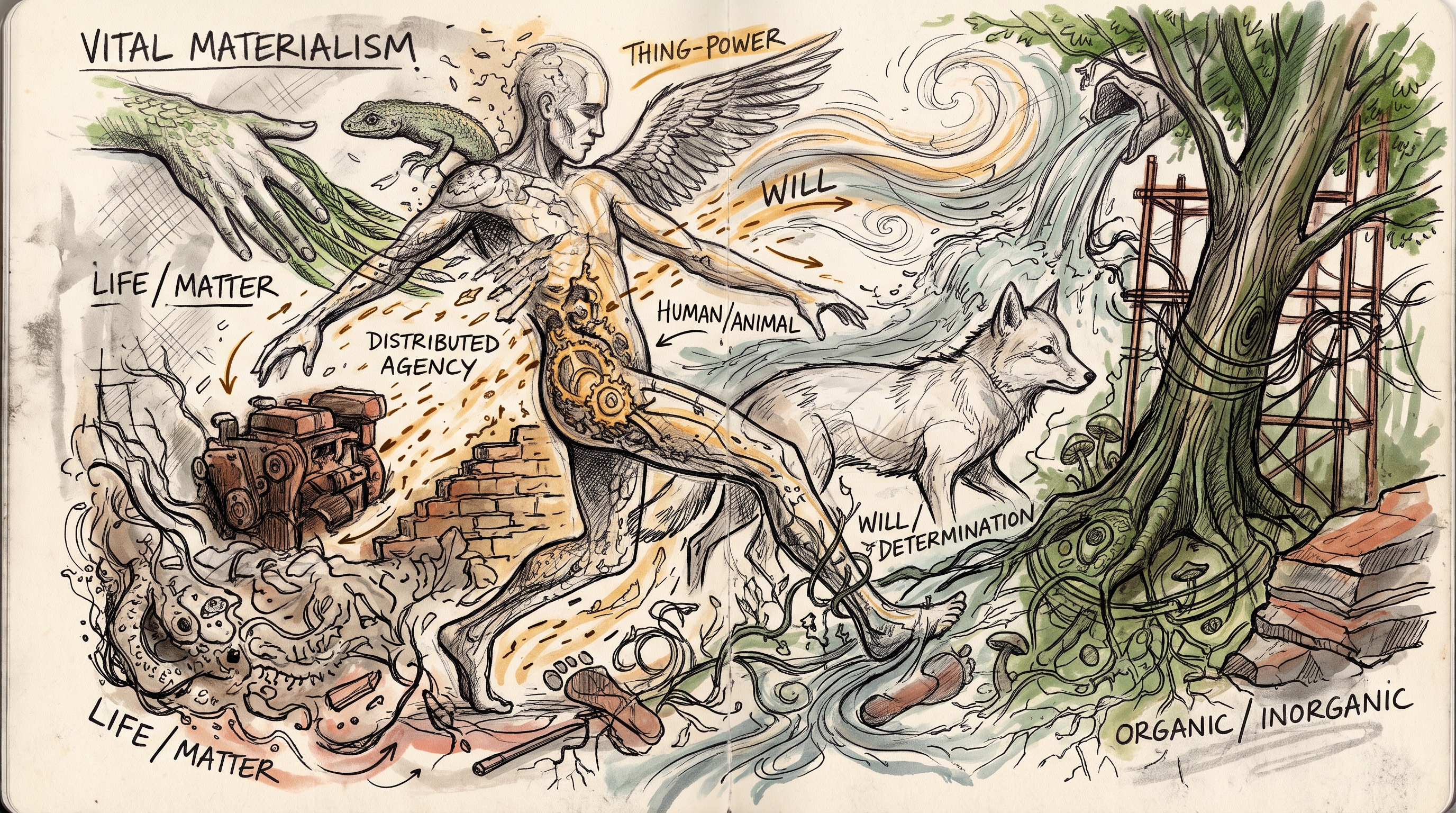
The Ontological Rupture: Decentering the Human Sovereign
Western philosophy and political theory have long been grounded in a Cartesian and mechanistic paradigm that divides existence into conscious subjects endowed with will, reason, and moral value, and dead objects consisting of inert extension available for human manipulation and economic extraction. This anthropocentric hierarchy created a chronic epistemic blind-spot across European modernity, rendering theorists oblivious to the active formative power, self-organizing autonomy, and ontological dignity of the nonhuman world.[1]
Vital materialism stages a radical ontological rupture against this dualism. It argues that the capacity to make things happen—to produce effects, alter trajectories, and generate affect—is not the exclusive monopoly of the human mind. The liveliness of matter is neither a supernatural occult force nor an esoteric abstraction; it operates continuously in-plain-sight.[2] When a discarded bottle cap glints beneath streetlights, when toxic run-off contaminates an aquifer, or when gut microbiota alter psychological mood and behavioral choices, nonhuman materiality actively asserts its presence, demanding to be recognized not as passive stuff, but as vibrant matter.
Philosophical Lineage and Genealogy
Vital materialism does not emerge ex nihilo; it recovers and radicalizes an underground current within Western philosophy that resists mechanistic reductionism while resolutely refusing supernatural dualism.[3]
Classical Roots: Atomism and the Lucretian Swerve
In ancient philosophy, Epicurus and Lucretius (De Rerum Natura) formulated a radical materialist cosmology grounded in indivisible atoms falling through the void.[3:1] Lucretius introduced the concept of the clinamen—a microscopic, uncaused, stochastic swerve in an atom's downward trajectory. This swerve injects an irreducible degree of indeterminacy, spontaneity, and creative turbulence directly into the physical architecture of reality.[1:1]
Within vital materialism, the clinamen demonstrates that matter is never entirely predictable, obedient, or settled. At any moment, the latent spontaneity of material forces can throw-a-wrench-in-the-works of human engineering, economic forecasting, and technocratic governance, proving that matter retains a recalcitrant autonomy that resists complete human enclosure.[1:2]
Spinoza's Monism and Conatus
Baruch Spinoza's immanent metaphysics serves as the structural cornerstone of vital materialism.[4] By rejecting Cartesian mind-body dualism in favor of substance monism (Deus sive Natura—God or Nature), Spinoza conceptualized thought and extension not as separate substances, but as two parallel attributes of a single, infinite, self-causing reality.[4:1]
Central to vital materialism is Spinoza's doctrine of conatus: the innate striving of every finite mode (whether a human being, a wolf, an iron bar, or a tidal wave) to persevere in its own existence and enhance its active power (potentia).[1:3] Matter is therefore not inert mass awaiting external kinetic propulsion; it is inherently energized, dynamic, and expressive. Furthermore, Spinoza's relational account of bodies as composite entities continually affected by and affecting other bodies directly anticipates Bennett's theory of assemblages.[4:2]
Critical Vitalism vs. Material Vitalism: Bergson and Deleuze
Vital materialism draws a sharp demarcation between classical "supernatural" vitalism and contemporary "material" vitalism.[3:2] In the late 19th and early 20th centuries, critical vitalists such as Henri Bergson (Creative Evolution) and Hans Driesch sought to protect biology from mechanical determinism by positing an élan vital (vital impetus) or entelechy—an immaterial, non-physical life principle that infuses and animates brute matter.[3:3]
Vital materialists critique this formulation for preserving a lingering Cartesian dualism: matter itself remains fundamentally lifeless, requiring a transcendent spiritual supplement to achieve animation.[1:4] In contrast, vital materialists adopt Gilles Deleuze and Félix Guattari's concept of material vitalism.[5] Vitality is entirely immanent to matter-energy itself. Matter is not an inert substrate sculpted by form; it is a morphogenetic, self-organizing continuum capable of generating complex order, phase shifts, and aesthetic patterns from within its own physical immanence.[5:1]
Core Architectural Concepts
As articulated by Jane Bennett in Vibrant Matter: A Political Ecology of Things (2010), vital materialism operates through four interrelated conceptual pillars:[1:5]
1. Thing-Power
Bennett defines "thing-power" as the curious capacity of inanimate objects to animate, act, produce effects, and evoke affect in human observers.[1:6] Bennett recounts a phenomenological encounter with a storm drain in Baltimore, where a collection of discarded items—a black plastic work glove, an unblemished bottle cap, a dense mat of oak pollen, a smooth stick of wood, and a dead rat—arrested her attention.[1:7]
In that moment of aesthetic shock, these objects ceased to be passive instruments or discarded garbage; they radiated an autonomous physical presence, exhibiting an irreducible dignity and an undeniable gravitational-pull that drew the human observer into an affective encounter with their nonhuman materiality.[1:8]
2. Actants and Distributed Agency
Drawing from Bruno Latour's Actor-Network Theory (ANT), vital materialism discards the anthropocentric definition of agency, which historically required conscious intention, deliberative moral will, and symbolic language.[2:1] Bennett replaces this narrow model with Latour's concept of the actant: any entity—human or nonhuman, organic or inorganic—that possesses efficacy, exerts force, and produces a discernible difference within a network of relations.[2:2]
Agency is fundamentally distributed. It is never the sovereign property of an isolated human subject acting upon an exterior world; instead, agency is an emergent property circulating through heterogeneous networks where electrons, weather patterns, microbial ecologies, legal texts, and human nervous systems collide and co-constitute outcomes.[1:9]
3. Agentic Assemblages
An assemblage is an ad hoc, open-ended grouping of diverse, vibrant materials of all kinds.[1:10] The agency of an assemblage cannot be reduced to the sum of its constituent parts; it possesses emergent properties and non-linear causal dynamics.[1:11]
- The North American Blackout Case Study: Bennett analyzes the massive electrical blackout of August 14, 2003, which left fifty million people in the United States and Canada without power.[1:12] Traditional investigations sought a single human or institutional culprit (such as Enron-style market deregulation, human operational error, or corporate underinvestment in maintenance). Bennett demonstrates that the blackout was in fact produced by a distributed agentic assemblage: an intricate cascade involving coal-fired power stations, high-voltage transmission lines sagging into brushfires on an unusually hot summer day, automatic safety switches, federal regulatory loopholes, profit-driven corporate software, and the recalcitrant physical behavior of electromagnetic fields and reactive power.[1:13]
- Emergent Phase Transitions: Within such vast networks, small localized shocks do not scale linearly; rather, micro-disruptions accumulate until they attain critical-mass, precipitating sudden phase shifts and catastrophic cascading failures that baffle human controllers.[1:14]
4. Metabolic and Edible Agency: The Porous Body
Vital materialism shatters the myth of the human body as an enclosed, sovereign biological fortress. Ingested substances—food, prescription drugs, synthetic chemicals, alcohol, and omega-3 fatty acids—are not passive fuel burned by a mechanistic furnace; they are active, chemical actants that enter into an intimate, seamless-integration with human neurobiology, shaping moods, cognitive capacities, impulse regulation, and political dispositions.[1:15]
Human consciousness is an impure, hybrid human-nonhuman assemblage. Environmental toxins, endocrine disruptors, and atmospheric pollutants spread via a powerful biological and sociological contagion-effect across living bodies, proving that the human sensorium cannot be neatly decoupled from the surrounding metabolic and industrial biosphere.[1:16]
Political Ecology and Posthuman Ethics
Vital materialism is not merely an ontological thesis; it is an intervention into political philosophy, ecological ethics, and democratic theory.[1:17]
Expanding the Democratic Public
Drawing upon John Dewey's pragmatic theory in The Public and Its Problems (1927), Bennett redefines a "public" as an association of bodies affected by a shared harm or indirect consequence of human transactions.[1:18] Dewey recognized that when industrial activities create externalities (such as toxic industrial runoff or air pollution), those affected bodies coalesce into a political public demanding remediation.[1:19]
Vital materialism extends Dewey's insight past the species barrier: nonhuman entities—threatened salmon runs, acidified oceans, plasticized soil biomes, and rapidly warming atmospheric currents—are themselves directly injured members of these ecological collectives. By recognizing nonhuman entities as active constituents woven directly into the-fabric-of-society, vital materialism calls for a Parliament of Things where nonhuman welfare and recalcitrance are integrated into public policy and urban design.[2:3]
Cultivating Affective Enchantment
Traditional environmentalism often relies on moralizing guilt, austere asceticism, or terrifying apocalyptic rhetoric to motivate ecological stewardship—strategies that frequently generate paralysis, cynicism, and defensive denial.[1:20] Bennett proposes instead that ecological ethics must be anchored in enchantment: cultivating a sensory attentiveness and childlike wonder toward the vitality of the physical world.[1:21]
When moments of aesthetic awe and sensory encounter with vibrant materials momentarily cast-a-spell-on human awareness, they loosen instrumental ego-defenses, fostering an affective generosity and ecological reverence that make sustainable, post-consumerist lifestyles genuinely desirable rather than punitive.[1:22]
The Fallacy of Disposability and Waste Metabolism
Global consumer capitalism depends upon the fantasy of frictionless disposal: the comforting illusion that when commodities break, wear out, or lose novelty, consumers can throw them "away" and permanently wash-your-hands-of their physical reality.[1:23]
Vital materialism exposes the ecological bankruptcy of this myth. There is no exterior "away." When an electronic device, a synthetic garment, or a single-use plastic container is deposited in a dumpster, it does not dissolve into nothingness; it enters a landfill assemblage, leaking heavy metals into local water tables, off-gassing methane into the atmosphere, and breaking down into microplastics that re-enter the food chain.[1:24] Matter cannot be disavowed; discarded things continue to metabolize, act, and govern human life long after their consumer utility has expired.
Critiques and Theoretical Counter-Perspectives
Despite its generative contributions to environmental humanities, feminist new materialism, and science and technology studies (STS), vital materialism faces intense critical pushback from Marxist political economists and philosophers of mind.[6]
Ecological Marxist Critique: The Dilution of Political Culpability
The most formidable critique of vital materialism emerges from historical materialism and ecosocialism, articulated forcefully by theorists like Andreas Malm (The Progress of This Storm).[6:1] Critics argue that by flattening the ontological distinction between human social intentionality and nonhuman physical causality, vital materialism dilutes political responsibility and obscures corporate accountability.[6:2]
If agency is distributed democratically across an electrical grid composed of coal plants, wires, electrons, software algorithms, and brushfires, it becomes impossible to hold specific fossil fuel executives, corporate boards, or capitalist state apparatuses politically, legally, and financially responsible for climate destruction.[6:3] A coal-fired generator does not choose to extract profits or lobby against renewable energy legislation; human beings operating within historically specific capitalist relations do. Critics caution that dissolving the nature-society binary analytically risks depoliticizing environmental struggle and playing directly into corporate public relations narratives.[6:4]
The Problem of Interiority and Experiential Asymmetry
From the standpoint of phenomenology and the philosophy of mind, critics question whether vital materialism risks creating an untenable symmetry between conscious organisms and inanimate objects.[3:4] While a boulder, a microprocessor, or an ocean wave certainly exerts physical force, reactive resistance, and systemic efficacy, it lacks the subjective interiority, pain, anticipation, and phenomenal consciousness characteristic of biological organisms.[3:5] By stretching the definition of agency to cover every physical reaction, vital materialism risks emptying the concept of agency of its qualitative, emancipatory meaning.[3:6]
🎴 Interactive Web Practice (Comprehension Check)
Question 1 (Thing-Power vs. Instrumental Objects): How does Jane Bennett's concept of "thing-power" fundamentally challenge the traditional Cartesian view of the physical world?
Answer: The traditional Cartesian paradigm treats the physical world as res extensa—inert, dead matter devoid of vitality, meaning, or agency, serving purely as a passive backdrop or resource for sovereign human intellect (res cogitans). Bennett's "thing-power" overturns this hierarchy by asserting that inanimate objects (ranging from discarded debris and mineral ores to plastics and power lines) possess an intrinsic liveliness, formative efficacy, and affective capacity that acts upon humans independently of human intentions or linguistic construction.
Question 2 (Distributed Agency and the 2003 Blackout): In what way does Bennett's analysis of the 2003 North American blackout illustrate the concept of an "agentic assemblage"?
Answer: Bennett demonstrates that the collapse of the power grid cannot be reduced to a single human cause (such as corporate greed or operator error) or a purely physical mechanical failure. Instead, agency was distributed across a heterogeneous assemblage composed of transmission wires, brushfires, extreme summer heat, automatic safety switches, volatile reactive power, free-market electricity trading regulations, and human consumers. The catastrophic blackout was an emergent outcome generated by the unpredictable interactions among all these vibrant human and nonhuman actants working in tandem.
Question 3 (Material Vitalism vs. Classical Vitalism): Why do vital materialists explicitly reject Henri Bergson's and Hans Driesch's concept of an élan vital or entelechy?
Answer: Early 20th-century critical vitalists like Bergson and Driesch posited an immaterial, quasi-spiritual life force (élan vital or entelechy) that enters into and animates passive physical matter. Vital materialists reject this formulation because it preserves a residual Cartesian dualism where matter itself remains dead and requires an external, supernatural supplement to become active. Following Deleuze and Guattari, vital materialists champion an immanent "material vitalism," asserting that vitality, self-organization, and morphogenetic creativity emerge directly from within the physical immanence of matter-energy itself.
Question 4 (The Ecological Marxist Counter-Critique): What critical hazard does Andreas Malm identify in flattening the ontological boundary between human and nonhuman agency?
Answer: Andreas Malm argues that distributing agency indiscriminately across human institutions, coal molecules, power grids, and climatic forces fatally undermines political and legal accountability. If inanimate matter and natural forces share equal culpability for ecological disasters, it becomes impossible to hold specific capitalist classes, fossil fuel corporations, and political leaders accountable for ecocide. Flattening agency into a diffuse network risks depoliticizing systemic exploitation and masking the deliberate economic choices driving environmental breakdown.
Resonant Notes
The following notes in the vault share direct thematic, ontological, and ecological connections with Vital Materialism:
🟣 Core Lexical Syllabus & Applied Metaphoric Expressions
- blind-spot — Diagnoses the foundational defect of Cartesian dualism and Western modern metaphysics, which created a profound blind spot regarding the active vitality, self-organizing dynamism, and thing-power of nonhuman matter.
- in-plain-sight — Captures Bennett's phenomenological encounter with ordinary detritus (a bottle cap, a dead rat, a plastic glove), showing how the vibrant agency and affective power of matter operate in plain sight, obscured only by habitual anthropocentrism.
- gravitational-pull — Illustrates how nonhuman material entities, geographic landscape features, and ecological assemblages exert an undeniable gravitational pull on human bodies, social institutions, and political decision-making.
- cast-a-spell-on — Conceptualizes the ethics of sensuous enchantment, wherein encounters with the vivid materiality of ordinary things momentarily cast a spell on human consciousness, suspending the instrumental impulse to consume and dominate.
- throw-a-wrench-in-the-works — Embodies nonhuman recalcitrance and stochastic contingency (the Lucretian clinamen), where an unpredicted material event—a transmission failure, a viral mutation, or extreme weather—can abruptly throw a wrench in the works of human technological governance.
- the-fabric-of-society — Broadens Latour's and Bennett's political ecology beyond the human species, demonstrating that nonhuman actants—electrical grids, food chemistry, mineral flows, and microbes—are inextricably woven into the fabric of society.
- seamless-integration — Articulates the posthuman dissolution of the subject-object boundary, revealing the seamless integration of human bodies with ingested nutrients, environmental toxins, and microbial biomes that compose the porous self.
- contagion-effect — Captures the affective, chemical, and biological transmission across open material assemblages, demonstrating how vibrant matter triggers a non-linear contagion effect through ecological and somatic networks.
- critical-mass — Explains the sudden phase transitions and emergence within agentic assemblages (such as the 2003 North American blackout or climate tipping points), where subterranean material interactions gather until they reach critical mass.
- wash-your-hands-of — Critiques the capitalist consumer fantasy of disposable waste, revealing that humans can never truly wash their hands of discarded commodities, as buried plastics, e-waste, and landfill methane persist as recalcitrant, metabolizing actants.
🔴 Relational Ontology, New Materialism & Posthumanism
- Animism — Serves as the ancient anthropological and relational precursor to vital materialism, positing a world composed of communicative persons—only some of whom are human—and dismantling the Cartesian divide between active spirit and passive matter.
- Dividual — Strathern's anthropological framework provides the structural model for the porous, non-sovereign subject in vital materialism, showing that human identity is not bounded and autonomous but composite and continually reconfigured through exchanges with the nonhuman environment.
- Boltzmannian Coarse-Graining and Nagarjunian Emptiness — Explores the deep convergence between statistical physics and Buddhist Madhyamaka philosophy; Nāgārjuna's deconstruction of inherent existence (svabhāva) mirrors vital materialism's thesis that discrete, permanent objects are epistemic abstractions imposed upon an interdependent, relational material flux.
- Zygmunt Bauman's sociological framework of Liquid Modernity — Connects to the precarious material flows of late capitalism, illustrating how the dissolution of durable solid institutions into precarious liquid consumerism creates uncontrollable ecological and sociological externalities.
🟡 Psychoanalysis, Perception & Media Ecology
- Freud's The Uncanny (Das Unheimliche) & Sigmund Freud — The experience of "thing-power" directly intersects Freud's uncanny (unheimlich): when an inanimate object displays autonomous presence, it breaches the modern rationalist ego's defenses, reawakening repressed animistic intuitions regarding the liveliness of the environment.
- The Eliza Effect — Documents the psychological readiness of human perception to detect intentionality, life, and communicative presence within non-living silicon artifacts, illustrating the innate cognitive predisposition toward posthuman relationality.
- Ghost in the Machine & Gilbert Ryle's-The Concept of Mind — Gilbert Ryle's devastating critique of the Cartesian "ghost in the machine" category mistake provides the analytical weapon vital materialists use to reject both mechanical materialism (matter as clockwork) and dualistic spiritualism (an immaterial soul piloting a meat vehicle).
- McLuhan's The Medium is the Message — Marshall McLuhan's media ecology anticipated vital materialism by arguing that the physical, technological medium itself—as an active material environment—restructures human perception and culture far more profoundly than any conscious human content transmitted through it.
🟢 Classical Philosophy, Process Metaphysics & Vitalism
- Henri Bergson & Henri Bergson’s Creative Evolution — Bergson's vitalist critique of spatialized clock-time and mechanistic reductionism laid the groundwork for process philosophy, although vital materialism reformulates Bergson's élan vital by grounding creative evolution strictly inside material immanence rather than an external metaphysical force.
- Heraclitus (c. 500 BCE) — The pre-Socratic metaphysics of cosmic fire, continuous flux (panta rhei), and the dynamic unity of opposites (enantiodromia) serves as the ancient genealogical ancestor of contemporary materialist ontologies of dynamic self-organization.
- American Transcendentalism & Ralph Waldo Emerson & Metaphysics of Henry David Thoreau — Transcendentalism's affirmation of the vibrant spiritual immanence of forests, ponds, and organic matter represents a 19th-century North American bridge between classical Spinozism and contemporary ecological materialism.
- Georg Lukács's formulation of reification (Verdinglichung) in History and Class Consciousness (1923) — Provides the essential historical-materialist foil: while Lukács critiques how capitalist commodity relations transform dynamic human relations into phantom, thing-like objects (Verdinglichung), vital materialism interrogates how those very "things" possess their own stubborn agency beyond the human gaze.
References
Jane Bennett / Vibrant Matter: A Political Ecology of Things (2010) / Duke University Press ↩︎ ↩︎ ↩︎ ↩︎ ↩︎ ↩︎ ↩︎ ↩︎ ↩︎ ↩︎ ↩︎ ↩︎ ↩︎ ↩︎ ↩︎ ↩︎ ↩︎ ↩︎ ↩︎ ↩︎ ↩︎ ↩︎ ↩︎ ↩︎ ↩︎
Bruno Latour / Reassembling the Social: An Introduction to Actor-Network-Theory (2005) / Oxford University Press ↩︎ ↩︎ ↩︎ ↩︎
Derek Cabrera & ResearchGate Contributors / Real Vitalism and the New Materialism (2022) / ResearchGate ↩︎ ↩︎ ↩︎ ↩︎ ↩︎ ↩︎ ↩︎
Baruch Spinoza / Ethics (1677) / Penguin Classics ↩︎ ↩︎ ↩︎
Gilles Deleuze & Félix Guattari / A Thousand Plateaus: Capitalism and Schizophrenia (1987) / University of Minnesota Press ↩︎ ↩︎
Andreas Malm / The Progress of This Storm: Nature and Society in a Warming World (2018) / Verso Books ↩︎ ↩︎ ↩︎ ↩︎ ↩︎