The Enclosure of the Intangible Commons — Intellectual Property, Artificial Scarcity, and the Colonization of Knowledge
🗂️ Interactive Notebook: Open Study Companion (Video Summary, Flashcards, Mind Map) ↗
Historical & Sociological Thesis: Throughout prehistory and antiquity, ideas functioned as non-rivalrous biological broadcasts—replicating across human minds at zero marginal cost without depleting their source.[1][2] During the European Renaissance and Enlightenment, early modern jurists and mercantile states executed an extraordinary act of social engineering: they constructed artificial scarcity around intangible thoughts.[3][4] Through the 1474 Venetian Patent Statute and the 1710 Statute of Anne, legal systems transformed communal knowledge into exclusionary private property.[3:1][5] What began as temporary, localized state-backed monopolies to incentivize mechanical immigration and break printing cartel censorship has metastasized into a planetary corporate regime of ownership over chemical formulas, genetic sequences, cultural symbols, and the digital commons.[5:1][6] Operating in plain sight, this second enclosure movement reifies living human culture into proprietary commodities, establishing a global architecture of rent extraction that criminalizes the ancient, relational impulse to share, adapt, and build upon collective human knowledge.[2:1][7]
1. The Physics of Thought vs. The Fiction of Scarcity
In the physical world, property law emerged to arbitrate disputes over rivalrous resources.[1:1] If a Paleolithic hunter consumed a piece of venison or wielded a specific flint hand-axe, no other member of the band could simultaneously consume that exact nourishment or hold that exact stone tool. Physical matter obeys classical conservation laws; its spatial possession is zero-sum.
Ideas, technical recipes, and melodies inhabit an entirely different ontology.[1:2] In twentieth-century public economics, formalized by Paul Samuelson in 1954 and expanded by Richard Musgrave, information was recognized as a pure non-rivalrous and non-excludable good.[1:3] When an ancestral flint-knapper demonstrated a pressure-flaking technique to a tribal peer, the peer acquired the skill without erasing the motor pathways from the teacher's brain. Knowledge exhibits fundamentally anti-rivalrous properties: the more minds that adopt an agricultural cycle, a linguistic grammar, or a mathematical theorem, the more resilient, sophisticated, and valuable that communal network becomes.[1:4]
"If nature has made any one thing less susceptible than all others of exclusive property, it is the action of the thinking power called an idea... He who receives an idea from me, receives instruction himself without lessening mine; as he who lights his taper at mine, receives light without darkening me." — Letter to Isaac McPherson[2:2]
The Fabrication of Artificial Scarcity
To convert a non-rivalrous broadcast into exclusionary property, legal institutions had to execute a conceptual sleight of hand: they had to invent artificial scarcity.[4:1] Because thoughts cannot be enclosed with timber palisades or stone ditches, the state erected invisible barbed wire across human cognition, enforced through legal injunctions, statutory fines, border seizures, and carceral violence.[4:2]
In his foundational political philosophy of property, John Locke (Second Treatise of Government, 1689) premised the private appropriation of the natural commons on the famous Lockean proviso: an individual may mix their physical labor with the earth to claim private land only where "there is enough, and as good, left in common for others." In the realm of intangible thought, however, enclosing a universal concept—a chord sequence, an algorithmic calculation, or a chemical receptor pathway—inevitably violates the Lockean proviso by precluding every other human mind from traversing that identical conceptual terrain.[4:3]
As legal scholar James Boyle observes, modern intellectual property represents a "Second Enclosure Movement."[4:4] Just as the British Parliamentary Enclosure Acts of the eighteenth and nineteenth centuries fenced off the communal pastures, forests, and fens—dispossessing the rural peasantry to manufacture an urban wage-labor force through the primitive accumulation (ursprüngliche Akkumulation) analyzed by Karl Marx—the expansion of intellectual property fences off the intellectual, communicative, and genetic commons, transforming humanity's collective cultural heritage into proprietary capital assets.[4:5][7:1]
Material vs. Intangible Property Regimes
| Analytical Dimension | Material Property (Tangible Commons) | Intellectual Property (Intangible Commons) |
|---|---|---|
| Physical Ontology | Rivalrous, finite physical matter obeying conservation laws. | Non-rivalrous, infinite cognitive patterns replicating without depletion. |
| Economic Character | Zero-sum consumption; simultaneous use creates physical conflict. | Anti-rivalrous; utility and network resilience compound with widespread diffusion. |
| Scarcity Mechanism | Natural physical scarcity dictated by geography and material availability. | Artificial statutory scarcity manufactured by state coercion and legal monopolies. |
| Appropriation Threshold | Bounded by physical possession and Locke's "enough and as good" proviso. | Encloses entire conceptual domains, foreclosing parallel discovery and creative iteration. |
| State Role | Adjudicating competing physical claims and recording physical boundaries. | Engineering criminal penalties to actively suppress natural cognitive mimicry and sharing. |
| Cultural & Social Impact | Allocates food, shelter, and physical tools across localized populations. | Stratifies global knowledge, restricting access to culture, software, and life-saving medicine. |
2. 1474: The Venetian Patent Statute and the Industrial Brevet
Prior to the late fifteenth century, technical craftsmanship across Europe was organized either through open communal diffusion or through the secretive, insular monopolies of medieval craft guilds. Sovereign monarchs occasionally issued ad hoc letters patent (from the Latin litterae patentes, meaning "open letters")—discretionary royal privileges granting favored court sycophants exclusive monopolies over imported technologies or domestic trades.[3:2]
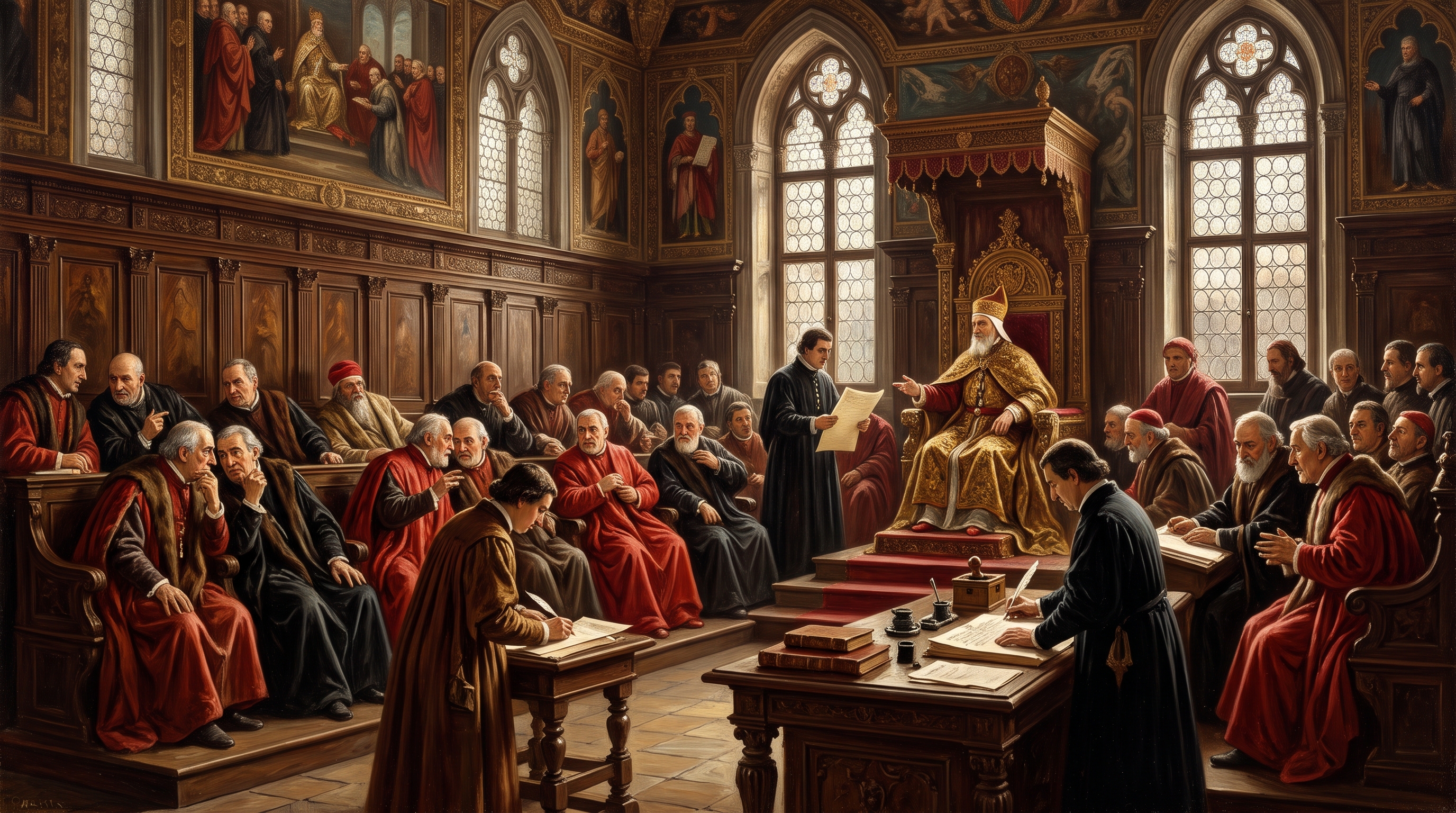
In 1421, the Republic of Florence granted master architect Filippo Brunelleschi an isolated three-year patent for Il Badalone, an amphibious, marble-transporting cargo vessel designed to convey Tuscan marble down the Arno River for the construction of Santa Maria del Fiore (which catastrophically foundered on its maiden voyage).[3:3] However, the historical pivot from arbitrary royal favor to a systematic, bureaucratic legal architecture took place on March 19, 1474, when the Senate of the Republic of Venice enacted the Venetian Patent Statute (Parte Veneziana sulle Invenzioni) by an overwhelming vote of 116 to 10.[4:6][8]
Core Mechanisms of the 1474 Statute
Recorded in the Venetian State Archives (Senato Terra), the 1474 statute formulated the structural DNA of modern patent law across four durable legal mechanisms:[4:7][8:1]
- Novelty and Utility: The contrivance had to represent a "new and ingenious device" (nuovo et ingegnoso artificio) not previously constructed within Venetian territory, reduced to workable, operational perfection.[4:8]
- Compulsory Registration and Public Disclosure: Inventors were required to formally register their machinery with the municipal magistrates (Provveditori di Comun), establishing the foundational utilitarian bargain: trading trade secrecy for state-enforced protection.[4:9]
- Term-Limited Exclusivity: The Venetian state granted a strict ten-year monopoly, forbidding any other resident from building an identical device within the borders of the Republic without the patentee's express license.[8:2]
- Statutory Destruction and Punitive Fines: Infringers were subject to a mandatory fine of 100 ducats and the immediate physical destruction of the unauthorized apparatus by municipal authorities, while the Venetian government reserved the sovereign right to deploy any patented mechanism for its own military, naval, and civil needs.[4:10]
Venice did not enact the 1474 statute out of abstract reverence for creative individualism. As a maritime empire confronting Ottoman territorial pressure in the Eastern Mediterranean and commercial rivalry from the Florentine and Milanese republics, Venice deployed the statute as an aggressive instrument of industrial recruitment.[3:4] By promising state-enforced profits, the Republic lured foreign master glassmakers, hydraulic engineers, textile artisans, and metallurgists to settle in the Venetian lagoon, granting approximately 2,000 patents between 1474 and the fall of the Republic in 1788.[3:5][8:3]
Chronological Matrix: The Evolution of Intellectual Enclosure Regimes
| Epoch & Instrument | Primary Domain Enclosed | Legal Mechanism & Sovereign Justification | Societal & Economic Consequence |
|---|---|---|---|
| Venetian Patent Statute (1474) | Mechanical contrivances, hydraulic pumps, glassmaking kilns. | 10-year exclusive monopoly; mercantilist state policy to lure foreign artisans. | Established the patent bargain: public disclosure of technical mechanics in exchange for temporary monopoly. |
| Stationers' Company Charter (1557) | Printed texts, religious pamphlets, dramatic plays. | Perpetual corporate monopoly granted to London printer-booksellers in exchange for state censorship. | Total guild control over publishing; authors possess zero statutory rights; ideological policing of sedition. |
| Statute of Anne (8 Ann. c. 21) (1710) | Literary manuscripts and printed books. | 14-year author-vested copyright (renewable once); statutory grant replacing perpetual common-law monopoly. | Inception of the legal persona of the author; formal statutory birth of the public domain upon term expiration. |
| Berne Convention (1886) | Cross-border literary, artistic, and musical works. | Automatic copyright upon fixation without formal registration; standardized minimum term of Life + 50 years. | Planetary expansion of copyright across colonial networks; universalization of Western romantic authorship. |
| Diamond v. Chakrabarty (1980) | Genetically modified living microorganisms. | Supreme Court interpretation of 35 U.S.C. § 101 encompassing "anything under the sun that is made by man." | The bio-enclosure: dismantling the Product of Nature doctrine; patenting transgenic animals, seeds, and DNA. |
| WTO TRIPS Agreement (1994) | Pharmaceuticals, computer software, agronomic seeds, microchips. | Mandatory planetary IP enforcement tied to global market access; compulsory 20-year product patents. | Global South access to life-saving medicines blocked; corporate pharmaceutical monopolies universalized. |
| Digital Millennium Copyright Act / WIPO (1998) | Digital media, computer code, cryptographic keys. | Anti-circumvention statutes; criminalizing the bypassing of Digital Rights Management (DRM) software fences. | Deleuzian control society: algorithmic fencing, continuous surveillance, and the elimination of digital ownership. |
3. 1710: The Statute of Anne and the Disciplinary Genesis of Copyright
While Venice enclosed mechanical inventions, the enclosure of linguistic and cultural expression—literature, poetry, music, and dramatic writing—traced an authoritarian genealogy rooted in royal paranoia and ecclesiastical censorship.[5:2] Following Johannes Gutenberg's perfection of movable-type metal printing in Mainz around 1440, European crowns recognized that the unfettered reproduction of texts threatened the stability of church and state.[5:3]
As media theorist Harold Innis demonstrated in Innis (1950) - Empire and Communications and Innis (1951) - The Bias of Communication, mechanized print operated as a volatile, space-binding technology that decentralized administrative authority and catalyzed religious and political rebellion.[5:4] In England, Queen Mary I met this crisis in 1557 by granting a royal charter to the Worshipful Company of Stationers—a tight cartel of ninety-seven London printers, binders, and booksellers.[5:5]
Under the charter and the subsequent Licensing of the Press Act 1662, no book or pamphlet could be legally printed in England unless it was entered into the Stationers' Hall register and approved by royal censors.[5:6] This early "copy-right" belonged entirely to the guild of publishers in perpetuity; individual authors were paid a flat, one-time fee for their physical manuscript and retained zero legal interest in subsequent editions.[5:7]
Michel Foucault: The Author as Penal Subject
In his foundational 1969 essay What is an Author? (Qu'est-ce qu'un auteur?), Michel Foucault identified the disciplinary origin of literary ownership.[9] Foucault pointed out that the modern concept of the "author" was not invented by society to celebrate individual genius, but to identify a punishable legal subject when dangerous ideas entered the social body:[9:1]
"Texts, books, and discourses really began to have authors... to the extent that authors became subject to punishment, that is, to the extent that discourses could be transgressive. In our culture... discourse was not originally a product, a thing, a kind of goods; it was essentially an act—an act placed in the bipolar field of the sacred and the profane, the licit and the illicit, the religious and the blasphemous. Historically, it was a gesture charged with risks before it became a possession caught in a circuit of property values." — What is an Author? (1969)[9:2]
Only after the state had successfully constructed the author as a legally accountable target for heresy and treason could the publishing cartel invert that disciplinary mechanism into an economic asset, arguing that the author's sacred individuality justified exclusive commercial monopolies.[5:8][9:3]
The 1695 Crisis and the Rhetoric of the "Starving Author"
When Parliament allowed the Licensing Act to lapse in 1695—revolted by state censorship and guild corruption—the Stationers' Company's perpetual monopoly abruptly collapsed.[5:9] Independent printers in Edinburgh, Glasgow, and the English provinces began printing inexpensive editions of Shakespeare, Milton, and the Bible, flooding the market with affordable literature.[5:10]
Confronting commercial catastrophe, the London booksellers mounted an aggressive lobbying offensive.[5:11] Recognizing that Parliament would never restore a state censorship licensing act or an explicit corporate monopoly, the booksellers executed a strategic rhetorical pivot: they abandoned their corporate justifications and pleaded for the protection of "starving authors," their destitute widows, and orphan children.[5:12]
The Architecture of 8 Ann. c. 21 (1710)
Parliament accepted the booksellers' premise but fundamentally subverted their objective.[5:13] On April 10, 1710, it enacted the Statute of Anne (An Act for the Encouragement of Learning, by Vesting the Copies of Printed Books in the Authors or Purchasers of such Copies, during the Times therein mentioned):[5:14]
- The Author as Sovereign Originator: For the first time in global jurisprudence, the initial copyright was vested directly in the author rather than the publishing cartel.[5:15]
- The Invention of the Public Domain: Rejecting perpetual corporate ownership, Parliament established a strict statutory lifespan: 21 years for books already in print, and 14 years for newly authored works (with a 14-year renewal term if the author remained alive).[5:16] Once the statutory clock expired, the text was liberated into the public commons, free for any citizen to reprint, recite, annotate, or translate without permission or licensing fees.[5:17]
- Statutory Privilege vs. Natural Right (Donaldson v. Beckett): When London booksellers claimed that the Statute of Anne merely supplemented an underlying, perpetual common-law natural property right, the British House of Lords crushed their claim in the landmark ruling Donaldson v. Beckett (1774).[5:18] The Lords affirmed that copyright is not an inherent natural right under common law, but an artificial statutory creation granted solely for utilitarian public enrichment.[5:19]
By establishing a finite monopoly that terminated in an open public domain, the Statute of Anne created the communicative substrate analyzed in Jürgen Habermas's The Structural Transformation of the Public Sphere: an accessible, literate commons where the bourgeois public sphere (Öffentlichkeit) could read, debate, and critically evaluate ideas beyond the sovereign grip of state and guild.[5:20]
4. From Utilitarian Bargain to Planetary Corporate Hegemony
Over the course of the nineteenth and twentieth centuries, the limited utilitarian compromises established in Venice (1474) and London (1710) were systematically dismantled.[4:11] Corporate lobbies successfully rebranded temporary regulatory privileges under the unified ideological banner of "Intellectual Property" (formalized globally with the establishment of the World Intellectual Property Organization, WIPO, in 1967).[4:12]
This semantic shift transformed temporary state monopolies into absolute moral entitlements, clearing the path for an aggressive planetary enclosure of knowledge across three distinct frontiers:[4:13][6:1]
1. The Global Extractive Frontier: TRIPS (1994) and the Pharmaceutical Enclosure
For most of the twentieth century, developing nations tailored their domestic patent statutes to mirror their socio-economic development.[6:2] Under the Indian Patents Act of 1970, for instance, the Indian Parliament intentionally banned patents on pharmaceutical products, permitting patents only on manufacturing processes.[6:3] This legal architecture allowed Indian scientists to synthesize generic versions of essential medications via alternative chemical processes, creating a vibrant domestic pharmacology that produced life-saving therapeutics for pennies and anchored public health across the Global South.[6:4]
In 1994, a coalition of American, European, and Japanese pharmaceutical, software, and media conglomerates orchestrated the adoption of the TRIPS Agreement (Trade-Related Aspects of Intellectual Property Rights) under the newly established World Trade Organization (WTO).[6:5]
- Global Harmonization by Coercion: Under the TRIPS single-undertaking rule, developing nations could not join the WTO or access global export markets without signing TRIPS, which mandated uniform, Western-style IP laws—including mandatory 20-year product patents on all pharmaceuticals, agrochemicals, and software algorithms.[6:6] Trade delegations deployed TRIPS enforcement as an unyielding bargaining chip to drive a hard bargain, forcing vulnerable economies to surrender domestic technological flexibility.[6:7]
- The African HIV/AIDS Catastrophe: During the late 1990s and early 2000s, patented antiretroviral (ARV) therapies for HIV/AIDS were priced by Western pharmaceutical monopolies at $10,000 to $15,000 per patient per year—astronomically beyond the reach of sub-Saharan African clinics where millions were dying.[6:8][10] Meanwhile, Indian generic manufacturers like Cipla proved they could manufacture the identical triple-combination ARVs for $350 per year (later dropping below $100 per year, or less than 30 cents per day).[10:1] Rather than permitting generic distribution, thirty-nine multinational pharmaceutical companies filed a catastrophic lawsuit against the South African government under Nelson Mandela in 1998, attempting to block the importation of generic ARVs.[10:2] Corporate executives sought to wash their hands of the resulting humanitarian mortality by hiding behind contractual compliance and trade law, until global activist outrage forced them to withdraw the suit, culminating in the 2001 WTO Doha Declaration on TRIPS and Public Health affirming developing nations' limited rights to issue compulsory licenses during public health crises.[6:9][10:3]
2. Owning the Code of Life: Diamond v. Chakrabarty (1980)
For over a century, an unassailable boundary of patent jurisprudence was the Product of Nature Doctrine: human beings could patent an industrial mousetrap, but they could never patent a mouse, an oak tree, or a mineral deposit.[11]
In 1972, General Electric genetic engineer Ananda Chakrabarty applied for a patent on a genetically modified strain of the bacterium Pseudomonas, engineered via plasmid transfer to metabolize crude petroleum spills.[11:1] When the U.S. Patent and Trademark Office rejected the claim on the grounds that living organisms are non-patentable products of nature, the dispute escalated to the U.S. Supreme Court.[11:2]
In the epochal 5-4 decision Diamond v. Chakrabarty (1980), Chief Justice Warren Burger overturned legal tradition, declaring that Congress intended statutory patent eligibility to encompass "anything under the sun that is made by man."[11:3]
- The Bio-Enclosure Gold Rush: Chakrabarty unleashed a corporate scramble to patent biological life.[11:4] Corporations patented transgenic organisms (such as the Harvard "OncoMouse" in 1988), agricultural crops genetically modified for pesticide resistance (such as Monsanto's Roundup Ready soybeans, combined with contracts forbidding farmers from saving seeds for replanting), and isolated human genes.[11:5]
- The Enclosure of the Human Genome: For two decades, biotechnology firms claimed proprietary monopolies over human genetic code.[11:6] Myriad Genetics patented the isolated BRCA1 and BRCA2 genetic sequences, monopolizing hereditary breast and ovarian cancer diagnostics and preventing independent university laboratories from testing patients' own DNA without paying prohibitive licensing royalties—until the Supreme Court partially rolled back the monopoly in Association for Molecular Pathology v. Myriad Genetics (2013), ruling that naturally occurring, isolated human DNA is non-patentable, while synthetic complementary DNA (cDNA) remains eligible for private ownership.[12]
This genetic enclosure directly intersects the posthuman philosophy of Vital Materialism and Animism. By reducing living organisms to mechanical assemblies of commodified genetic code, the legal apparatus severed the ecological boundary between vibrant living matter and industrial manufacture, subordinating planetary biology to corporate capital extraction.[11:7]
3. The Perpetual Cartoon and Algorithmic Acoustic Fencing
In the cultural domain, the 14-year bargain of the Statute of Anne was steadily eviscerated by media cartels.[5:21] Through continuous legislative interventions—culminating in the U.S. Copyright Term Extension Act of 1998 (the "Sonny Bono Act," derisively nicknamed the "Mickey Mouse Protection Act" due to intensive lobbying by The Walt Disney Company)—copyright terms were stretched to the life of the author plus 70 years, or 95 years for corporate works-for-hire.[4:14][5:22]
Even as foundational twentieth-century characters like Mickey Mouse (Steamboat Willie, 1928) finally enter the public domain, entertainment conglomerates deploy perpetual trademark law to lock down the visual silhouettes and brand identities of these characters, creating an overlapping legal thicket that defeats the statutory promise of the commons.[4:15]
In the acoustic realm, entertainment conglomerates and forensic musicologists have turned the finite mathematical intervals of the twelve-tone Western chromatic scale into litigious real estate.[4:16] High-profile copyright infringement lawsuits targeting four-note melodic phrases, rhythmic timbres, and baseline grooves have intimidated independent artists, converting the ancient human tradition of musical variation, parody, and folk recombination into a hazardous minefield of strict legal liability.[4:17]
5. Sociological, Media Ecological, and Epistemological Frameworks
The systematic enclosure of the intangible commons cannot be comprehended solely as an economic transaction; it represents a profound civilizational transformation analyzed across classical sociology, media ecology, and continental philosophy.[9:4][7:2][13]
Sociological & Philosophical Paradigms of Intellectual Enclosure
| Theorist / Framework | Core Conceptual Tool | Diagnostic Application to Intellectual Enclosure | Vault Resonance |
|---|---|---|---|
| Georg Lukács | Reification (Verdinglichung) | Fluid human thought and collective cultural knowledge are transformed into the "phantom objectivity" of patent portfolios and IP assets. | Georg Lukács's formulation of reification (Verdinglichung) in History and Class Consciousness (1923) |
| Georg Simmel (1858-1918) | Monetary Abstraction & The Philosophy of Money | Monetary valuation flattens qualitative creative expressions and philosophical discoveries into interchangeable, quantifiable royalty streams. | The Philosophy of Money (Philosophie des Geldes) / Simmel and the Attention Economy — Abstraction, Alienation, and Cognitive Capture |
| Michel Foucault | Disciplinary Power & The "Author-Function" | The author was engineered as a penal subject for state prosecution before being inverted into a legal property-holder. | Michel Foucault / Discipline and Punish |
| Gilles Deleuze | Postscript on the Societies of Control | Replaces physical print copyright with continuous digital modulation: DRM, automated content filters, and biometric tracking. | Postscript on the Societies of Control / Dividual |
| Harold Innis (1894–1952) | Monopolies of Knowledge & Space-Binding Media | Legal elites construct exclusionary monopolies around dominant communication media to consolidate imperial hegemony. | Innis (1950) - Empire and Communications / Innis (1951) - The Bias of Communication |
| Marshall McLuhan (1911-1980) | Print Typography as Mechanization | Movable type conditioned the psychological illusion of the isolated, bounded individual ego claiming sovereign ownership over language. | McLuhan's The Medium is the Message / The Gutenberg Galaxy |
| James C. Scott | High Modernism & State Legibility | States codify informal, vernacular communal wisdom and oral recipes into formal legal registries to make knowledge taxable and legible. | Seeing Like a State (1998) / The Metricization of Mind — Standardized Testing, State Legibility, and the Domestication of Childhood |
| Zygmunt Bauman | Liquid Modernity & Precarious Commodification | Durable cultural inheritances dissolve into privatized, transient subscription models, creating chronic consumer precarity. | Zygmunt Bauman's sociological framework of Liquid Modernity |
Georg Lukács and the Reification of Mind
In History and Class Consciousness (1923), Marxist philosopher Georg Lukács's formulation of reification (Verdinglichung) in History and Class Consciousness (1923) demonstrated how the commodity form colonizes the human sensorium and social relations.[7:3] Under capitalism, dynamic, qualitative interactions between living subjects assume the "phantom objectivity" (gespenstige Gegenständlichkeit) of autonomous things governed by abstract economic laws.[7:4]
In the regime of intellectual property, human thought undergoes absolute reification:[7:5]
- Fluid, dialogical ideas—which exist solely through relational exchange between human minds—are severed from living speech and reified into transferable property titles, patent licenses, and corporate balance-sheet assets.[4:18][7:6]
- The legal system projects a deceptive facade of neutrality, pretending that corporate patent portfolios are the natural, inevitable reward for individual ingenuity, rather than an artificial, state-enforced statutory enclosure of the collective knowledge commons.[4:19][7:7]
- The worker or laboratory researcher becomes a specialized cog in the machine, surrendering all patents and copyrights to multinational employers under standard corporate works-for-hire and invention-assignment agreements.[4:20][7:8]
Gilles Deleuze: DRM and the Societies of Control
In Postscript on the Societies of Control, Gilles Deleuze diagnosed the historical transition from disciplinary enclosures (prisons, factories, schools) to continuous cybernetic modulation.[13:1]
In the digital era, the enclosure of the intangible commons no longer relies on physical booksellers' halls or printing press seizures; it operates through ubiquitous, automated code:[13:2]
- The Dividual of Knowledge: Culture is fragmented into micro-samples, audio fingerprints, and algorithmic streams.[13:3] Platforms do not interact with living creators or listeners; they evaluate digital fingerprints and automated content-matching metadata.[13:4]
- Algorithmic Acoustic Fencing: Platforms like YouTube deploy automated Content ID systems that continuously scan billions of hours of uploads, instantaneously demonetizing, muting, or erasing content that matches proprietary acoustic audio fingerprints—often executing automated takedowns of public-domain classical performances, birdsong recordings, or academic lectures.[4:21][13:5]
- The Abolition of Ownership: In the liquid modern economy (Zygmunt Bauman's sociological framework of Liquid Modernity), citizens no longer purchase or own physical books, musical records, or software discs.[4:22] Instead, they purchase temporary, revocable licenses to stream media from centralized corporate clouds. Corporate publishers retain the unilateral power to remotely alter, redact, or delete texts already delivered to users' personal reading devices (as occurred in 2009 when Amazon remotely erased copies of George Orwell's 1984 from Kindle devices overnight).[4:23] The consumer navigates cultural life on autopilot, perpetually paying rent to access the shared civilizational memory of their own species.[4:24][13:6]
6. The Intersubjective Paradox and the AI Enclosure Frontier
The historical progression of intellectual property culminates in an unprecedented epistemological contradiction: the great AI enclosure of the human cultural commons.[4:25]
Over the past two decades, billions of human beings contributed their poetry, essays, photographs, software code, scientific papers, and conversational dialogue to the open internet—operating under the implicit social compact that their creative expressions formed part of an open, shared digital commons.[4:26]
In the early 2020s, transnational artificial intelligence corporations scraped this entire planetary cultural archive without consent, compensation, or attribution, ingesting trillions of words and images to train foundational Large Language Models (LLMs) and generative image synthesizers.[4:27] Having ingested the collective cultural inheritance of humanity, these corporations have encircled the resulting synthetic capabilities behind proprietary paywalls, software APIs, and closed corporate models, selling synthetic access to human culture back to the very species that created it.[4:28]
This modern enclosure reveals the ultimate intersubjective paradox of intellectual property:[4:29]
- When an ordinary human being copies an image or samples a four-bar musical phrase, corporate rights-holders brand them as "pirates" and deploy federal copyright statutes to demand thousands of dollars in statutory damages.[4:30]
- When an AI conglomerate ingests the entirety of human literature, art, and music to train commercial, profit-generating software systems, corporate attorneys insist that such mass scraping constitutes protected "fair use."[4:31]
The entire institutional architecture is built on sand, resting on a legal fiction that criminalizes human tribal sharing while sanctioning corporate automation to enclose the collective mind.[4:32] Intellectual property law, engineered five centuries ago in the Venetian lagoon to encourage mechanical craftsmanship, has evolved into an all-encompassing apparatus of rentier extraction, fencing off the boundless horizon of human imagination to protect corporate balance sheets.[4:33][6:10][7:9]
🎴 Interactive Web Practice (Comprehension Check)
Question 1 (Economic Ontology & The Public Good Paradox): Why does classical and public economics classify ideas and knowledge as non-rivalrous, and how did early modern jurists construct artificial scarcity to enclose the intangible commons?
Answer: In public economics (formalized by Paul Samuelson and Richard Musgrave), information and ideas are classified as non-rivalrous and non-excludable public goods. Unlike physical, material matter—which is strictly rivalrous and obeys conservation laws (if one person consumes a loaf of bread or uses an axe, another cannot)—ideas can be shared infinitely across minds at zero marginal cost without depleting or lessening the source. As Thomas Jefferson famously illustrated, lighting one taper at another receives light without darkening the first. Furthermore, knowledge is often anti-rivalrous: widespread adoption enhances network resilience and collective utility.
Because thoughts cannot be naturally fenced with physical barriers, early modern jurists and states constructed artificial scarcity through legal engineering. By enacting statutory monopolies—beginning with the 1474 Venetian Patent Statute and the 1710 Statute of Anne—states erected imaginary legal fences around intangible patterns of thought, backed by the threat of state violence, physical destruction of unauthorized devices, financial penalties, and criminal imprisonment. This converted non-rivalrous biological broadcasts into exclusionary, tradeable private property.
Question 2 (Foucault's Author-Function & The Statute of Anne): How does Michel Foucault's analysis of the "author-function" illuminate the transition from sixteenth-century English printing cartels to the 1710 Statute of Anne?
Answer: In What is an Author? (1969), Michel Foucault demonstrated that the modern persona of the "author" did not originate from an enlightened desire to honor creative genius, but as a disciplinary and penal mechanism of state power. Texts were assigned authors so that sovereign authorities could identify, arrest, and punish specific individuals when printed discourse committed heresy, sedition, or blasphemy against the crown and church.
In sixteenth-century England, the Worshipful Company of Stationers held a perpetual corporate monopoly over printing in exchange for enforcing state censorship under royal licensing acts; authors had zero economic or statutory rights once they sold their manuscripts. When the licensing acts lapsed in 1695, the booksellers strategically shifted their rhetoric from guild privileges to moral pleas for "starving authors." Parliament responded with the Statute of Anne (1710), which accepted the moral figure of the author but subverted the booksellers' monopoly by vesting copyright initially in the author for a strictly term-limited period (14 years, renewable once). When the statutory term expired, the work passed into the public domain, establishing that copyright was an artificial statutory grant rather than an inherent common-law natural property right (reaffirmed in Donaldson v. Beckett, 1774).
Question 3 (TRIPS, Biopiracy, and Posthuman Commodification): How did the 1994 WTO TRIPS Agreement and the 1980 Diamond v. Chakrabarty Supreme Court decision transform global health, biology, and the philosophical boundary of property?
Answer: The 1994 WTO TRIPS Agreement globalized Western-style intellectual property regimes by conditioning participation in international trade on the mandatory enforcement of 20-year product patents, stripping developing countries (such as India) of their sovereign ability to manufacture affordable generic medications. During the late 1990s HIV/AIDS crisis in sub-Saharan Africa, this regime allowed Western pharmaceutical monopolies to price life-saving antiretrovirals at over $10,000 per patient annually, locking out millions of dying patients until generic manufacturers and international activist outrage forced the 2001 WTO Doha Declaration affirming public health emergency exceptions.
Simultaneously, the landmark U.S. Supreme Court decision Diamond v. Chakrabarty (1980) dismantled the long-standing "Product of Nature Doctrine," ruling that genetically modified living organisms are patentable manufactures under the rationale that patent law encompasses "anything under the sun that is made by man." This initiated the modern bio-enclosure: corporations acquired patent monopolies over transgenic animals, genetically modified seeds, and isolated human DNA sequences (such as Myriad Genetics' BRCA1/2 patents). Philosophically, this event marks the absolute Cartesian commodification of living nature, eroding the ethical boundaries between vibrant biological life and inert industrial machinery, directly conflicting with the insights of Vital Materialism and indigenous Animist relational ethics.
Resonant Notes
The following notes in the vault share direct thematic, sociological, and economic connections with The Enclosure of the Intangible Commons:
🔴 Enclosure, State Legibility & Legal Regimes of Scarcity
- The Standardization of Suffering — The DSM (1952), Intersubjective Consensus, and the Looping Effects of Psychiatric Classification — Companion historical study analyzing how post-war psychiatric nosology and corporate insurance matrices enclosed fluid spectrums of human emotional distress into standardized diagnostic checklists and proprietary pharmaceutical markets.
- The Freeze-Drying of Language — The Dictionary (1755), Prescriptive Grammar, and the Social Stratification of Speech — Companion historical study analyzing how eighteenth-century lexicographers and prescriptive grammarians enclosed the living oral commons into a standardized statutory code, operating as an identical high-modernist apparatus of state legibility and class gatekeeping.
- The Metricization of Mind — Standardized Testing, State Legibility, and the Domestication of Childhood — Companion historical study analyzing how high-modernist state bureaucracies flattened multidimensional human intelligence into a scalar metric, mirroring how property statutes compress non-rivalrous thought into proprietary assets.
- The Industrialization of Inquiry — The Science Citation Index (1960), Bibliometric Surveillance, and the Commodification of Truth — Companion historical study analyzing how postwar "Big Science" and bibliometric surveillance (SCI, JIF, and the
-index) flattened qualitative inquiry into scalar citation velocity, domesticating researchers through Goodhart's Law. - The Consumer Credit Score - Quantifying the Soul — Companion historical study analyzing how financial algorithms standardized human trustworthiness into an abstract, disciplinary three-digit number (FICO), creating an identical regime of algorithmic stratification and artificial scarcity.
- Nocturnalization - The Industrialization of Light — Companion historical inquiry into how municipal gas grids and electric lighting industrialized nocturnal space, enclosing biological darkness alongside the legal enclosure of intangible knowledge.
- The Specular Revolution - Optics, Interiority, and the Modern Self — Companion historical study exploring how Venetian glass mirrors and early modern optical science engineered the bounded, introspective Cartesian ego that subsequently claimed private ownership over literary and intellectual creations.
- Michel Foucault — Disciplinary power, panopticism, and the "author-function" reveal how early modern states constructed authorship as a penal category for policing transgressive ideas before it was repurposed into an economic property right.
- The Social Construction of Reality - A Treatise in the Sociology of Knowledge — Berger and Luckmann's analysis of institutionalization and reification demonstrates how artificial legal fictions (such as copyright and patents) solidify into objective, unquestioned social realities.
- Max Weber (1864-1920) — Weber's concepts of formal rationalization (Zweckrationalität), bureaucratic codification, and the disenchantment of the world (Entzauberung) explain the transformation of communal oral traditions into calculable legal titles.
🟡 Reification, Commodification & Classical Political Economy
- Georg Lukács's formulation of reification (Verdinglichung) in History and Class Consciousness (1923) — Lukács's diagnosis of reification and commodity fetishism explains how dynamic human thoughts, scientific discoveries, and linguistic expressions are alienated from social life and endowed with the "phantom objectivity" of patent portfolios and trade secrets.
- The Philosophy of Money (Philosophie des Geldes) & Georg Simmel (1858-1918) — Simmel's critique of monetary abstraction reveals how quantitative market valuation flattens qualitative spiritual, artistic, and philosophical achievements into indifferent, tradeable exchange values.
- Simmel and the Attention Economy — Abstraction, Alienation, and Cognitive Capture — Georg Simmel's analysis of cognitive overstimulation and abstraction provides the theoretical foundation for understanding how digital platform enclosures capture and monetize the shared human sensorium.
- Adam Smith's An Inquiry into the Nature and Causes of the Wealth of Nations — Classical economic analysis of capital accumulation, division of labor, and market monopolies, highlighting the historical tension between competitive enterprise and state-backed monopoly privileges.
- Jürgen Habermas's The Structural Transformation of the Public Sphere — The emergence of the bourgeois public sphere (Öffentlichkeit) depended on accessible, term-limited print culture, which is directly threatened by the commercial monopolization of publishing and media consolidation.
- Zygmunt Bauman's sociological framework of Liquid Modernity — Bauman's framework of liquid modern precarity and the consumer society illuminates the modern shift from durable physical property ownership to precarious, revocable digital media subscriptions.
🟢 Media Ecology, Posthuman Ecology & Control Societies
- Innis (1950) - Empire and Communications & Innis (1951) - The Bias of Communication — Harold Innis's space-binding media analysis demonstrates how imperial and corporate elites construct "monopolies of knowledge" around dominant communications infrastructure to control trade and social memory.
- McLuhan's The Medium is the Message & Marshall McLuhan (1911-1980) — McLuhan's analysis of print technology demonstrates how movable typography conditioned Western consciousness to perceive thought as fragmented, linear, and individually owned property.
- Postscript on the Societies of Control & Gilles Deleuze — Deleuze's diagnosis of control societies illuminates the modern transition from physical print copyright to continuous digital modulation: DRM code, automated content-filtering algorithms, and continuous behavioral telemetry.
- Dividual — Traces how human cultural expressions and genetic sequences are broken down into trackable, monetizable data points and proprietary digital samples that supersede living creators.
- Vital Materialism — Jane Bennett's posthuman political ecology challenges the Cartesian commodification of living organisms (Diamond v. Chakrabarty), asserting the vibrant agency and moral consideration of nonhuman matter.
- Animism — Relational ontologies wherein seeds, medicinal flora, and ecological knowledge are recognized not as patentable private property, but as sacred, reciprocal gifts within an interdependent, more-than-human web of life.
- sleight-of-hand — Metaphoric expression capturing the rhetorical maneuver that equates non-rivalrous cognitive patterns with physical larceny to justify punitive intellectual property regimes.
- in-plain-sight — Metaphoric expression diagnosing how corporate monopolies over the genetic code of life, seeds, and digital culture operate invisibly within everyday legal institutions.
- built-on-sand — Metaphoric expression characterizing the fragile economic foundations of rentier monopolies that depend on continuous state coercion to suppress natural digital diffusion.
- wash-your-hands-of — Metaphoric expression illustrating how transnational pharmaceutical conglomerates abdicate moral accountability for preventable humanitarian crises by hiding behind WTO compliance.
- a-facade — Metaphoric expression exposing how intellectual property law projects an outward illusion of incentivizing universal human progress while serving as a protective fortress for corporate rent extraction.
- cog-in-the-machine — Metaphoric expression depicting how scientific researchers and creative laborers are subordinated as interchangeable employees whose inventions are automatically assigned to corporate employers.
- drive-a-hard-bargain & a-bargaining-chip — Applied metaphoric expressions reflecting how global superpowers deploy intellectual property enforcement as leverage to extract geopolitical and economic concessions from the Global South.
References
Paul A. Samuelson / The Pure Theory of Public Expenditure / The Review of Economics and Statistics, Vol. 36, No. 4 (1954), pp. 387–389 / JSTOR ↩︎ ↩︎ ↩︎ ↩︎ ↩︎
Thomas Jefferson / Letter to Isaac McPherson (13 August 1813) / The Writings of Thomas Jefferson, Memorial Edition, Vol. 13, pp. 333–335 / National Archives Founders Online ↩︎ ↩︎ ↩︎
Giulio Mandich / Venetian Patents (1450–1550) / Journal of the Patent Office Society, Vol. 30, No. 3 (1948), pp. 166–224 ↩︎ ↩︎ ↩︎ ↩︎ ↩︎ ↩︎
James Boyle / The Public Domain: Enclosing the Commons of the Mind / Yale University Press, 2008 / thepublicdomain.org ↩︎ ↩︎ ↩︎ ↩︎ ↩︎ ↩︎ ↩︎ ↩︎ ↩︎ ↩︎ ↩︎ ↩︎ ↩︎ ↩︎ ↩︎ ↩︎ ↩︎ ↩︎ ↩︎ ↩︎ ↩︎ ↩︎ ↩︎ ↩︎ ↩︎ ↩︎ ↩︎ ↩︎ ↩︎ ↩︎ ↩︎ ↩︎ ↩︎ ↩︎
Mark Rose / Authors and Owners: The Invention of Copyright / Harvard University Press, 1993 / hup.harvard.edu ↩︎ ↩︎ ↩︎ ↩︎ ↩︎ ↩︎ ↩︎ ↩︎ ↩︎ ↩︎ ↩︎ ↩︎ ↩︎ ↩︎ ↩︎ ↩︎ ↩︎ ↩︎ ↩︎ ↩︎ ↩︎ ↩︎ ↩︎
Peter Drahos and John Braithwaite / Information Feudalism: Who Owns the Knowledge Economy? / The New Press, 2002 / Earthscan ↩︎ ↩︎ ↩︎ ↩︎ ↩︎ ↩︎ ↩︎ ↩︎ ↩︎ ↩︎ ↩︎
Georg Lukács / History and Class Consciousness: Studies in Marxist Dialectics (Geschichte und Klassenbewußtsein, 1923) / Translated by Rodney Livingstone / MIT Press, 1971 / mitpress.mit.edu ↩︎ ↩︎ ↩︎ ↩︎ ↩︎ ↩︎ ↩︎ ↩︎ ↩︎ ↩︎
Roberto Berveglieri / Le vie di Venezia: Brevetti e innovazione nella Serenissima (1474–1788) / Marsilio Editori, 1995 ↩︎ ↩︎ ↩︎ ↩︎
Michel Foucault / What is an Author? (Qu'est-ce qu'un auteur?, 1969) / In Language, Counter-Memory, Practice, edited by Donald F. Bouchard / Cornell University Press, 1977 ↩︎ ↩︎ ↩︎ ↩︎ ↩︎
Ellen 't Hoen / The Global Politics of Pharmaceutical Monopoly Power: Drug Patents, Access, Innovations and the Application of the WTO Doha Declaration on TRIPS and Public Health / AMB Publishers, 2009 / medicineslawandpolicy.org ↩︎ ↩︎ ↩︎ ↩︎
United States Supreme Court / Diamond v. Chakrabarty, 447 U.S. 303 (1980) / Justia U.S. Supreme Court Center / supreme.justia.com ↩︎ ↩︎ ↩︎ ↩︎ ↩︎ ↩︎ ↩︎ ↩︎
United States Supreme Court / Association for Molecular Pathology v. Myriad Genetics, Inc., 569 U.S. 576 (2013) / Justia U.S. Supreme Court Center / supreme.justia.com ↩︎
Gilles Deleuze / Postscript on the Societies of Control (Post-scriptum sur les sociétés de contrôle, 1990) / October, Vol. 59 (Winter 1992), pp. 3–7 / JSTOR ↩︎ ↩︎ ↩︎ ↩︎ ↩︎ ↩︎ ↩︎