The Freeze-Drying of Language — The Dictionary (1755), Prescriptive Grammar, and the Social Stratification of Speech
🗂️ Interactive Notebook: Open Study Companion (Video Summary, Flashcards, Mind Map) ↗
Historical & Sociological Thesis: For 99 percent of human evolutionary history, language existed as a dynamic, uncodified biological ecosystem—fluid, regional, and continuously mutating across geographic valleys without centralized statutory rules or the concept of a "misspelling."[1] The publication of Samuel Johnson’s A Dictionary of the English Language (1755) and the subsequent rise of nineteenth-century compulsory state school boards fundamentally altered how humans speak, listen, and evaluate social worth.[1:1][2] Framed as neutral instruments of Enlightenment rationality, civic progress, and universal literacy, standardized dictionaries and prescriptive grammar laws functioned in practice as mechanisms of socio-economic stratification and high-modernist state legibility.[1:2][3] By elevating the regional dialect of a tiny metropolitan elite in London or Paris as "Standard" and categorizing agrarian or working-class vernaculars as "broken," "vulgar," or "corrupt," linguistic standardization transformed an adaptive tool for local community bonding into an auditory and textual caste marker.[1:3][4] Operating in plain sight, this linguistic enclosure constructs a deceptive facade of meritocratic universalism, erecting an institutional apparatus that sentences millions to systemic discrimination based on an arbitrary, three-second sociolectal shibboleth.[1:4][5]
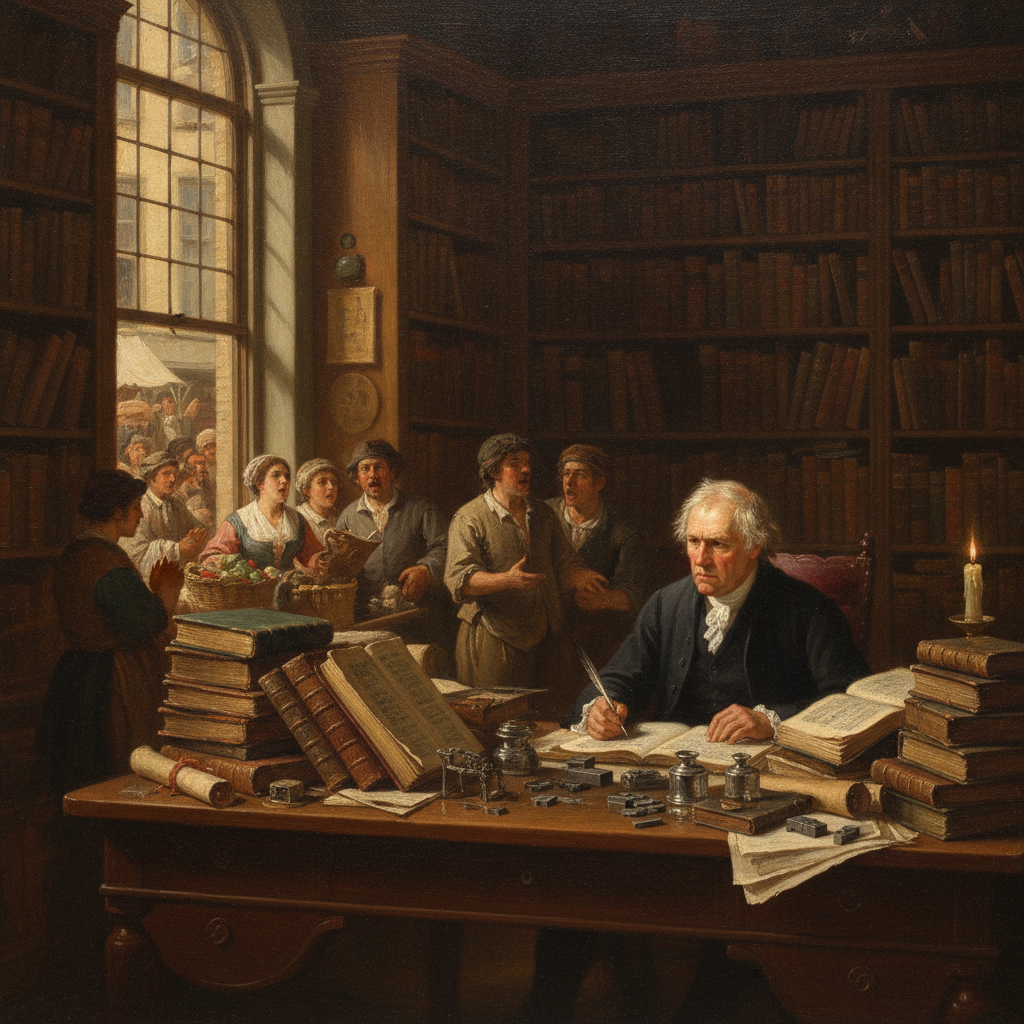
1. The Pre-Standardized Linguistic Ecosystem: The Living Dialect Continuum
For the vast majority of human history, spoken communication operated without centralized orthographic, lexical, or grammatical authorities.[1:5] Human speech existed along an unbroken dialect continuum, where linguistic features shifted gradually from village to village across geographic topography.[1:6]
While speakers situated at opposite ends of an empire or kingdom might find one another mutually unintelligible—such as a Northumbrian peasant attempting to converse with a Somerset serf—neighboring communities communicated seamlessly through fluid, overlapping idioms.[1:7] As demonstrated by anthropological models of social scale in Dunbar's Number - The Rule of 150 and phenomenological analyses of everyday life in Alfred Schütz (1899–1959), language was an embodied, face-to-face social practice anchored in direct communal reciprocity and mutual recognition, not a statutory code enforced by an administrative state.[1:8][3:1]
Linguistic Epochs: From Fluid Oral Continuum to Standardized State Code
| Epoch & Paradigm | Primary Operational Medium | Epistemic Substrate & Linguistic Authority | Social & Institutional Function |
|---|---|---|---|
| Oral / Dialect Continuum (Pre-Modern) | Embodied, face-to-face vocal speech and localized folklore. | Communal consensus, situational pragmatism, natural phonemic drift. | Organic tribal bonding, inter-village diplomacy, and ecological adaptation. |
| Scribal Manuscript Culture (Medieval to Early Modern) | Handwritten parchment, individual manuscripts, monastic scripts. | Idiosyncratic scribe conventions, phonetic transcription, local dialect loyalty. | Feudal administration, religious liturgy, and scholastic preservation for clerical elites. |
| The Print Standardization (Johnson 1755 / Lowth 1762) | Movable metal typography, luxury folios, prescriptive textbooks. | Metropolitan bourgeois elite, Latinate syntactic models, lexicographical canons. | Mercantile contractual legibility, imperial administration, and linguistic gatekeeping. |
| Compulsory State Enforcement (1870 Forster / 1881 Ferry) | Mandatory primary schooling, standardized inspection curricula. | State school inspectors (HMIs), national testing boards, Received Pronunciation (RP). | Industrial labor homogenization, eradication of regional patois, and class sorting. |
| Algorithmic Textual Gatekeeping (21st Century) | Automated spell-checkers, applicant tracking systems (ATS), LLMs. | Normalized corporate corpora, automated statistical language models. | Frictionless digital credentialing, white-collar sorting, and sociolectal marginalization. |
Orthographic Fluidity and Performative Spelling
Prior to the eighteenth century, writing was fundamentally phonemic, pragmatic, and idiosyncratic.[3:2] There existed no moral or intellectual binary between "correct" and "incorrect" spelling; orthography functioned as an adaptable, expressive medium designed to capture the cadence of an individual speaker, accommodate regional accent, or solve the mechanical constraints of printing:[3:3]
- Elite Variability: Even at the pinnacle of early modern literary production, orthographic uniformity did not exist.[3:4] Surviving legal documents, signatures, and manuscripts demonstrate that William Shakespeare spelled his own surname in at least six distinct permutations (including Shakspeare, Shakspere, and Shaksper), while Queen Elizabeth I routinely varied the spelling of basic nouns and verbs within the same official state letter.[3:5] Variation was recognized as a mark of rhetorical flair and pragmatic flexibility rather than ignorance.[3:6]
- Typesetter Pragmatism: Following Johannes Gutenberg's introduction of movable metal type, early printing compositors routinely added or deleted silent letters (such as the terminal e in olde or shoppe, or varying y and i) simply to justify the right-hand margins of their physical type cases.[3:7] The physical layout of the printed page dictated spelling, not an immutable lexical law.[3:8]
- Grammatical Pluralism: Syntactic patterns later stigmatized by eighteenth-century prescriptive grammarians—most notably multiple negation ("I cannot go no further") and double comparatives ("more worser")—were standard, prestigious features of Middle and Early Modern English, utilized by Geoffrey Chaucer and Shakespeare for rhetorical intensification.[6] In Germanic languages, negative concord historically reinforced the negative polarity of an assertion; it was never misunderstood as an algebraic cancellation.[6:1]
The Media Ecology of Print and the Demand for State Legibility
The pressure to freeze-dry language cannot be separated from the historical transformation of media technologies analyzed by Marshall McLuhan (1911-1980) and Harold Innis (1894–1952).[7][8]
In Innis (1950) - Empire and Communications and Innis (1951) - The Bias of Communication, Innis demonstrated that imperial expansion requires space-binding media—light, portable, and uniform communication networks that allow central administrative authorities to coordinate trade, enforce laws, and project military power across vast distances.[8:1] Oral dialects are intensely time-binding: they preserve sacred communal traditions across generations within localized valleys, but their regional variation creates communicative friction across imperial territories.[8:2]
As mercantile capitalism replaced feudal arrangements and Britain emerged as a global maritime empire, the uncontrolled fluidity of the vernacular was diagnosed by the metropolitan ruling class as an administrative crisis.[7:1][8:3] In A Proposal for Correcting, Improving and Ascertaining the English Tongue (1712), satirist and political essayist Jonathan Swift petitioned the Crown to establish an official academy to halt linguistic change, decrying the living language as decaying into "barbarity" and demanding that English be permanently stabilized so that state edicts and commercial contracts could remain legible to future generations.[7:2]
This demand for uniformity represents the early modern linguistic manifestation of what political scientist James C. Scott terms "state legibility" in Seeing Like a State.[3:9] Just as centralized states simplified complex customary land-tenure systems into uniform cadastral maps, and diverse human identities into standardized patronymic surnames—dynamics also explored in The Metricization of Mind — Standardized Testing, State Legibility, and the Domestication of Childhood and The Consumer Credit Score - Quantifying the Soul—mercantile and bureaucratic elites sought to standardize speech, constructing an artificial, uniform linguistic registry that stripped away local idiomatic diversity.[3:10][7:3]
2. 1755: Samuel Johnson and the Imperial Fixation of English
Confronted with the rapid expansion of global commerce, London booksellers recognized that an authoritative English dictionary represented both an urgent administrative necessity and a lucrative commercial enterprise.[2:1] In 1746, a syndicate of five prominent publishing houses contracted thirty-seven-year-old Grub Street scholar Samuel Johnson for the substantial sum of 1,500 guineas to single-handedly construct an English lexicon comparable to the collaborative, state-backed output of the forty-member Académie Française.[2:2]
The 1747 Plan vs. The 1755 Preface: The Lexicographer's Tragic Concession
Johnson's intellectual evolution across the nine arduous years of compiling the dictionary captures the foundational dialectic between prescriptive ambition and descriptive reality:[2:3][8:4]
- The Prescriptive Ambition (1747): In his initial Plan of a Dictionary of the English Language (1747), addressed to his aristocratic patron, Lord Chesterfield, Johnson articulated the prevailing Enlightenment fantasy: his objective was to "preserve the purity, and ascertain the meaning of our English idiom" and to permanently "fix the English language" against the corrupting ravages of time, colloquial slang, and foreign contamination.[8:5]
- The Lexicographer's Concession (1755): By the time Johnson published the two massive folio volumes of A Dictionary of the English Language on April 15, 1755, his empirical immersion in over 114,000 contextual quotations had fundamentally disabused him of this prescriptive fantasy.[2:4][9] In his renowned Preface, Johnson acknowledged that attempting to arrest the organic evolution of living human speech was as futile as attempting to lash the wind:[9:1]
"Those who have been persuaded to think well of my design, require that it should fix our language, and put a stop to those alterations which time and chance have hitherto been suffered to make in it without opposition... With this consequence I will confess that I have not flattered myself since I have known the nature of language. When we see men grow old and die at a certain time one after another, from century to century, we laugh at the elixir that promises to prolong life to a thousand years; and with equal justice may the lexicographer be derided, who being able to produce no example of a nation that has preserved their words and phrases from mutability, shall imagine that his dictionary can embalm his language, and secure it from corruption and decay... To enchain syllables, and to lash the wind, are equally the undertakings of pride, unwilling to measure its desires by its strength."[9:2]
The Class Architecture of the Lexical Corpus
Despite Johnson's philosophical concession in the Preface, the structural execution of his 42,773-entry dictionary operated in practice as a powerful instrument of linguistic enclosure and class gatekeeping.[2:5]
Rather than documenting how the broader English-speaking population actually communicated in 1755, Johnson restricted his illustrative corpus almost exclusively to an insular canon of dead, elite male writers spanning the late Elizabethan, Jacobean, and Restoration periods—predominantly William Shakespeare, John Milton, John Dryden, Joseph Addison, and Alexander Pope:[2:6]
- The Exclusion of Manual and Agrarian Life: The technical vocabularies of agriculture, seafaring, mining, weaving, and mechanical trade were largely omitted, or dismissed as vulgar jargon unworthy of civilized literature.[2:7]
- Marginal Branding of the Vernacular: Words originating from colloquial street exchange, working-class labor, or regional dialects that Johnson could not avoid including were stigmatized in the margins with derogatory editorial labels, branded as "low," "barbarous," "ludicrous," "cant," or "corrupt."[2:8]
- Material Inequality and Economic Enclosure: The physical artifact of the dictionary was prohibitively out of reach for ordinary citizens.[2:9] Issued in two colossal folio volumes measuring over 16 inches tall and printed on fine rag paper, the work retailed for £4 10s—an astronomical sum equivalent to three to six months of net wages for a skilled eighteenth-century artisan or agrarian laborer.[2:10]
From its inception, the definitive codification of "Standard English" was an exclusionary luxury commodity, accessible exclusively to the landed gentry, university scholars, and the upwardly mobile mercantile bourgeoisie.[2:11] In the terminology of The Enclosure of the Intangible Commons — Intellectual Property, Artificial Scarcity, and the Colonization of Knowledge, Johnson's folio fenced off the living linguistic commons, vesting ownership of legitimate speech in the hands of the propertied elite.[2:12]
3. The Eighteenth-Century Grammar Codifiers: Inventing "Errors" and Latinate Fetishism
While Johnson codified the lexicon and spelling, a subsequent cadre of eighteenth-century clergymen, schoolmasters, and philosophers set out to discipline English syntax.[6:2]
Guided by Cartesian rationalism, the quest for universal grammar, and a reverent obsession with Classical Latin, these prescriptive grammarians manufactured arbitrary syntactic taboos that turned centuries of organic Germanic usage into socially disqualifying "errors."[6:3]
Robert Lowth and Lindley Murray: The Penological Shift
The decisive figure in this grammatical counter-revolution was Anglican bishop Robert Lowth, who published A Short Introduction to English Grammar in 1762.[6:4] Written originally for the private instruction of his son, Lowth's treatise was quickly adopted across private grammar schools, selling out dozens of editions before being adapted, expanded, and mass-marketed by American-born Quaker legal scholar Lindley Murray in his 1795 textbook English Grammar.[6:5]
Murray's textbook became an international publishing phenomenon, selling over 20 million copies across Britain and the United States throughout the nineteenth century.[6:6] Lowth and Murray fundamentally inverted the pedagogical function of grammar: rather than providing a descriptive map of how living speakers communicate, they constructed a penological code of solecisms, establishing arbitrary rules that required expensive scholastic training to master.[6:7]
Manufactured Grammatical Prohibitions: Logic vs. Linguistic Reality
| Prescriptive Prohibition | Fabricated Latinate / Algebraic Justification | Historical English & Linguistic Reality | Socio-Economic Gatekeeping Function |
|---|---|---|---|
| Ban on Split Infinitives ("to boldly go") | In Classical Latin, an infinitive is a synthetic, single-word lemma (amare, ire) that is physically impossible to split. | English infinitives are analytic, two-word periphrastic constructions (to + verb). Splitting them for rhythmic cadence and emphasis has been natural since Middle English.[6:8] | Disqualifies vernacular speakers who intuitively place adverbial modifiers adjacent to the active verb. |
| Prohibition of Double Negatives ("I didn't do nothing") | Lowth imported binary algebraic logic: two mathematical negatives multiply to form a positive ((-1) x (-1) = +1); thus, a double negative affirms. | In Germanic and Romance languages, negative concord functions as emphatic polarity intensification, operating in Old English, Chaucer, and Shakespeare.[6:9] | Stigmatizes working-class speakers as "illogical," translating grammatical dialect into an imputed defect of rationality. |
| Ban on Sentence-Final Prepositions ("The man you spoke to") | Derived from Latin etymology (prae-positio, meaning "placed before"); Latin relative syntax forbids stranding prepositions at clause terminals. | Preposition stranding is an ancient structural signature of Germanic syntax, utilized naturally by Shakespeare, Milton, and the King James Bible.[6:10] | Enforces stiff, hyper-formal inversion ("The man to whom you spoke"), signaling expensive classical schooling. |
| Enforced Subject Complements ("It is I" vs. "It is me") | Latin copular verbs take identical nominative case alignments on both sides of the predicate (ego sum). | English pronouns follow positional and disjunctive syntax: post-verbal pronouns naturally default to accusative/objective forms ("It's me").[6:11] | Creates artificial hesitation in everyday speech, causing speakers to hyper-correct and reveal class insecurity. |
| Shall vs. Will Dictum | Elaborate mathematical matrices invented by John Wallis (1653) and popularized by Lowth to govern future tense intentionality. | Colloquial English historically relied on contextual modal auxiliaries; Scots, Irish, and northern English dialects never recognized the distinction. | Served as a geographic and national filter, explicitly marking Scottish, Irish, and provincial speakers as non-standard outsiders. |
The Latinization Trap: Superimposing a Dead Architecture
The core intellectual deception of eighteenth-century prescriptivism was the Latinization trap.[6:12] Classical Latin was a highly synthetic, inflectional language that relied on nominal case endings (nominative, genitive, dative, accusative, ablative) to determine syntactic relationships, permitting flexible, poetic word orders.[6:13] English, by contrast, had undergone profound morphological erosion following the Norman Conquest, evolving into an analytic, positional language that relied on strict Subject-Verb-Object (SVO) word order, prepositions, and auxiliary particles to express grammatical relations.[6:14]\n\nBy forcing an analytic Germanic tongue into the conceptual corset of a dead Mediterranean language, Lowth and Murray did not discover the underlying "logic" of English; they engineered an artificial sociolect that was alien to every native speaker's intuitive grammatical competence.[6:15] Because acquiring this counter-intuitive syntax required years of private tutoring or boarding-school immersion, adherence to "proper grammar" was transformed into an immediate, institutional filter:
By framing dialectal vernacular constructions—such as negative concord or preposition stranding—as violations of universal mathematical logic, prescriptive grammarians achieved a devastating ideological coup. A speaker who said "I ain't got no money" was no longer merely recognized as an individual from a specific agrarian village or urban working-class parish; they were branded as someone whose cognitive faculties were defective, disordered, and incapable of coherent reasoning.[6:16][10]
4. Nineteenth-Century Compulsory Schooling: State Enforcement and Dialect Eradication
Throughout the eighteenth century, dictionaries and prescriptive grammar manuals remained commercial commodities purchased by the upwardly mobile bourgeoisie to cultivate gentility.[6:17][2:13] In the nineteenth century, the rise of the centralized industrial nation-state, mass urban factories, and conscript military armies transformed linguistic standardization into an aggressive, mandatory state project.[10:1][5:1]
The British Elementary Education Act of 1870 and the Dialect Purge
With the passage of the Elementary Education Act 1870 (the Forster Act), the British Parliament established state-funded school boards across England and Wales, mandating universal primary schooling for working-class children.[10:2] While celebrated by liberal historians as an egalitarian triumph of universal literacy, the institutional curriculum functioned in practice as a systematic campaign to eradicate indigenous working-class dialects:[10:3][5:2]
- The Payment-by-Results Regime: Under the Revised Code of 1862 and subsequent board school regulations, state funding for schools was tethered directly to student performance on annual standardized examinations in the "Three Rs" (reading, writing, arithmetic) administered by Her Majesty's Inspectors of Schools (HMIs).[10:4]
- Pathologizing Regional Speech: HMIs—recruited almost exclusively from the aristocratic ranks of Oxford and Cambridge—treated regional dialects in Lancashire, Yorkshire, Cornwall, and the East End of London not as ancient linguistic systems with legitimate historical genealogies, but as biological pathologies.[5:3] School inspection reports routinely equated regional phonetic varieties with "slovenly articulation," "moral degradation," and "mental feebleness."[5:4] Teachers whose students retained regional accents faced funding cuts and professional dismissal, compelling schools to deploy physical intimidation, drill instruction, and relentless shaming to purge non-standard vernaculars.[10:5][5:5]
- The Codification of Received Pronunciation (RP): Simultaneously, the elite network of British public boarding schools (Eton, Harrow, Winchester, Rugby) consolidated an accentless sociolect christened by phonetician Daniel Jones as Received Pronunciation (RP) (and popularized in polite society as the "Queen's English" or "BBC English").[1:9][5:6] For the first time in human history, an accent ceased to indicate where in geographic space a speaker was born, and indicated instead what social class they inhabited.[1:10] To enter the higher echelons of the civil service, the diplomatic corps, the judiciary, or corporate management, an applicant had to completely shed their native geographic accent, submitting their vocal cords to the phonetic discipline of the metropolitan ruling caste.[1:11][5:7]
The French Jacobin Blueprint: Abbé Grégoire and Linguistic Treason
Across the English Channel, the state-directed eradication of regional vernaculars was conducted with ideological ruthlessness under the banner of revolutionary nationalism.[11] On June 4, 1794, during the height of the French Revolution, Abbé Henri Grégoire delivered his landmark report to the National Convention: Report on the Necessity and Means of Obliterating Dialects and Universalizing the Usage of the French Language (Rapport sur la nécessité et les moyens d'anéantir les patois et d'universaliser l'usage de la langue française).[11:1]
Grégoire's national survey revealed a startling reality: out of a population of 28 million citizens, only 3 million spoke standard Parisian French fluently, while over 6 million spoke no French at all, communicating instead in autonomous regional languages: Occitan, Breton, Basque, Catalan, Alsatian, and Flemish:[11:2]
"We can unify the language of a great nation... This enterprise, which has not been fully achieved by any people, is worthy of the French people, who are centralizing all branches of the social organization and who must be jealous of consecrating, as soon as possible, in a single and indivisible Republic, the single and invariable usage of the language of liberty... Patois, regional dialects, and corrupt idioms are counter-revolutionary remnants of feudalism that maintain citizens in ignorance and isolate them from the national will."[11:3]
Under the French Third Republic, this Jacobin blueprint achieved total institutional realization through the mandatory, secular primary schooling laws engineered by Jules Ferry in 1881–1882.[12] The republican schoolmasters—eulogized as les hussards noirs de la République ("the black hussars of the Republic")—were dispatched to the rural provinces with the explicit mandate to civilize the peasantry and stamp out regional languages:[12:1]
- The Symbole (Token of Shame): In schools throughout Brittany, Occitania, and the Basque Country—mirroring the contemporaneous Welsh Not in Britain—teachers enforced absolute linguistic conformity through physical stigmatization.[12:2] A child overheard speaking their native mother tongue (patois) was forced to wear a humiliating physical token—a wooden clog (sabot), an iron horseshoe, a carved bone, or a piece of slate—hung around their neck.[12:3] The child holding the token at the conclusion of the school day was subjected to corporal punishment, public ridicule, or cleaning duties.[12:4]
- Internalized Linguistic Shame: Through this daily ritual, generations of rural children were conditioned to equate their ancestral mother tongue with backwardness, stupidity, and treason, willingly abandoning their linguistic heritage to ensure their children would avoid the social stigma of the patois.[12:5] As historian Eugen Weber documents in Peasants into Frenchmen, the modern nation-state was forged not merely through railways and military barracks, but through the deliberate, violent enclosure of vernacular speech.[12:6]
5. Sociological, Media Ecological, and Epistemological Frameworks
The historical freeze-drying of language cannot be comprehended purely as an educational or philological phenomenon; it represents a foundational transformation of modern institutional power analyzed across classical sociology, media ecology, and continental philosophy.[1:12][8:6][4:1]
Sociological & Epistemological Paradigms of Linguistic Standardization
| Sociologist / Philosopher | Core Theoretical Framework | Diagnostic Application to Linguistic Standardization | Core Vault Resonance |
|---|---|---|---|
| Pierre Bourdieu | Symbolic Violence (Violence symbolique) & Linguistic Capital | The official language establishes a unified linguistic market where working-class dialects are devalued, causing speakers to internalize their own subordination. | Language and Symbolic Power (1991) / Freedom from a Sociological Perspective / Consumers |
| James C. Scott | High Modernism & State Legibility | Standardized dictionaries and grammars simplify vernacular, organic speech patterns into a uniform administrative code legible to distant state bureaucracies. | Seeing Like a State (1998) / The Metricization of Mind — Standardized Testing, State Legibility, and the Domestication of Childhood |
| Michel Foucault | Disciplinary Power & The Normalizing Examination | Mandatory grammar instruction operates as a disciplinary apparatus that measures, ranks, and corrects the vocal sensorium according to an arbitrary norm. | Michel Foucault / Discipline and Punish (1975) |
| Max Weber (1864-1920) | Formal Rationalization (Zweckrationalität) | The bureaucratic elimination of idiosyncratic, oral language variations in favor of calculable, standardized, and predictable communication protocols. | Max Weber (1864-1920) / Disenchantment (Entzauberung) |
| Georg Lukács | Reification (Verdinglichung) | Fluid, relational verbal exchange is alienated from living human communities and reified into an immutable, objective statutory code ("the grammar book"). | Georg Lukács's formulation of reification (Verdinglichung) in History and Class Consciousness (1923) |
| Georg Simmel (1858-1918) | Monetary Abstraction & The Philosophy of Money | Just as money reduces qualitative goods to a single quantitative price metric, a standardized national language flattens regional idioms into a single currency of speech. | The Philosophy of Money (Philosophie des Geldes) / Simmel and the Attention Economy — Abstraction, Alienation, and Cognitive Capture |
| Harold Innis (1894–1952) | Monopolies of Knowledge & Space-Binding Media | Imperial and mercantile elites monopolize print technology and dictionary production to centralize administrative authority over peripheral oral regions. | Innis (1950) - Empire and Communications / Innis (1951) - The Bias of Communication |
| Marshall McLuhan (1911-1980) | Movable Type as Visual Mechanization | The print medium linearizes and homogenizes speech, replacing the rich acoustic space of oral dialect with the static visual uniformity of the printed line. | McLuhan's The Medium is the Message / The Gutenberg Galaxy (1962) |
| Zygmunt Bauman | Liquid Modernity & Compulsory Individualization | Displaces structural educational disparities onto the isolated speaker, who internalizes non-standard pronunciation as a personal moral and intellectual failure. | Zygmunt Bauman's sociological framework of Liquid Modernity |
Pierre Bourdieu: Symbolic Violence and the Unified Linguistic Market
In Language and Symbolic Power (1991), French sociologist Pierre Bourdieu provided the definitive critical anatomy of standardized language, demonstrating that the "official language" is inextricably bound up with the formation of the modern nation-state:[4:2]
- The Creation of the Unified Linguistic Market: In pre-modern societies, an agrarian dialect possessed autonomous, localized value within its native village context; a speaker had no need to measure their speech against the dialect of the king's court.[4:3] The modern state, through national administration, civil service examinations, and compulsory schooling, dismantles these localized economies of speech, establishing a single, unified linguistic market dominated by the standard language.[4:4]
- Linguistic Capital: In this national market, fluency in the standard language functions as linguistic capital—an asset that yields significant material and symbolic profits in university admissions, employment interviews, and social recognition.[4:5] Because elite children acquire the standard dialect naturally and effortlessly from birth within the domestic sphere, the educational system treats their class habitus as general intelligence, while treating the dialect of working-class children as an intellectual handicap.[4:6]
- Symbolic Violence (Violence symbolique): The ultimate triumph of linguistic standardization is not coercive physical suppression, but the psychological internalization of inferiority.[4:7] When a regional or working-class speaker feels embarrassment, hesitation, or shame upon speaking in public—struggling to "correct" their pronunciation or apologetically excusing their grammar—they are enduring symbolic violence.[4:8] They have been conditioned by the school system to actively collaborate in their own subordination, accepting the arbitrary dialect of the ruling class as the sole legitimate measure of human eloquence and cognitive worth.[4:9]
Georg Lukács and the Reification of Living Speech
The standardization of language represents the absolute manifestation of reification (Verdinglichung), formulated by Marxist philosopher Georg Lukács's formulation of reification (Verdinglichung) in History and Class Consciousness (1923).[13]
Lukács demonstrated that under the commodity structure of industrial capitalism, living, dynamic social relations between human subjects assume the "phantom objectivity" (gespenstige Gegenständlichkeit) of autonomous things governed by natural, unalterable laws.[13:1]
In the freeze-drying of language, human communication undergoes a total reifying inversion:[13:2]
- From Living Practice to Statutory Property: Language, which evolved across millions of years as a dynamic, interactive biological practice between embodied subjects, is severed from the community and objectified into an external entity: "the English language" codified in a dictionary or grammar manual.[2:14][13:3]
- The False Autonomy of the Standard: The codified grammar book projects a deceptive facade of natural objectivity, pretending that split infinitives or double negatives are inherently corrupt, rather than arbitrary stylistic preferences manufactured by an eighteenth-century metropolitan elite.[6:18][13:4]
- The Worker as Defective Instrument: The working-class speaker is reified into a subordinate cog in the machine, whose native communicative capacities are declared unfit for industrial and corporate administration until they are retooled and standardized by the educational apparatus.[10:6][13:5]
6. The Auditory and Textual Shibboleth: Contemporary Stratification in the Digital Era
The historical convergence of Samuel Johnson's 1755 lexicon, Lowth's prescriptive syntax, and nineteenth-century compulsory schooling forged a durable social technology that continues to dominate contemporary society: the three-second caste marker.[1:13][5:8]
The Matched-Guise Technique: The Auditory Shibboleth
In experimental sociolinguistics, studies utilizing the matched-guise technique—pioneered by Wallace Lambert—reveal that human listeners form decisive, subconscious evaluations regarding an unknown speaker's socio-economic class, intelligence, trustworthiness, competence, and employability within three to five seconds of hearing their voice.[1:14]
When the exact same individual recites an identical informational script using Received Pronunciation versus a regional working-class accent (such as Cockney, Geordie, Brummie, or Appalachian), test subjects across all demographic cohorts—including working-class speakers themselves—routinely rank the standard-accented guise as significantly more intelligent, educated, professional, and authoritative:[1:15][5:9]
- Phonetic Shibboleths: Acoustic features such as H-dropping ('ouse for house), glottalization (bu'er for butter), or non-standard vowel shifts are natural, universal mechanisms of phonological evolution.[1:16] However, because nineteenth-century school boards and etiquette manuals branded them as vulgar, they function as immediate, visceral triggers for institutional discrimination.[1:17][5:10]
- Accent Ceilings in Corporate Hierarchies: Sociological surveys across British finance, corporate law, and executive management confirm the persistence of a formidable "accent ceiling." Candidates who maintain regional working-class accents are routinely barred from senior partnership tracks, disqualified not on the basis of their analytical competence, but because they fail to project the required "executive presence" or "polish" defined by the metropolitan sociolect.[5:11]
Digital Gatekeeping: Automated Orthographic Disqualification
In the digital era, the rigid orthographic framework erected in 1755 operates as an automated gatekeeper within corporate recruitment and white-collar employment.[3:11] Modern enterprises deploy automated Applicant Tracking Systems (ATS) that scan millions of resumes and cover letters, automatically discarding applicants who exhibit non-standard orthography, minor typographical inconsistencies, or informal syntactical constructions.[3:12]
A misplaced apostrophe, a split infinitive, or confusion between homophones (there, their, they're)—distinctions that never troubled Shakespeare, Queen Elizabeth I, or early modern printers—is interpreted by corporate algorithms and hiring committees as an unpardonable signal of cognitive deficiency, sloppiness, or low intelligence.[3:13] The standardized lexicon acts as an invisible, digitized border wall, sanitizing corporate institutions of non-standard vernaculars while preserving an unquestioned aura of meritocratic neutrality.[3:14]
Algorithmic Reification: Large Language Models and Linguistic Erasure
This historical trajectory reaches its contemporary culmination in the architecture of Generative Artificial Intelligence and Large Language Models (LLMs):[13:6]
- The Reinforcement of the Metropolitan Standard: Pre-trained on massive internet text scrapes dominated by digitized corporate journalism, academic repositories, and standardized publishing platforms, LLMs inherently internalize and amplify standard language ideology.[13:7]
- Dialectal Erasure and Stigmatization: When users submit prompts in African American Vernacular English (AAVE), regional Scots, or non-standard Caribbean patois, automated language models routinely "correct" the text into corporate Standard English, or generate diagnostic feedback warning that the syntax contains "grammatical errors."[13:8]
- The Globalized Linguistic Monoculture: Just as eighteenth-century grammarians imposed Latin syntax onto living Germanic speech, twenty-first-century algorithmic models threaten to flatten global linguistic diversity into a sanitized, frictionless corporate dialect, conditioning human writers to communicate on autopilot to satisfy the predictive scoring matrices of computational transformers.[13:9]
The freeze-drying of language, initiated in a Georgian London study in 1755 to bring order to imperial commerce, has triumphed as a planetary disciplinary architecture: an invisible, institutional machine that operates in plain sight, fencing off the living wellspring of human verbal innovation and converting our ancestral communal gift into a permanent instrument of socioeconomic stratification.[1:18][2:15][4:10]
🎴 Interactive Web Practice (Comprehension Check)
Question 1 (Bourdieu & Symbolic Violence): How does Pierre Bourdieu's concept of "symbolic violence" and the "unified linguistic market" explain why working-class speakers often feel shame or anxiety about their native dialects?
Answer: In Pierre Bourdieu's sociolinguistic framework (Language and Symbolic Power), the modern state constructs a unified linguistic market through centralized administration, legal systems, and compulsory schooling. In this unified market, only the standardized language—modeled on the regional dialect of the metropolitan bourgeois elite—is endowed with high linguistic capital.
In pre-industrial societies, localized regional dialects possessed autonomous communicative validity within their own geographic valleys; a peasant had no reason to feel inadequate compared to the king's speech. However, the state-sponsored school system devalues all non-standard regional and working-class dialects, branding them as "ungrammatical," "corrupt," and "uneducated."
Because working-class children are subjected to years of schooling where their native idioms are corrected and penalized, they internalize the ruling class's arbitrary linguistic norms as the objective, natural standard of beauty and intelligence. When a working-class individual feels self-conscious, tongue-tied, or ashamed of their accent in professional or educational settings, they are experiencing symbolic violence: they have become active participants in their own domination, validating the arbitrary social hierarchy that disenfranchises them.
Question 2 (The Latinization Fallacy & Manufactured Errors): Why did 18th-century prescriptive grammarians like Robert Lowth ban split infinitives and double negatives, and why are these bans linguistically unfounded in English?
Answer: Eighteenth-century prescriptive grammarians like Robert Lowth (1762) and Lindley Murray (1795) operated under the philosophical sway of Enlightenment rationalism and a reverence for Classical Latin, which they regarded as the supreme manifestation of universal logic.
1. The Split Infinitive Fallacy: In Latin, an infinitive is a single synthetic word (e.g., amare = "to love") that cannot physically be divided. English, however, is an analytic Germanic language that uses a two-word periphrastic construction (the prepositional particle to + verb stem). English speakers had naturally placed adverbs between the particle and the verb (e.g., "to boldly go") since Middle English for rhythmic cadence and rhetorical clarity. Banning split infinitives was an artificial imposition of Latin morphological constraints onto Germanic syntax.
2. The Double Negative Fallacy: Lowth imported binary algebraic logic into grammar, declaring that two negatives cancel each other out to make an affirmative ((-1) x (-1) = +1). In natural human languages (including Germanic and Romance tongues), negative concord does not cancel negation; it intensifies polarity. Multiple negation had been standard, prestigious usage across centuries of English literature, including the works of Geoffrey Chaucer and William Shakespeare.
By inventing these arbitrary prohibitions, grammarians constructed an artificial sociolect that could only be acquired through expensive, private classical schooling, transforming grammar from an organic communicative system into an exclusionary class barrier.
Question 3 (State Legibility & The Three-Second Auditory Shibboleth): How did 19th-century compulsory education transform language from a geographic marker into an auditory caste marker, and how does this affect social mobility today?
Answer: Prior to the nineteenth century, an individual's speech indicated where they were from along an organic dialect continuum; it did not dictate their cognitive capacity or social worth. With the rise of industrial capitalism, state-enforced compulsory education—such as Britain's 1870 Forster Act and France's 1881–1882 Jules Ferry laws—institutionalized standardized speech to satisfy James C. Scott's concept of high-modernist state legibility. To produce a uniform, interchangeable industrial workforce and military, states actively suppressed regional dialects through school inspection regimes (Payment-by-Results in Britain) and humiliating punishments (the symbole in France and the Welsh Not in Britain).
Simultaneously, elite public boarding schools in Britain consolidated Received Pronunciation (RP) as a non-regional, class-exclusive sociolect. For the first time in history, an accent indicated not geographic origin, but caste status.
In contemporary society, this functions as an auditory and textual shibboleth. Sociolinguistic matched-guise experiments demonstrate that listeners evaluate a stranger's intelligence, socioeconomic status, trustworthiness, and competence within three to five seconds of hearing their voice. Regional working-class phonetic features (such as H-dropping or glottal stops) trigger subconscious institutional bias, establishing an "accent ceiling" in corporate, legal, and financial sectors. In digital spaces, automated Applicant Tracking Systems (ATS) and LLMs automatically discard or alter non-standard syntax, enforcing class stratification under the guise of objective meritocracy.
Resonant Notes
The following notes in the vault share direct thematic, sociological, and linguistic connections with The Freeze-Drying of Language, Prescriptive Standardization, and Sociolectal Gatekeeping:
🔴 High Modernism, State Legibility & Institutional Standardization
- The Standardization of Suffering — The DSM (1952), Intersubjective Consensus, and the Looping Effects of Psychiatric Classification — Companion historical study analyzing how postwar military administration and health insurance reimbursement standardized human emotional distress into alphanumeric billing codes, operating as an identical high-modernist apparatus of state legibility.
- The Metricization of Mind — Standardized Testing, State Legibility, and the Domestication of Childhood — Companion historical study analyzing how early twentieth-century psychometrics flattened multidimensional human intelligence into scalar percentiles to fulfill state legibility demands, mirroring how dictionaries flattened oral dialects into standardized statutory lexicons.
- The Industrialization of Inquiry — The Science Citation Index (1960), Bibliometric Surveillance, and the Commodification of Truth — Companion historical study analyzing how postwar "Big Science" and bibliometric surveillance (SCI, JIF, and the
-index) flattened qualitative inquiry into scalar citation velocity, domesticating researchers through Goodhart's Law. - The Enclosure of the Intangible Commons — Intellectual Property, Artificial Scarcity, and the Colonization of Knowledge — Companion historical inquiry examining how early modern patent and copyright statutes constructed artificial scarcity around non-rivalrous ideas, prefiguring the lexical enclosure of the common tongue by eighteenth-century lexicographers.
- The Consumer Credit Score - Quantifying the Soul — Companion historical study analyzing how financial algorithms standardized human trustworthiness into an abstract, three-digit disciplinary metric (FICO), operating as an identical apparatus of state legibility and algorithmic stratification.
- Nocturnalization - The Industrialization of Light — Companion historical inquiry exploring how municipal gas and electrical grids colonized biological darkness, disciplining the nocturnal sensorium alongside the linguistic standardization of schoolhouses.
- The Specular Revolution - Optics, Interiority, and the Modern Self — Companion historical investigation tracing how optical mirrors and Cartesian interiority engineered the self-surveilling modern subject, enabling the internalization of linguistic shame.
- Michel Foucault — Disciplinary power, panopticism, and the examination apparatus demonstrate how nineteenth-century schools, barracks, and factories surveyed the human body and normalized vocal habits through documentary records.
- Max Weber (1864-1920) — Weber's concepts of formal rationalization (Zweckrationalität), bureaucratic efficiency, and the disenchantment of the world (Entzauberung) explain the systematic replacement of organic, vernacular oral traditions by calculable administrative text.
- Durkheimian Sociology & Durkheimian Sociology and Reified Gestalt — Émile Durkheim’s analysis of mechanical versus organic solidarity and the collective conscience illuminates the pre-standardized communal matrix that once anchored linguistic belonging before state homogenization.
🟡 Reification, Media Ecology & Symbolic Power
- Georg Lukács's formulation of reification (Verdinglichung) in History and Class Consciousness (1923) — Lukács's diagnosis of reification and commodity fetishism explains how dynamic, relational human speech was alienated from living communities and endowed with the "phantom objectivity" of an immutable statutory code in grammar books.
- The Philosophy of Money (Philosophie des Geldes) & Georg Simmel (1858-1918) — Simmel's critique of monetary abstraction reveals how quantitative currency flattens qualitative individuality, serving as the structural blueprint for how a standardized national language flattens regional dialects into an interchangeable medium of exchange.
- Simmel and the Attention Economy — Abstraction, Alienation, and Cognitive Capture — Simmel's analysis of sensory overstimulation and metropolitan calculability directly informs the modern transition from acoustic oral environments to standardized visual print.
- Harold Innis (1894–1952), Innis (1950) - Empire and Communications, & Innis (1951) - The Bias of Communication — Innis's media theory demonstrates how imperial elites construct "monopolies of knowledge" around space-binding media (print) to centralize administrative authority over peripheral, time-binding oral cultures.
- Marshall McLuhan (1911-1980) & McLuhan's The Medium is the Message — McLuhan's analysis of movable typography illustrates how print mechanization linearized the Western sensorium, creating the psychological illusion that language is a static visual artifact rather than a living acoustic resonance.
- Jürgen Habermas's The Structural Transformation of the Public Sphere — The emergence of the bourgeois public sphere (Öffentlichkeit) depended on standardized print literacy, which simultaneously established an exclusionary linguistic barrier against the non-literate working class.
- The Social Construction of Reality - A Treatise in the Sociology of Knowledge — Berger and Luckmann's analysis of institutionalization and legitimation shows how an arbitrary social convention (the dialect of eighteenth-century London) was reified into an unquestionable, objective natural law.
- Freedom from a Sociological Perspective — Explores Pierre Bourdieu's formulation of the habitus and cultural reproduction, illuminating how embodied linguistic habits perpetuate class hierarchies without overt physical coercion.
- Consumers — Analyzes Bourdieu's Distinction and aesthetic gatekeeping, showing how linguistic preferences, culinary tastes, and artistic consumption function as continuous games of social stratification.
🟢 Control Societies, Linguistic Stratification & Applied Metaphorics
- Postscript on the Societies of Control & Gilles Deleuze — Deleuze's diagnosis of the control society illuminates the modern mutation from disciplinary schoolhouse enclosures to continuous algorithmic modulation, where automated grammar checkers and ATS software filter human subjects.
- Dividual — Traces how human identity is fragmented into trackable data packets and linguistic tokens, replacing living speakers with digital textual profiles.
- Zygmunt Bauman's sociological framework of Liquid Modernity — Bauman's framework of liquid modern precarity and compulsory individualization explains how systemic linguistic discrimination is individualized as personal inadequacy or lack of education.
- Dunbar's Number - The Rule of 150 — Evolutionary limits of face-to-face social networks, illustrating why the demographic explosion of the industrial metropolis prompted states to engineer standardized linguistic proxies for trust and class.
- Aldous Huxley's Brave New World (1932) — Huxley's dystopian caste conditioning mirrors the sociolectal sorting engineered by eighteenth-century prescriptivists and nineteenth-century elite public schools.
- George Orwell (1903-1950) — Orwell's analysis of Newspeak in Nineteen Eighty-Four and the politics of language in Politics and the English Language captures the totalizing state ambition to freeze, restrict, and police the boundaries of human speech.
- Lexical Priming - A New Theory of Words and Language — Michael Hoey's corpus-linguistic theory of lexical priming provides the descriptive counter-model to prescriptivism, demonstrating that language acquisition is governed by natural, probabilistic psychological associations rather than rigid grammatical statutes.
- in-plain-sight — Applied metaphoric expression diagnosing how class-based linguistic stratification operates invisibly within everyday public institutions and hiring practices.
- a-facade — Applied metaphoric expression exposing how standardized grammar erects a false front of objective meritocracy to mask systemic socioeconomic gatekeeping.
- built-on-sand — Applied metaphoric expression characterizing the fragile historical justifications of prescriptive grammar rules that collapse upon etymological inspection.
- cog-in-the-machine — Applied metaphoric expression capturing how compulsory board schools domesticated working-class children into standardized linguistic components for industrial factories.
- like-clockwork — Applied metaphoric expression describing the rigid, standardized routines of nineteenth-century school inspections enforcing linguistic compliance.
- on-autopilot — Applied metaphoric expression depicting how modern subjects navigate standardized corporate communication without conscious reflection on its class origins.
- wash-your-hands-of — Applied metaphoric expression illustrating how modern hiring algorithms and admissions committees abdicate moral responsibility for excluding marginalized dialects by appealing to objective grammatical rules.
- sleight-of-hand — Applied metaphoric expression capturing the intellectual maneuver that equated natural Germanic grammar with logical defect to justify prescriptivism.
- cut-from-the-same-cloth — Applied metaphoric expression demonstrating that standardized dictionaries, metricized testing, and consumer credit scores share the identical high-modernist DNA of state legibility.
- the-fabric-of-society — Applied metaphoric expression diagnosing how dialect suppression severed organic regional communities to reweave them into a centralized, national industrial state.
- draw-the-line — Applied metaphoric expression conceptualizing how eighteenth-century grammarians drew an arbitrary line between legitimate speech and stigmatized vernaculars.
References
Asif Agha / The Social Life of Cultural Value: Enregisterment and the Rise of Received Pronunciation / Language & Communication, Vol. 23, No. 3–4 (2003), pp. 231–273 / ScienceDirect ↩︎ ↩︎ ↩︎ ↩︎ ↩︎ ↩︎ ↩︎ ↩︎ ↩︎ ↩︎ ↩︎ ↩︎ ↩︎ ↩︎ ↩︎ ↩︎ ↩︎ ↩︎ ↩︎
Allen Reddick / The Making of Johnson's Dictionary 1746–1773 / Cambridge University Press, 1996 / Cambridge Core ↩︎ ↩︎ ↩︎ ↩︎ ↩︎ ↩︎ ↩︎ ↩︎ ↩︎ ↩︎ ↩︎ ↩︎ ↩︎ ↩︎ ↩︎ ↩︎
David Crystal / Spell It Out: The Curious, Enthralling and Extraordinary Story of English Spelling / Profile Books, 2012 / davidcrystal.com ↩︎ ↩︎ ↩︎ ↩︎ ↩︎ ↩︎ ↩︎ ↩︎ ↩︎ ↩︎ ↩︎ ↩︎ ↩︎ ↩︎ ↩︎
Pierre Bourdieu / Language and Symbolic Power / Edited and introduced by John B. Thompson, translated by Gino Raymond and Matthew Adamson / Harvard University Press, 1991 / Harvard University Press ↩︎ ↩︎ ↩︎ ↩︎ ↩︎ ↩︎ ↩︎ ↩︎ ↩︎ ↩︎ ↩︎
Lynda Mugglestone / Talking Proper: The Rise of Accent as Social Symbol / Oxford University Press, 2003 / OUP ↩︎ ↩︎ ↩︎ ↩︎ ↩︎ ↩︎ ↩︎ ↩︎ ↩︎ ↩︎ ↩︎ ↩︎
Ingrid Tieken-Boon van Ostade / The Bishop's Grammar: Robert Lowth and the Rise of Prescriptivism in English / Oxford University Press, 2010 / OUP ↩︎ ↩︎ ↩︎ ↩︎ ↩︎ ↩︎ ↩︎ ↩︎ ↩︎ ↩︎ ↩︎ ↩︎ ↩︎ ↩︎ ↩︎ ↩︎ ↩︎ ↩︎ ↩︎
Jonathan Swift / A Proposal for Correcting, Improving and Ascertaining the English Tongue (1712) / In The Prose Works of Jonathan Swift, edited by Herbert Davis / Basil Blackwell, 1957 / Jack Lynch's Eighteenth-Century Resources ↩︎ ↩︎ ↩︎ ↩︎
Harold A. Innis / Empire and Communications / Oxford University Press, 1950 / University of Toronto Press ↩︎ ↩︎ ↩︎ ↩︎ ↩︎ ↩︎ ↩︎
Samuel Johnson / Preface to A Dictionary of the English Language / W. Strahan, London, 1755 / Internet Archive ↩︎ ↩︎ ↩︎
John Hurt / Elementary Schooling and the Working Classes 1860–1918 / Routledge & Kegan Paul, 1979 / Routledge ↩︎ ↩︎ ↩︎ ↩︎ ↩︎ ↩︎ ↩︎
Abbé Henri Grégoire / Rapport sur la nécessité et les moyens d'anéantir les patois et d'universaliser l'usage de la langue française (1794) / Imprimerie Nationale, Paris / Gallica BnF ↩︎ ↩︎ ↩︎ ↩︎
Eugen Weber / Peasants into Frenchmen: The Modernization of Rural France, 1870–1914 / Stanford University Press, 1976 / Stanford University Press ↩︎ ↩︎ ↩︎ ↩︎ ↩︎ ↩︎ ↩︎
Georg Lukács / History and Class Consciousness: Studies in Marxist Dialectics (Geschichte und Klassenbewußtsein, 1923) / Translated by Rodney Livingstone / MIT Press, 1971 / mitpress.mit.edu ↩︎ ↩︎ ↩︎ ↩︎ ↩︎ ↩︎ ↩︎ ↩︎ ↩︎ ↩︎