Difference Between Agile and Waterfall
🗂️ Interactive Notebook: Open Study Companion (Video Summary, Flashcards, Mind Map) ↗
Waterfall and Agile represent two fundamentally different paradigms in software engineering and project management. Waterfall is a linear, predictive methodology where project phases execute sequentially, prioritizing exhaustive upfront planning, formal sign-offs, and high predictability.[1] In contrast, Agile is an iterative, adaptive approach that decomposes delivery into short time-boxed cycles (sprints), prioritizing empirical feedback, rapid working software deployment, and continuous customer collaboration.[2]
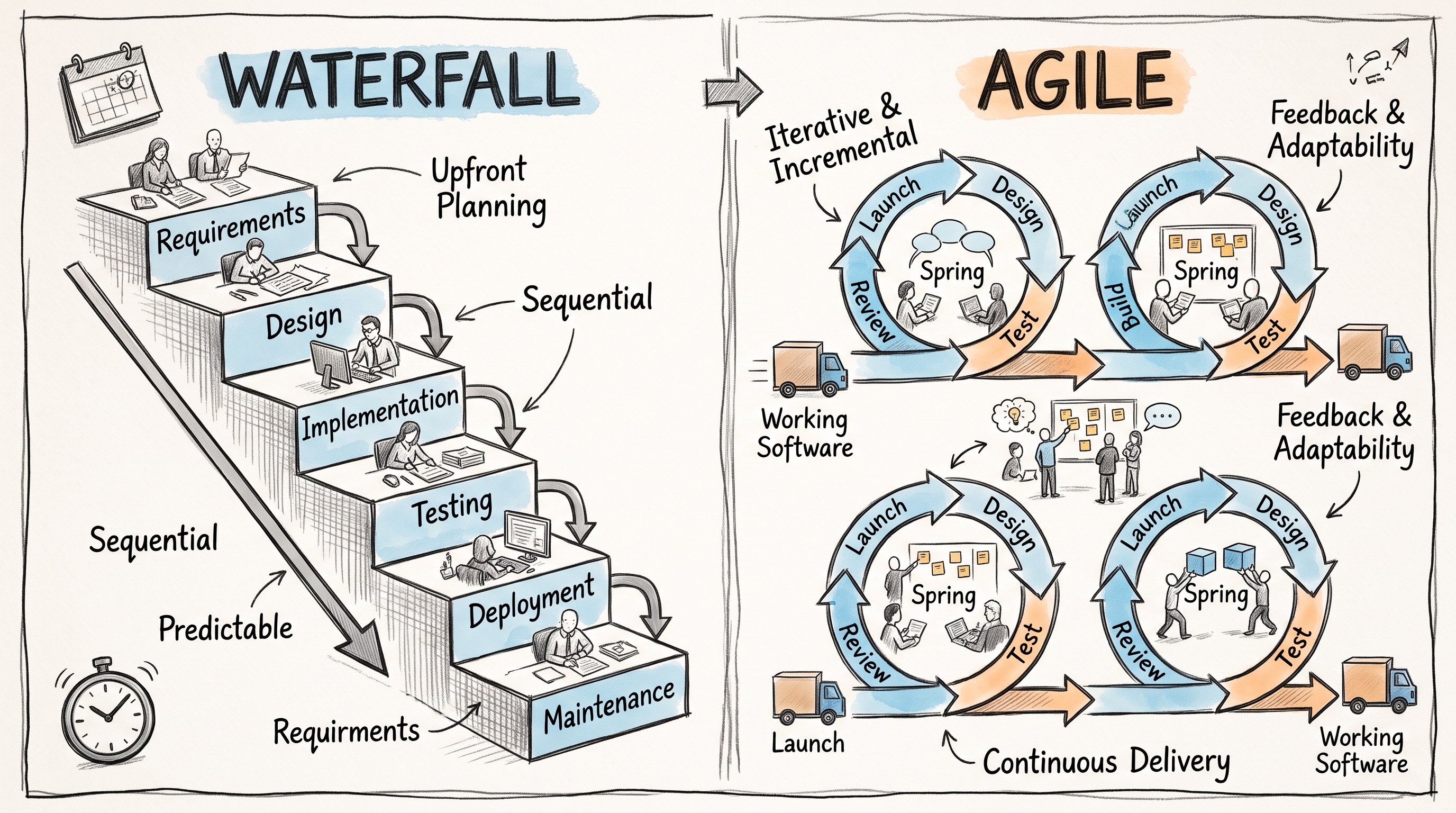
Architectural Overview of Methodologies
The Waterfall Model
The Waterfall model represents the classical plan-driven approach to software engineering, first formally analyzed by Winston W. Royce in 1970.[1:1] Borrowed from heavy manufacturing and civil engineering, it organizes delivery into discrete, non-overlapping phases that cascade downward in a deterministic sequence:
- Requirements Gathering & Analysis: System and business specifications are exhaustively documented and baselined upfront before any architectural design or coding begins.[1:2]
- System Design: Enterprise architects translate the frozen requirements into technical architectures, database schemas, and interface definitions.[3]
- Implementation (Coding): Software engineers write production code strictly aligned with the approved technical specifications.[3:1]
- Integration & Verification: The integrated system undergoes rigorous testing against the original baseline requirements to detect defects.[3:2]
- Deployment & Maintenance: The finalized deliverable is released to production, followed by ongoing support, defect patching, and maintenance updates.[3:3]
While Winston Royce's 1970 paper is universally cited as the origin of the Waterfall model, Royce actually presented the purely sequential model as risky and inherently flawed, explicitly advocating for intermediate feedback loops and prototyping between stages to prevent late-stage project failure.[1:3]
The Agile Methodology
Formally codified in the 2001 Manifesto for Agile Software Development, Agile emerged as a direct response to the rigidity of heavyweight, documentation-driven methodologies.[2:1] Rather than attempting to predict and freeze every requirement upfront, Agile accepts requirement evolution as inevitable, delivering functioning software in short cadence cycles typically spanning one to four weeks.[2:2]
- Iterative & Incremental Delivery: Projects are partitioned into small, inspectable increments rather than a single monolithic release.[4]
- Cross-Functional Pods: Self-organizing teams combine developers, designers, product managers, and QA specialists with end-to-end delivery accountability.[2:3]
- Continuous Customer Collaboration: Key stakeholders review working increments at the conclusion of every cycle, enabling rapid strategic pivots.[2:4]
- Empirical Process Control: Decisions rely on direct observation, working increments, and actual velocity rather than speculative long-range schedules.[4:1]
Core Structural Differences
| Dimension | Waterfall Methodology | Agile Methodology |
|---|---|---|
| Execution Flow | Linear and sequential; discrete phases execute without overlap | Iterative and cyclical; phases repeat within each sprint cadence |
| Requirements Strategy | Fixed and baselined upfront; alterations require formal change requests | Emergent and evolving; reprioritized continuously in a dynamic backlog |
| Delivery Cadence | Single monolithic release at the conclusion of the lifecycle | Frequent, incremental releases of potentially shippable software |
| Quality Assurance | Segregated phase executed after code completion | Integrated continuously into every development iteration |
| Stakeholder Role | Concentrated at project initiation and final acceptance testing | Continuous collaboration and review at each sprint demo |
| Constraint Focus | Scope is fixed; schedule and budget flex to accommodate scope | Schedule and budget are fixed; scope flexes based on team velocity |
| Risk Distribution | High late-stage integration, validation, and obsolescence risk | Early assumption testing; continuous risk reduction throughout |
The Iron Triangle Dynamics
Project governance balances the core constraints of the project management "Triple Constraint": scope, schedule, and cost. Waterfall and Agile invert how these variables are governed:[4:2]
- Waterfall Fixes Scope (Plan-Driven): Because the scope baseline is locked during initiation, the schedule and budget must expand if unexpected technical complexity or dependencies emerge during execution.[4:3]
- Agile Fixes Schedule and Cost (Value-Driven): By locking the sprint duration (time-box) and team capacity (budget), teams flex the scope, ensuring the highest-value user stories ship on schedule while deferring lower-priority items.[4:4]
Transitioning to Agile does not eliminate planning. Instead, it transitions project governance from point-in-time predictive planning (attempting to blueprint the entire lifecycle at inception) to continuous rolling-wave planning (re-evaluating priorities, dependencies, and velocity at the boundary of each iteration).[5]
Risk Profiles and Failure Modes
Waterfall Risk Curve
In sequential lifecycles, operational and architectural risk accumulates silently until late in the delivery schedule, typically when subsystem integration and user acceptance testing commence:[3:4]
- Late Defect Discovery: Flawed architectural assumptions and misunderstood requirements remain invisible until integration, when remediating core code becomes exponentially expensive.[3:5]
- The "Big Bang" Integration Trap: Postponing system integration until all individual components are built frequently produces cascading interface errors and schedule deadlocks.[3:6]
- Market Obsolescence: On multi-year delivery cycles, shifting customer expectations or competitor actions can render the finalized deliverable obsolete before deployment.[5:1]
Agile Risk Curve
Agile deliberately front-loads risk by compelling teams to integrate, test, and demonstrate functional software within the very first sprint:[4:5]
- Scope Creep & Architectural Drift: Without rigorous product ownership, iterative execution can degenerate into reactive feature churn that lacks a coherent structural vision.[5:2]
- Stakeholder Fatigue: Continuous collaboration requires ongoing dedication from business stakeholders; if customer engagement falters, feedback loops collapse.[4:6]
- Technical Debt Accumulation: Relentless pressure to ship visible user features can lead engineering pods to neglect refactoring, documentation, and automated tests.[4:7]
Decision Framework: Selecting the Right Approach
When to Choose Waterfall
- Strict Regulatory & Safety-Critical Environments: Industries governed by stringent compliance mandates (e.g., aerospace, medical devices, nuclear infrastructure) where exhaustive documentation and formal verification gates are legally non-negotiable.[3:7]
- Fixed-Price, Well-Understood Contracts: Engagements where technical requirements and deliverables are fully defined, unambiguous, and unlikely to change, such as standard infrastructure migrations or civil engineering projects.[5:3]
- Mature Technology Stacks: Initiatives where both the problem domain and the underlying engineering architecture are thoroughly mastered by the team.[5:4]
When to Choose Agile
- High Uncertainty & Dynamic Markets: Startups, consumer digital applications, and R&D projects where user needs must be discovered through continuous market interaction.[2:5]
- Complex & Novel Problem Domains: Projects featuring emerging technologies, fluid business models, or unvalidated user behaviors where upfront estimation is inherently unreliable.[4:8]
- Accelerated Time-to-Market: Environments where launching a Minimum Viable Product (MVP) captures early competitive positioning and yields actionable user telemetry.[4:9]
"Responding to change over following a plan—that is, while there is value in the items on the right, we value the items on the left more." — Manifesto for Agile Software Development[2:6]
🎴 Interactive Web Practice (Comprehension Check)
Question 1 (Core Conceptual Paradigm / Royce's Model): How do Waterfall and Agile fundamentally diverge in their approach to uncertainty, and why did Winston Royce's original 1970 paper warn against pure sequential execution?
Answer: Waterfall operates on a predictive, deterministic model that assumes uncertainty can be eliminated upfront through exhaustive requirements gathering and technical design before execution starts. Agile operates on an empirical, adaptive model that treats uncertainty as an inevitable reality, managing it through short delivery cycles, working software increments, and continuous feedback.
In his seminal 1970 paper, Winston Royce explicitly described the pure sequential Waterfall process as flawed and "risky and invites failure." He cautioned that when testing occurs exclusively at the tail end of a project, design defects discovered during verification require redesigning and rewriting code from earlier stages, creating catastrophic budget overruns and schedule delays. Royce advocated for early prototyping and iterative feedback loops between phases—principles that later formed the foundation of modern adaptive frameworks.
Question 2 (The Triple Constraint Inversion): How do Waterfall and Agile invert the management of the "Iron Triangle" (Scope, Schedule, Cost), and what practical consequence does this have for scope creep?
Answer: In traditional Waterfall project management, scope is fixed at project initiation through formal sign-offs, while time and cost are estimated variables. When unforeseen technical roadblocks or scope creep arise, the project baseline fractures, forcing schedule extensions and budget increases.
In Agile, the relationship is inverted: time and cost are fixed through time-boxed iterations (sprints) and stable, dedicated team staffing, while scope is the variable factor. Scope is maintained in an ordered, flexible backlog. Rather than allowing scope creep to expand delivery dates or budgets, Agile teams pull only the highest-priority user stories that fit within their proven velocity. If new requirements emerge or existing tasks take longer than anticipated, lower-priority backlog items are deferred to future sprints, preserving deadlines and product quality.
Question 3 (Risk Trajectories & Selection Criteria): How do the risk accumulation profiles of Waterfall and Agile differ across the project lifecycle, and under what specific organizational conditions is Waterfall still the optimal delivery choice?
Answer: In Waterfall, risk accumulates silently across the requirements, design, and coding phases, reaching a dangerous peak late in the lifecycle during system integration and user acceptance testing—a dynamic known as the "big bang" integration trap. In Agile, risk is front-loaded and continuously mitigated because cross-functional teams integrate and test working software in every sprint, verifying assumptions with real stakeholders early and often.
Despite Agile's adaptability, Waterfall remains the optimal framework under specific conditions:
- Safety-Critical & Heavily Regulated Domains: Aerospace, medical equipment, rail signaling, and nuclear power systems, where comprehensive upfront traceability, exhaustive documentation, and rigorous verification gates are legally mandated before deployment.
- Firm-Fixed-Price Commercial Contracts: Commercial agreements where requirements and scope boundaries are unambiguous, well-established, and unlikely to evolve.
- Stable Technology on Repeatable Builds: Initiatives like datacenter migrations or physical infrastructure deployments where proven architectural patterns leave little technical uncertainty.
Resonant Notes
The following notes in the vault share direct thematic, operational, and strategic connections with Agile and Waterfall:
🔴 Project Management, Governance & Lifecycles
- PM - Agile Methodology — In-depth exploration of Agile values, the Scrum framework (roles, ceremonies, artifacts), and velocity tracking metrics that operationalize adaptive delivery.
- Project Management Lifecycles and Gate Deliverables — Comprehensive contrastive analysis between linear predictive stage-gate governance and adaptive, rolling-wave iterative frameworks.
- PM - Work Breakdown Structure — Analyzes the hierarchical task decomposition used to freeze scope in predictive lifecycles versus fluid product backlogs in adaptive teams.
- PM - Assessing Risk — Outlines proactive qualitative and quantitative threat mitigation techniques, directly mirroring Agile's practice of failing fast through short sprint feedback loops.
- Project Risk Management - A Comprehensive Guide to Identifying and Managing Project Threats — Advanced threat management strategies detailing how sequential handoffs generate schedule, budget, and scope creep risks.
- The Ultimate Project Management Jargon Lexicon — Authoritative reference defining essential domain terminology across both predictive and adaptive environments.
- The Anatomy of a Project Disaster - RMS Titanic Case Study — Post-mortem investigation illustrating how rigid assumptions, failure to adapt to real-time telemetry, and siloed communication lead to catastrophic structural failure.
🟡 Strategic Trade-Offs, Software Transformation & Organizational Design
- Difference Between Efficiency and Effectiveness — Distinguishes between optimizing task execution speed ("doing things right", which Waterfall often hyper-optimizes) and delivering authentic customer value ("doing the right thing", Agile's core focus).
- Difference Between Just-in-Time (JIT) and Just-in-Case (JIC) — Parallels how Agile software engineering pulls features on demand (JIT) whereas Waterfall accumulates documentation and pre-planned features in advance (JIC).
- Every Business Is a Software Business - Core Frameworks and Enterprise Transformation — Examines why modern digital transformation requires migrating from legacy Waterfall IT silos to cross-functional Agile software pods.
- From Cogs to Collaboration - The Evolution of Management Thought — Traces the historical evolution from Taylorist command-and-control structures underlying early plan-driven models to autonomous, self-organizing teams.
- A Plan Is Not A Strategy — Critiques the conflation of predictive operational planning with adaptive strategic choice, reinforcing the Agile principle of responding to change.
- Frank Gehry's Master-Builder Model - De-Risking Megaprojects Through Simulation and Execution — Demonstrates how complex physical megaprojects resolve the Waterfall-Agile tension by utilizing heavy digital simulation to de-risk physical construction.
🟢 Execution, Decision Heuristics & Cognitive Workflow
- Execution - The Discipline of Getting Things Done — Focuses on bridging the gap between strategic intent and day-to-day operational execution through accountability, clear milestones, and cadence reviews.
- Stakeholder Mapping and Analysis — Diagnostic framework for managing stakeholder expectations, contrasting Waterfall's formal sign-off gates with Agile's continuous sprint review collaboration.
- Signal vs Static - Breaking Down Communication Noise — Deconstructs organizational communication barriers, highlighting why Agile emphasizes synchronous team collaboration over lengthy Waterfall documentation.
- The Eisenhower Matrix (Urgent vs. Important) — Practical prioritization tool used by teams and product owners to balance feature delivery with technical debt refactoring.
References
Winston W. Royce / Managing the Development of Large Software Systems / Proceedings of IEEE WESCON ↩︎ ↩︎ ↩︎ ↩︎
Kent Beck et al. / Manifesto for Agile Software Development / agilemanifesto.org ↩︎ ↩︎ ↩︎ ↩︎ ↩︎ ↩︎ ↩︎
Ian Sommerville / Software Engineering (10th Edition) / pearson.com ↩︎ ↩︎ ↩︎ ↩︎ ↩︎ ↩︎ ↩︎ ↩︎
Ken Schwaber and Jeff Sutherland / The Scrum Guide / scrumguides.org ↩︎ ↩︎ ↩︎ ↩︎ ↩︎ ↩︎ ↩︎ ↩︎ ↩︎ ↩︎
Project Management Institute / A Guide to the Project Management Body of Knowledge (PMBOK Guide) / pmi.org ↩︎ ↩︎ ↩︎ ↩︎ ↩︎